Ipamorelin: complete guide to the selective GHRP (studies, dosing, status)
Ipamorelin is a synthetic pentapeptide that stimulates growth hormone (GH) secretion by activating the ghrelin receptor, GHS-R1a. Developed by Novo Nordisk and described in 1998 by Raun et al. as "the first selective growth hormone secretagogue", it differs from the older GHRPs (GHRP-6, GHRP-2, hexarelin) on one specific point: in swine, it releases GH without raising ACTH or cortisol, even at doses more than 200 times the effective dose. That selectivity is why it is so often paired with GHRH analogues such as CJC-1295.
This guide brings together what the published literature actually supports: structure, mechanism, human pharmacokinetics (Gobburu et al. 1999), preclinical data, the postoperative ileus trials and their phase 2 failure, comparison with the other GHRPs, studied doses, reconstitution and regulatory status. The products mentioned are intended exclusively for in vitro and in vivo research use only (RUO), in line with the requirements applicable in France and Europe.
Molecular identity
Ipamorelin has five residues: Aib-His-D-2-Nal-D-Phe-Lys-NH2. Three of them are not among the amino acids found in living organisms: aminoisobutyric acid (Aib) at position 1, D-2-naphthylalanine (D-2-Nal) at position 3 and D-phenylalanine at position 4. The C-terminus is amidated. Its molecular formula is C38H49N9O5 and its molecular weight 711.85 g/mol for the free base, figures used in the evaluation published by the FDA in 2024.
Its design is described by Raun et al. (European Journal of Endocrinology, 1998, vol. 139, p. 552-561). It came out of a series of GHRP-1 derivatives lacking the central Ala-Trp dipeptide, which is why it is shorter than the hexapeptides of the family (GHRP-6, GHRP-2, hexarelin).
Mechanism of action: the ghrelin receptor
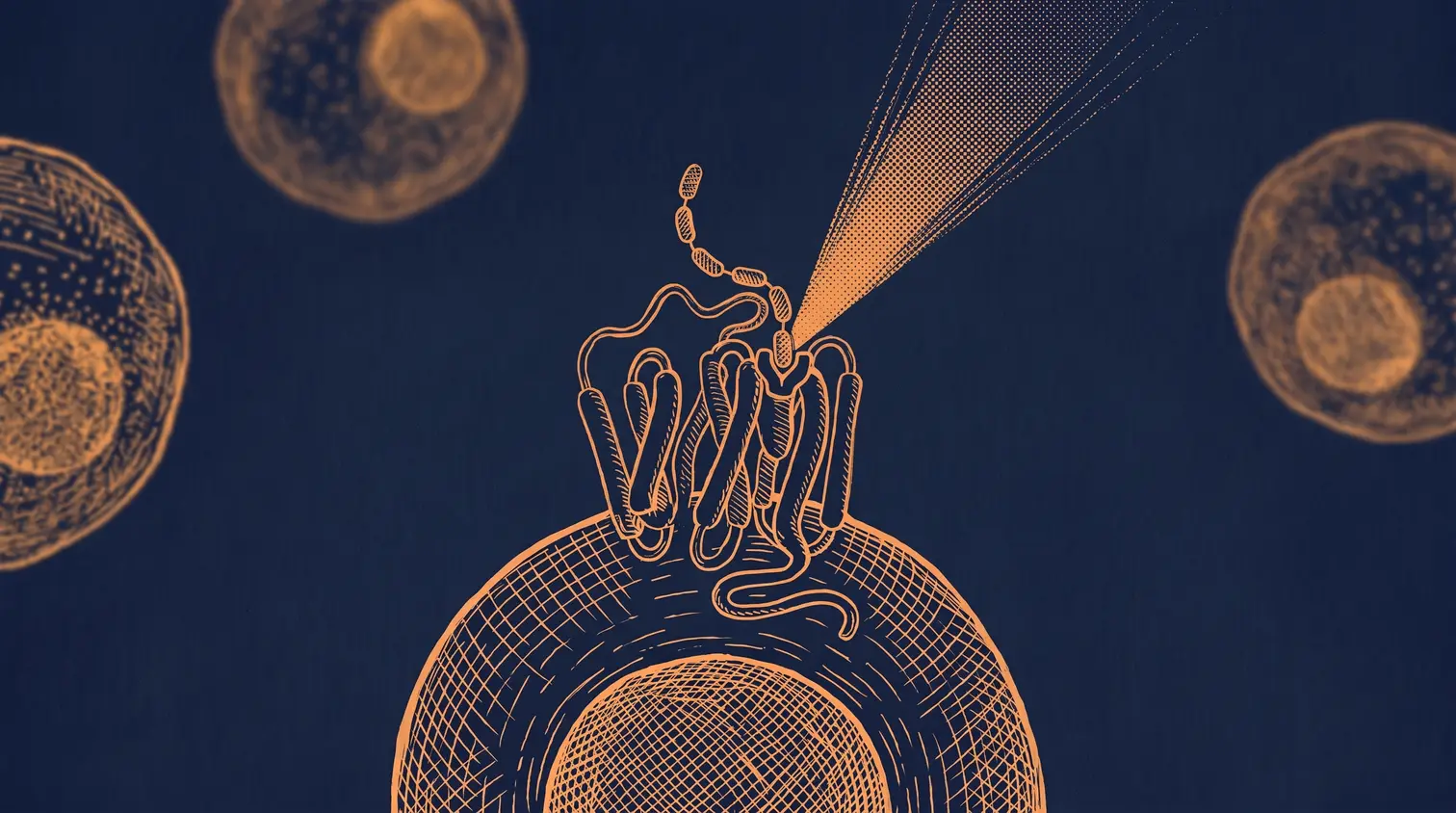
The target receptor was identified before its natural ligand. Howard et al. (Science, 1996) cloned it from swine and human pituitary and hypothalamus and named it GHS-R, the growth hormone secretagogue receptor. Three years later, Kojima et al. (Nature, 1999) isolated its endogenous ligand from rat stomach: a 28-amino-acid peptide carrying an octanoyl group on serine 3, essential for its activity. They called it ghrelin. Ipamorelin therefore mimics a gut hormone.
Raun et al. confirmed this mode of action with antagonists: ipamorelin acts through a GHRP-type receptor, like GHRP-6, and not through the GHRH receptor. On cultured rat pituitary cells, it released GH with potency and efficacy close to GHRP-6 (EC50 of 1.3 nmol/l versus 2.2 nmol/l; maximal effect of 85% versus 100%).
Practical consequence: the GH released comes from the subject's own pituitary, and the response remains subject to the usual brakes, including somatostatin. The FDA review makes the point plainly: complete GH deficiency does not respond to secretagogues.
Selectivity: what Raun 1998 showed, and in which species
The finding that built ipamorelin's reputation comes from a study in conscious swine. Raun et al. compared three secretagogues:
- Ipamorelin: ED50 of 2.3 nmol/kg, maximal GH of 65 ng/ml.
- GHRP-6: ED50 of 3.9 nmol/kg, maximal GH of 74 ng/ml.
- GHRP-2: more potent (ED50 of 0.6 nmol/kg) but less effective (maximal GH of 56 ng/ml).
None of the three changed FSH, LH, prolactin or TSH. The difference lay in the stress axis: GHRP-6 and GHRP-2 raised ACTH and cortisol, whereas ipamorelin did not raise them beyond what is seen after GHRH stimulation, even at more than 200 times its ED50. The authors conclude that its selectivity is comparable to that of GHRH itself.
Two caveats are needed to read this result honestly. It was obtained in swine: no published human study has measured ACTH, cortisol or prolactin under ipamorelin (Gobburu 1999 measured only GH). And prolactin did not move with any of the three peptides in swine: the often-claimed advantage on prolactin rests on human data from the other GHRPs, not on a direct comparison.
Pharmacokinetics in humans
The reference is the study by Gobburu, Agersø, Jusko and Ynddal (Pharmaceutical Research, 1999, vol. 16, p. 1412-1416). Protocol: 15-minute intravenous infusion at five dose levels (4.21; 14.02; 42.13; 84.27 and 140.45 nmol/kg), with eight healthy male volunteers per level.
| Parameter | Value (Gobburu 1999) |
|---|---|
| Terminal half-life | About 2 hours |
| Clearance | 0.078 l/h/kg |
| Volume of distribution at steady state | 0.22 l/kg |
| Linearity | Dose-proportional parameters |
| GH peak | Single, at 0.67 h (about 40 minutes), then exponential decline |
| Concentration for half-maximal stimulation (SC50) | 214 nmol/l |
| Modelled maximal GH production rate | 694 mIU/l/h |
Reading: at every dose, ipamorelin produces a single episode of GH release that falls back to negligible levels, with no sustained elevation. Inter-individual variability was greater for the GH response than for peptide concentrations.
In rats, a study by Johansen et al. (1998), cited by the FDA, reports a half-life of about 27 minutes and 60 to 80% of the molecule excreted unchanged in urine. No published study describes the subcutaneous route in humans, a gap the FDA points out.
Preclinical data
Bone and growth
Johansen et al. (Growth Hormone & IGF Research, 1999) injected ipamorelin subcutaneously three times a day for 15 days into adult female rats, at 18, 90 or 450 µg per day. Longitudinal tibial growth rose from 42 µm/day (controls) to 44, 50 and 52 µm/day depending on dose (p < 0.0001), with clear, dose-dependent weight gain. Total IGF-1 and serum bone markers did not change.
Svensson et al. (Journal of Endocrinology, 2000) gave ipamorelin (0.5 mg/kg/day), GHRP-6 (0.5 mg/kg/day) or GH by minipump for 12 weeks to young adult female rats. All three increased bone mineral content, but in proportion to body weight: the bone was bigger, not denser.
Andersen et al. (Growth Hormone & IGF Research, 2001) treated female rats for 3 months with a glucocorticoid, with or without ipamorelin (100 µg/kg three times a day): the combination increased muscle strength and quadrupled periosteal bone formation compared with the glucocorticoid alone.
Weight, appetite and fat mass
Ipamorelin mimics ghrelin, a hormone that stimulates appetite. Lall et al. (Biochemical and Biophysical Research Communications, 2001) showed in mice that twice-daily ipamorelin increased body weight by about 15% in two weeks and raised the proportion of fat mass, including in GH-deficient mice. It also increased food intake, which GH alone did not. The authors conclude that the fat gain is GH-independent and partly driven by appetite: a point to keep in mind in any body composition study.
Gut motility
Ghrelin speeds up gastric emptying and transit, which shaped the clinical programme. In rats after abdominal surgery, a single dose of ipamorelin (1 mg/kg) shortened the time to first bowel movement (Venkova et al., Journal of Pharmacology and Experimental Therapeutics, 2009), and 52% of the meal remained in the stomach under ipamorelin versus 78% under placebo (Greenwood-Van Meerveld et al., Journal of Experimental Pharmacology, 2012).
The clinical programme: postoperative ileus, and a failure
On the strength of these animal data, Helsinn Therapeutics tested intravenous ipamorelin in postoperative ileus, the temporary gut paralysis that follows abdominal surgery. Two phase 2 trials are listed on ClinicalTrials.gov.
NCT00672074: the published trial (Beck et al. 2014)
A multicentre, randomised, double-blind, placebo-controlled trial run from 2008 to 2009 in adults undergoing small or large bowel resection. Patients received 0.03 mg/kg ipamorelin by infusion twice daily, from postoperative day 1 to day 7 or discharge. Of 117 patients enrolled, 114 were analysed (56 ipamorelin, 58 placebo).
Result published by Beck, Sweeney and McCarter (International Journal of Colorectal Disease, 2014, vol. 29, p. 1527-1534): median time to first tolerated solid meal of 25.3 hours under ipamorelin versus 32.6 hours under placebo, a non-significant difference (p = 0.15). Secondary endpoints (first bowel movement, overall GI recovery, length of stay) did not differ either. The authors conclude that it was well tolerated and that there was no significant difference in efficacy.
NCT01280344: the second trial, with no published results
A second phase 2 trial, sponsored by Helsinn, enrolled 320 patients after bowel resection between 2011 and 2013, with three ipamorelin arms (0.03 mg/kg twice daily, 0.06 mg/kg twice daily, 0.06 mg/kg three times daily) versus placebo. It is listed as "completed" on ClinicalTrials.gov, but no results have been posted there and no publication could be found. The FDA cites a 2020 review (Ishida et al.) stating that development was stopped after disappointing results. No phase 3 trial was ever started.
Bottom line: no efficacy has been demonstrated in humans, in any indication. The only published trial, negative, used intravenous infusion, not subcutaneous injection.
Comparison with GHRP-6, GHRP-2 and hexarelin
All four peptides activate the same receptor. They differ in length, potency and above all in their side hormonal effects.
| Molecule | Structure | Documented non-GH effects | Status |
|---|---|---|---|
| Ipamorelin | 5 residues (Aib-His-D-2-Nal-D-Phe-Lys-NH2) | No rise in ACTH or cortisol in swine (Raun 1998); not measured in humans | Not approved; phase 2 with no demonstrated efficacy |
| GHRP-6 | 6 residues (His-D-Trp-Ala-Trp-D-Phe-Lys-NH2) | ACTH and cortisol increased in swine (Raun 1998) | Not approved |
| GHRP-2 (pralmorelin) | 6 residues | ACTH and cortisol increased in swine (Raun 1998) | Developed in Japan as a diagnostic agent for GH deficiency |
| Hexarelin (examorelin) | 6 residues (His-D-2-methyl-Trp-Ala-Trp-D-Phe-Lys-NH2) | Prolactin, ACTH and cortisol increased in humans (Korbonits 1995; Arvat 1997) | Not approved |
GHRP-6 is the prototype of the family. Bowers et al. (Endocrinology, 1984) described this hexapeptide that releases GH without LH, FSH, TSH or prolactin in their animal models, with a GH peak 10 to 20 minutes after intravenous injection in rats.
GHRP-2, or pralmorelin, is the most potent of the three in Raun's swine study (ED50 of 0.6 nmol/kg), at the cost of a rise in ACTH and cortisol. It is the only one of these peptides to have found a medical use: Kaken developed it in Japan as a diagnostic agent for GH deficiency, with a GH peak cut-off of 15 µg/l to separate deficient patients from healthy subjects (Drugs in R&D review, 2004).
Hexarelin is a GHRP-6 with a methylated tryptophan at position 2. Its side effects are well documented in humans: in a randomised double-blind trial in 12 healthy volunteers, Korbonits et al. (Clinical Endocrinology, 1995) measured a rise in prolactin, cortisol and ACTH after 2 µg/kg intravenously. It also illustrates desensitisation: in seven children treated intranasally, the GH peak fell from 70.6 to 34.1 mIU/l by day 7, without preventing faster growth (Klinger et al., European Journal of Endocrinology, 1996). Ipamorelin has not been the subject of an equivalent human study; in rats treated for 15 days, Johansen et al. only noted a "marginally reduced" GH response to a test dose of ipamorelin.
Ipamorelin is therefore neither the most potent nor the most effective member of the family: its appeal lies in its narrow hormonal profile, shown in animals. To place these peptides alongside GHRH analogues, see our GHRH vs GHRP comparison.
The combination with CJC-1295
Ipamorelin is very often studied with a GHRH analogue, most often CJC-1295 without DAC (Mod GRF 1-29). The reasoning is mechanistic: GHRH and ghrelin work through two different receptors, and stimulating both at once produces more than the sum of the two. Bowers et al. (Journal of Clinical Endocrinology & Metabolism, 1990) showed this in 18 healthy men with native GHRH and a first-generation GHRP, and describe the effect as synergistic.
The limit is clear: no published clinical trial has tested the CJC-1295 + ipamorelin combination, whether for pharmacokinetics, efficacy or tolerability. The choice of the no-DAC form rests on matching profiles: two short-acting molecules whose peaks coincide, whereas CJC-1295 with DAC raises GH continuously for days. Both forms are covered in our complete CJC-1295 guide, and the class as a whole in our GH secretagogues overview. A tesamorelin + ipamorelin blend also exists, currently out of stock.
Doses studied in the literature
The published human doses concern only the intravenous route:
- Gobburu et al. 1999: 15-minute infusion from 4.21 to 140.45 nmol/kg. With a molecular weight of 711.85 g/mol, this corresponds to roughly 3, 10, 30, 60 and 100 µg/kg. Every dose released GH.
- Beck et al. 2014: 0.03 mg/kg (30 µg/kg) twice daily for up to 7 days, about 2.25 mg per infusion for a 75 kg adult.
- NCT01280344: 0.03 mg/kg twice daily, 0.06 mg/kg twice daily and 0.06 mg/kg three times daily (results unpublished).
In animals, subcutaneously: 18 to 450 µg per day in female rats (Johansen 1999), 100 µg/kg three times a day (Andersen 2001), 0.5 mg/kg/day by minipump (Svensson 2000).
No subcutaneous dose has been validated by a published human trial. The schedules in circulation, expressed in hundreds of micrograms per injection, come from practice, not from the literature. The 2-hour half-life measured by Gobburu explains why they are split across the day.
Reconstitution protocol (research use only)
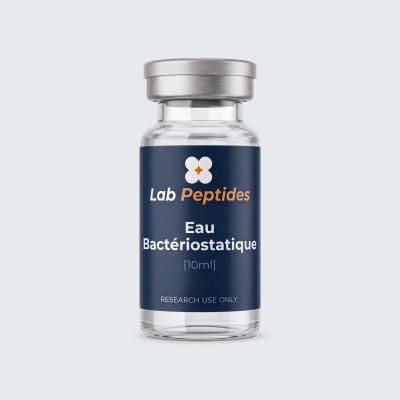
Ipamorelin comes as a lyophilised powder and is reconstituted in bacteriostatic water (0.9% benzyl alcohol). The calculations below use a U-100 insulin syringe, on which 1 ml equals 100 units, so 1 unit equals 0.01 ml. The 100 and 200 µg amounts are calculation examples.
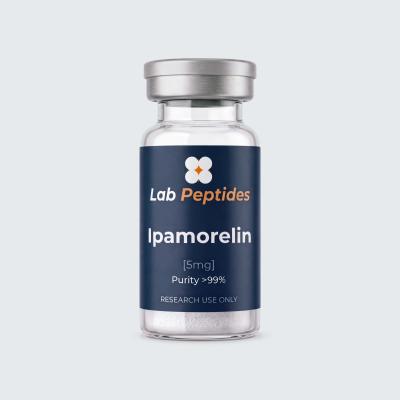
Ipamorelin 5 mg vial:
- 2 ml of bacteriostatic water gives 2.5 mg/ml: 100 µg = 0.04 ml = 4 units; 200 µg = 8 units.
- 2.5 ml gives 2 mg/ml: 100 µg = 0.05 ml = 5 units; 200 µg = 10 units.
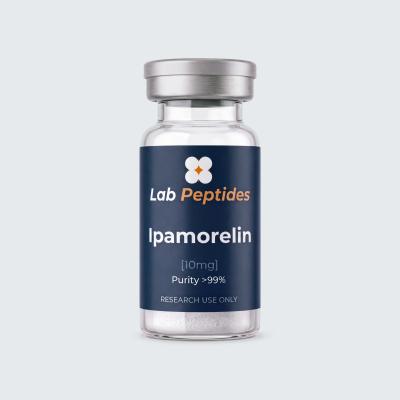
Ipamorelin 10 mg vial:
- 2 ml gives 5 mg/ml: 100 µg = 0.02 ml = 2 units, a volume that is hard to read accurately.
- 4 ml gives 2.5 mg/ml: 100 µg = 4 units.
- 5 ml gives 2 mg/ml: 100 µg = 5 units; 200 µg = 10 units.
Good practice: let the vial reach room temperature, inject the water slowly against the glass wall, swirl gently without shaking until fully dissolved, then check that the solution is clear and free of particles.
Stability and storage
Stability data cited by the FDA in its 2024 evaluation indicate that lyophilised ipamorelin remains stable for about three weeks at room temperature, but should be stored desiccated below -18 °C for the long term, since moisture strongly degrades lyophilised peptides. Once in solution, it remains stable for 2 to 3 weeks at 4 °C. Source: a supplier data sheet, not a published study. In practice: keep the reconstituted solution refrigerated, handle it aseptically, and avoid repeated freezing.
Safety and reported signals
The only published human tolerability data with repeated dosing come from the Beck et al. 2014 trial, in patients recovering from major bowel surgery. The authors consider ipamorelin well tolerated: adverse events in 87.5% of patients on ipamorelin and 94.8% on placebo, mainly nausea, vomiting and abdominal distension, mostly related to surgery. The FDA review nevertheless details some differences:
- Hypokalaemia: 12.5% on ipamorelin versus 3.4% on placebo.
- Insomnia: 10.7% versus 5.2%.
- Hyperglycaemia at discharge: 14.3% versus 8.6%.
- Serious adverse events: 17.9% versus 15.5%, mainly infections, anastomotic leaks and readmissions.
- Two deaths in the ipamorelin group, in patients operated on for colon cancer who developed an anastomotic leak. The FDA states that their relationship to ipamorelin is unclear.
The FDA adds theoretical concerns: glucose intolerance common to molecules that stimulate GH, a possible effect on reward circuits (ghrelin acts on the ventral tegmental area), immunogenicity linked to impurities, and the absence of published repeat-dose toxicity, genotoxicity or carcinogenicity studies. For research, useful markers are GH and IGF-1, fasting glucose, potassium, body weight and body composition.
Regulatory status
Ipamorelin is not authorised as a medicine in any country and appears in no pharmacopoeia (European, US, Japanese, Chinese or Indian), according to the FDA's search. In Europe, it is sold as a research reagent (RUO), not intended for human use.
- United States: the FDA proposed not to add it to the list of substances usable in compounding (503A list). At the advisory committee meeting of 29 October 2024, the vote was 0 in favour, 12 against and 1 abstention for both the acetate and the free base.
- Australia: ipamorelin has been added to the Poisons Standard among performance and image enhancing drugs, possession of which without authority is illegal (according to the FDA review).
- Sport: the World Anti-Doping Agency names it in its 2026 Prohibited List, section S2.2.4, among GH secretagogues, alongside ibutamoren (MK-677) and ghrelin; GHRP-2, GHRP-6 and hexarelin appear in the GHRP sub-heading. Prohibited in and out of competition.
Frequently asked questions about ipamorelin
Is ipamorelin a GHRP?
Yes, broadly speaking: it activates the ghrelin receptor (GHS-R1a) like GHRP-6, GHRP-2 and hexarelin, and is chemically derived from GHRP-1. It has five residues instead of six. The World Anti-Doping Agency classifies it among "growth hormone secretagogues".
What is its half-life?
About 2 hours in men after intravenous infusion (Gobburu 1999), with a single GH peak at around 40 minutes. In rats, about 27 minutes.
Has it been tested in humans?
Yes, in a pharmacokinetic study in healthy volunteers (Gobburu 1999) and in two phase 2 trials in postoperative ileus. The only published one (Beck 2014, 114 patients) showed no significant efficacy; the second (320 patients) has not published results, and development was stopped.
Why combine it with CJC-1295?
Because the two act on two different receptors and the GHRH + GHRP combination proved synergistic in humans (Bowers 1990). The specific CJC-1295 + ipamorelin combination has never been tested in a published trial.
Conclusion
Ipamorelin is the first GHRP described as selective, and that is its real strength: in swine, it releases GH without affecting ACTH or cortisol. In humans, it produces a single, brief GH peak with a half-life of about two hours. The rest of the file is thin. Clinical efficacy has never been demonstrated, the only published trial is negative, selectivity has not been confirmed in humans, and the combination with CJC-1295 rests on reasoning, not on a trial. For a researcher, it is a precise tool for studying the ghrelin pathway and GH pulsatility, provided the literature is read with these limits in mind.
Order your ipamorelin 5 mg or the 10 mg format: stock in France, fast shipping. For a complete protocol, pair it with CJC-1295 no DAC.