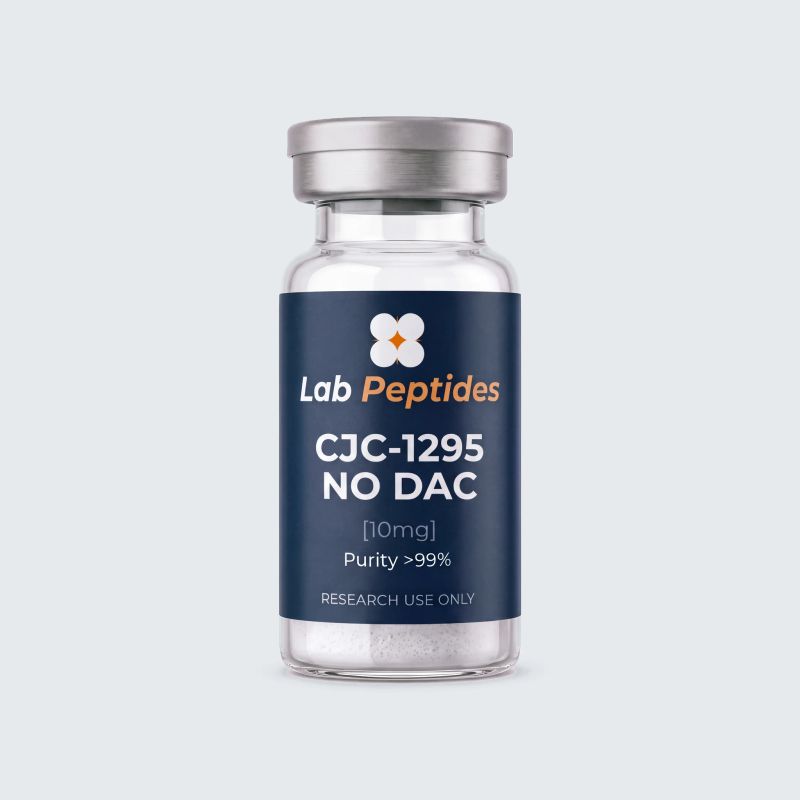
CJC-1295 NO DAC 10mg GH / IGF-1 axis
GHRH 1-29 analogue, no DAC. 99.5% purity.
The GHRH that respects the rhythm. A GHRH 1-29 analogue modified at four positions, without the DAC complex: it acts for about thirty minutes instead of several days and lets the pituitary pulse normally. The go-to partner for Ipamorelin. HPLC purity ≥98%, 10 mg vial. For research use only.
- Certificate of analysis
- In stock in France
 Ordered with its water: shipped in a magnetic box
-10 % for life on each cyclePause, skip or cancel in 1 clickNo commitment, no hidden fees
No card: each delivery is paid in Bitcoin (extra -5%) or by bank transfer
Your complete kit
The vial alone cannot be used as is. Add what you need to prepare it:
Frequently bought together


Research Use Only (RUO) · Prohibited for human or veterinary use.
Key facts
CJC-1295 without DAC, also known as Mod GRF (1-29), is a synthetic analogue of the first 29 amino acids of human GHRH — the fragment that carries the hormone's activity on its own.
Four substitutions set it apart from the natural sequenceD-Ala2, which protects it from DPP-4 degradation, plus Gln8, Ala15 and Leu27, which improve its stability. The result is a half-life of about thirty minutes, against a few minutes for native GHRH.
In detail
The whole difference with CJC-1295 with DAC lies in what is missing: the Drug Affinity Complex, which binds the molecule to albumin and stretches its half-life to several days. Without it, action stays brief — and that is precisely what protocols seeking to preserve the natural pulsatility of growth hormone secretion are after, rather than flattening it.
This vial delivers 10 mg of CJC-1295 without DAC at HPLC purity of at least 98%. For research use only.
Protocol and preparation
| Water added | Concentration | Reading marker |
|---|---|---|
| 1 ml | 10 mg/ml | 10 UI = 1 mg |
| 3 ml | 3,33 mg/ml | 40 UI = 1,33 mg |
The volume of water does not change the product, only its concentration. Add the water slowly along the vial wall, then swirl without shaking.
Asepsis
Disinfect surfaces and stoppers (70% alcohol).
Solvent
Draw the required volume of bacteriostatic water.
Introduction
Add gently against the vial wall (avoid a direct jet on the powder).
Solubilization
Roll the vial gently. Do not shake vigorously (degradation risk).
Solution storage Once reconstituted: 2-8°C (refrigerator).
Warning Theoretical tool for chemical handling. Does not constitute medical advice.
I open the dilution calculator- The amount of powder looks tiny. A lyophilisate takes up a few millimetres at the bottom of the vial, sometimes just a translucent film. The stated weight is there.
- The powder is compact, stuck to the wall or to the stopper. Transport moves the freeze-dried cake around. It changes nothing to reconstitution.
- The vial carries no individual label. That is our standard packaging, not a downgraded vial.
- After reconstitution, deposits or filaments appear. This is common, especially with small molecules. Let it settle and roll the vial between your palms, never shake it.
- The parcel is plain. Nothing on the outside indicates the contents or the brand name.
What is not normal: a cracked vial, an uncrimped cap or a stopper that moves, powder that has liquefied or changed colour. In those specific cases, write to us with a photo and we take the vial back.
The vial is then full up to the neckThis is normal, it holds 3 ml at most. The 3 ml bacteriostatic water vial is enough.
Documented pairing. CJC-1295 without DAC combined with Ipamorelin is the most described secretagogue protocol in research literature, the two molecules acting on different receptors.
Technical data
- Reconstitution
- 3 ml d'eau → 3,33 mg/ml. 3 UI = 100 mcg ; 6 UI = 200 mcg ; 9 UI = 300 mcg. Le flacon contient 3 ml au plus : il est plein jusqu'au col, c'est normal.
- Peptide sequence
- Tyr-D-Ala-Asp-Ala-Ile-Phe-Thr-Gln-Ser-Tyr-Arg-Lys-Val-Leu-Ala-Gln-Leu-Ser-Ala-Arg-Lys-Leu-Leu-Gln-Asp-Ile-Leu-Ser-Arg-NH2
- Molecular formula
- C152H252N44O42
- Molecular weight
- 3367.9 g/mol
- CAS number
- 863288-34-0
- Physical form
- Poudre lyophilisée blanche
- Recommended solubility
- Eau bactériostatique, NaCl 0.9%, acide acétique 0.1%
- Storage conditions
- Au réfrigérateur (+2 à +8 °C), à l'abri de la lumière. En poudre, possible au congélateur pour une conservation longue. Une fois préparé : réfrigérateur, jamais au congélateur.
- Use
- Research reagent, in vitro only (RUO)
Storage & handling
Unreconstituted lyophilised vial: stable for several months between 2 and 8 °C, several years at -20 °C, protected from light. Ambient-temperature transport does not degrade it.
After reconstitution: refrigerated between 2 and 8 °C, protected from light. The 0.9% benzyl alcohol in bacteriostatic water allows repeated draws over several weeks. Never freeze a reconstituted solution.
At 3 ml for 10 mg, a vial is drawn from over a long periodThis is precisely the case where asepsis quality at each draw matters most. A fresh needle every time, a disinfected septum every time.
Mechanism of action
GHRH acts on the GHRH-R receptor of somatotroph cells in the anterior pituitary, a G-protein coupled receptor. Its activation raises intracellular cyclic AMP, activates protein kinase A and triggers both the release of stored growth hormone and the transcription of its gene.
The D-Ala2 modification is the decisive one: it blocks the cleavage site of dipeptidyl peptidase-4, the enzyme that inactivates native GHRH within minutes. The other three substitutions limit oxidation and aggregation in solution.
The point that explains the frequent pairing with a GHRP such as Ipamorelin: the two families act on distinct receptors — GHRH-R on one side, GHS-R1a on the other — and through different signalling pathways. The literature describes a response greater than the sum of each taken alone, which is the documented basis for this combination.
By keeping a short action, the DAC-free analogue also lets somatostatin, the axis's physiological brake, express itself, which preserves the pulsatile character of secretion.
Studies and references
GHRH has been characterised since the 1980s and its 1-29 fragment, the shortest to retain full activity, is the basis of several analogues. Sermorelin, unmodified GHRH 1-29, was marketed as a diagnostic agent for somatotroph function, which solidly documents the overall mechanism.
Work on CJC-1295 clearly distinguishes the two versions. The version with DAC was the subject of early-phase trials showing sustained IGF-1 elevation over several days. The version without DAC, this one, is by contrast overwhelmingly documented in research literature and preclinical work, not by dedicated clinical trials.
Pairing with a GHRP is the best-described pointThe combined effect of a GHRH analogue and a secretagogue acting on GHS-R1a is reported as greater than each taken alone, which remains consistent with the duality of signalling pathways.
Frequently asked questions
How much water to reconstitute the 10 mg vial?
What is the difference with CJC-1295 with DAC?
Why is it so often paired with Ipamorelin?
Are Mod GRF (1-29) and CJC-1295 without DAC the same thing?
Must the solution be perfectly clear?
 The complete guideCJC-1295: complete guide to DAC vs no DAC (Mod GRF 1-29) in researchCJC-1295 with or without DAC: structure, half-life (8 days versus 30 minutes), GH pulsatility, the Teichman and Ionescu 2006 trials, the ipamorelin combination, comparison with sermorelin and tesamorelin, and reconstitution.Read the guide