CJC-1295: complete guide to DAC vs no DAC (Mod GRF 1-29) in research
CJC-1295 is a synthetic analog of GHRH (growth hormone-releasing hormone), the hypothalamic hormone that tells the pituitary to release growth hormone (GH). Two different molecules actually circulate under this name: CJC-1295 with DAC (Drug Affinity Complex), designed by the Canadian company ConjuChem to bind blood albumin and last close to a week, and CJC-1295 without DAC, more accurately called Mod GRF 1-29, which keeps only the peptide part and acts for a few tens of minutes. That difference in duration changes everything: the GH secretion profile, the dosing rhythm studied and the way the literature should be read.
This guide brings together the published data on the structure of both forms, their mechanism, their pharmacokinetics, the two reference human trials (Teichman et al. 2006; Ionescu and Frohman 2006), the combination with ipamorelin, and the comparison with sermorelin and tesamorelin. The products mentioned are intended exclusively for in vitro and in vivo research (RUO), in line with the requirements applicable in France and Europe.
Molecular identity: one backbone, two molecules
Native human GHRH has 44 amino acids, but all of its biological activity sits in its first 29 residues: this is the GRF(1-29) fragment from which sermorelin and CJC-1295 derive. The fragment has one major weakness. In plasma, dipeptidyl peptidase-4 (DPP-4) cleaves off the first two amino acids and produces a GRF(3-44) fragment with less than one thousandth of the activity of the intact molecule. Frohman et al. (Journal of Clinical Investigation, 1986) measured a half-life of 6.8 minutes for GHRH(1-44) injected intravenously in healthy volunteers.
To fix this fragility, the peptide part of CJC-1295 carries four substitutions in the GRF(1-29) sequence, hence the name "tetrasubstituted GRF(1-29)": D-alanine at position 2 (which blocks DPP-4 cleavage), glutamine at position 8, alanine at position 15 and leucine at position 27 (replacing an oxidation-prone methionine). This 29-amino-acid peptide, amidated at the C-terminus, is exactly what the market sells as CJC-1295 no DAC or Mod GRF 1-29.
CJC-1295 with DAC adds a C-terminal lysine to this backbone, carrying a reactive maleimidopropionamide group. That group forms a covalent bond with the free thiol of cysteine 34 of serum albumin. Jetté et al. (Endocrinology, 2005) described this design in rats: among three derivatives tested, CJC-1295 gave a GH area under the curve four times higher than GRF(1-29) over two hours, remained detectable in plasma beyond 72 hours, and appeared on the albumin band on Western blot as early as 15 minutes after injection.
A piece of history explains the naming confusion. The code "CJC-1295" originally refers to the molecule with DAC. In 2009 the Norwegian anti-doping laboratory analysed a seized preparation sold under that name and found a 29-amino-acid peptide with an amidated C-terminus, in other words the form without DAC (Henninge et al., Drug Testing and Analysis, 2010). The trade name "CJC-1295 no DAC" grew out of that usage. The two forms share the sequence, not the pharmacokinetics.
Mechanism of action: the GHRH receptor
Both forms activate the GHRH receptor (GHRH-R), a class B G protein-coupled receptor expressed by the somatotroph cells of the anterior pituitary. Binding activates the Gs protein, adenylate cyclase and cyclic AMP production, which triggers both the release of stored GH and the synthesis of new GH. Circulating GH then stimulates hepatic IGF-1 production, which serves as an integrated marker of the effect.
This mechanism has an important consequence: a GHRH analog does not replace GH, it asks the pituitary to make it. The response remains subject to physiological brakes, first of all somatostatin, which inhibits GH secretion, and negative feedback from IGF-1. This is why the trial authors restrict the clinical interest of these analogs to subjects whose pituitary is functional.
The work of Alba et al. (American Journal of Physiology – Endocrinology and Metabolism, 2006) shows the other side of this mechanism. In mice lacking the GHRH gene, a daily injection of 2 µg of CJC-1295 for 5 weeks normalised body weight and length and increased GH messenger RNA in the pituitary, a sign of somatotroph cell proliferation. The same dose given every 48 or 72 hours improved growth without normalising it.
Pharmacokinetics: DAC versus no DAC
The difference between the two forms is first a matter of duration. Once bound to albumin, an abundant and long-lived protein, the DAC form escapes renal filtration and DPP-4. Teichman et al. (2006) estimated its half-life at 5.8 to 8.1 days in healthy adults; Ionescu and Frohman (2006) use a value of about 8 days.
The form without DAC has not been the subject of a published human pharmacokinetic study. Its half-life is generally quoted at around 30 minutes: longer than native GHRH thanks to DPP-4 resistance, but in the range of half an hour, not days. This figure circulates in secondary references and should be read as an estimate, not as a value measured in a published trial.
| Parameter | CJC-1295 with DAC | CJC-1295 without DAC (Mod GRF 1-29) |
|---|---|---|
| Structure | Tetrasubstituted GRF(1-29) + maleimidopropionamide lysine | Tetrasubstituted GRF(1-29), 29 amino acids |
| Albumin binding | Yes, covalent (cysteine 34) | No |
| Half-life | 5.8 to 8.1 days (Teichman 2006) | About 30 minutes (estimate, no published human study) |
| GH profile | Continuous rise in baseline, pulses preserved | Short pulse after each administration |
| Rhythm studied | Weekly or every two weeks in humans | No published human trial |
| Human data | Two trials published in 2006 | No dedicated clinical publication |
The two reference trials in humans
Teichman et al. 2006: duration of action
Published in the Journal of Clinical Endocrinology & Metabolism (vol. 91, pp. 799-805), this work combines two randomised, double-blind, placebo-controlled ascending-dose trials lasting 28 and 49 days, run at two sites in healthy adults aged 21 to 61. The first tested four ascending single subcutaneous doses; the second, two or three doses given weekly or every two weeks.
Reported results: after a single injection, mean plasma GH rose 2- to 10-fold for 6 days or more, and mean IGF-1 1.5- to 3-fold for 9 to 11 days, in a dose-dependent manner. After repeated doses, IGF-1 stayed above baseline for up to 28 days, with a cumulative effect. No serious adverse reactions were reported; the authors describe the molecule as relatively well tolerated, particularly at doses of 30 and 60 µg/kg.
Ionescu and Frohman 2006: the pulsatility question
Natural GH secretion is pulsatile: peaks, mostly at night, separated by troughs where GH is almost undetectable. This rhythm accounts for part of the hormone's effects. A stimulus lasting a week could therefore be expected to flatten those peaks. Ionescu and Frohman (Journal of Clinical Endocrinology & Metabolism, vol. 91, pp. 4792-4797) addressed the question directly.
Method: in healthy men aged 20 to 40, GH was sampled every 20 minutes over 12 overnight hours, before and one week after a single injection of 60 or 90 µg/kg CJC-1295. Results: pulse frequency and amplitude were unchanged. Baseline GH between pulses, however, rose 7.5-fold (p < 0.0001), bringing mean GH up 46% and IGF-1 up 45%. Both doses gave similar responses, and the rise in IGF-1 did not correlate with any pulse parameter.
Interpretation: the DAC form does not abolish pulsatility, but it adds a continuous background of GH. The authors conclude that raised troughs weigh in the IGF-1 increase. The "DAC or no DAC" debate largely comes down to this point: the DAC form keeps the floor permanently raised, the form without DAC produces a short pulse that falls back. Which profile best serves a given experimental objective remains an open question that the literature has not settled with a head-to-head trial.
The interrupted clinical programme
ConjuChem then launched a phase II trial in people living with HIV who had visceral fat accumulation, the indication in which tesamorelin would later be approved. According to aidsmap, this randomised, placebo-controlled trial, which had enrolled 192 participants, was stopped on 17 July 2006 after the death of a participant at a site in Argentina, with the relationship to the product under investigation at the time. CJC-1295 never obtained marketing authorisation, and the results of that phase II were not published in a peer-reviewed journal.
Comparison: sermorelin, tesamorelin, CJC-1295
All four molecules act on the same receptor. They differ in length, protection against DPP-4 and how long they stay in the blood.
| Molecule | Structure | Half-life | Status |
|---|---|---|---|
| Sermorelin | Amidated GRF(1-29), native sequence | A few minutes | Geref, FDA-approved (1990 diagnostic, 1997 treatment), withdrawn for non-safety reasons |
| Tesamorelin | GHRH(1-44) + N-terminal hexenoyl group | 11 minutes (FDA label) | Egrifta, FDA-approved in 2010 |
| CJC-1295 without DAC | Tetrasubstituted GRF(1-29) | About 30 minutes (estimate) | Not approved |
| CJC-1295 with DAC | Same + albumin-binding maleimide lysine | 5.8 to 8.1 days | Not approved, phase II stopped in 2006 |
Sermorelin is GRF(1-29) with an unmodified sequence. Marketed as Geref, it was approved by the FDA in 1990 for diagnosis and in 1997 for treating GH deficiency in children. The manufacturer withdrew it from the US market, and the FDA determined in 2013 that the withdrawal was not for reasons of safety or effectiveness. With no protection against DPP-4, its duration of action is very short.
Tesamorelin keeps all 44 amino acids of GHRH and adds an N-terminal hexenoyl group (a C6 chain with a double bond) that protects it from DPP-4. It is the only one of these molecules with a phase III clinical dossier. In the trial by Falutz et al. (New England Journal of Medicine, 2007), 412 patients living with HIV received 2 mg a day or placebo for 26 weeks: visceral adipose tissue fell by 15.2% on tesamorelin versus a 5.0% rise on placebo, and IGF-1 rose by 81%. The current FDA label gives an elimination half-life of 11 minutes and subcutaneous bioavailability below 4%, which requires daily injection.
CJC-1295 sits at both ends of this family. Its form without DAC is, like sermorelin and tesamorelin, a short-acting molecule, but better protected than sermorelin. Its DAC form is the only one that lasts several days. For an overview of the class, see our GHRH vs GHRP comparison.
The combination with ipamorelin
CJC-1295 is very often studied with ipamorelin. The two molecules act through different pathways. CJC-1295 activates the GHRH receptor; ipamorelin activates the growth hormone secretagogue receptor (GHS-R1a), the ghrelin receptor. The first sets the intensity of the response, the second triggers the pulse.
The rationale for combining the two pathways rests on an older finding. Bowers et al. (Journal of Clinical Endocrinology & Metabolism, 1990) gave 18 healthy men a hexapeptide GH secretagogue (GHRP) and GHRH, alone and together: the combination released more GH than the sum of the two, an effect the authors describe as synergistic. That work used native GHRH and a first-generation GHRP, not CJC-1295 or ipamorelin.
Ipamorelin was selected among the GHRPs for its selectivity. Raun et al. (European Journal of Endocrinology, 1998) described this pentapeptide (Aib-His-D-2-Nal-D-Phe-Lys-NH2): in swine it releases GH with a potency close to GHRP-6, but without raising ACTH or cortisol, even at doses more than 200 times the effective dose, whereas GHRP-6 and GHRP-2 did raise them. In humans, Gobburu et al. (Pharmaceutical Research, 1999) measured a half-life of about 2 hours and a single GH peak at around 40 minutes (0.67 h), across five dose levels with eight volunteers per level.
Key point: no published clinical trial has evaluated the CJC-1295 + ipamorelin combination as such. The reasoning rests on the GHRH + GHRP synergy shown with other molecules and on the profile of each component taken separately. The most pharmacokinetically consistent pairing is the form without DAC with ipamorelin, two short-acting molecules whose peaks coincide. The full secretagogue landscape is covered in our feature on CJC-1295, ipamorelin, GHRPs and MK-677.
Doses studied in the literature
The only published human doses concern the DAC form, expressed in micrograms per kilogram of body weight:
- Teichman et al. 2006: ascending single doses, then two or three weekly or biweekly doses; 30 and 60 µg/kg judged best tolerated. For a 75 kg adult, that is roughly 2.25 mg and 4.5 mg per injection.
- Ionescu and Frohman 2006: single injection of 60 or 90 µg/kg, with no significant difference in response between the two doses.
- Alba et al. 2006 (mice): 2 µg per animal, once daily, every 48 hours or every 72 hours for 5 weeks; only daily dosing normalised growth.
For the form without DAC, no dose has been validated by a published clinical trial. The schedules in circulation (often 100 µg per administration) come from practice, not from the literature. As a reference point for a related molecule, tesamorelin is used at 2 mg a day in the trial by Falutz et al. 2007.
Reconstitution protocol (research use only)
Both forms come as lyophilised powder and are reconstituted in bacteriostatic water (0.9% benzyl alcohol). The calculations below use a U-100 insulin syringe, on which 1 ml equals 100 units, so 1 unit equals 0.01 ml.
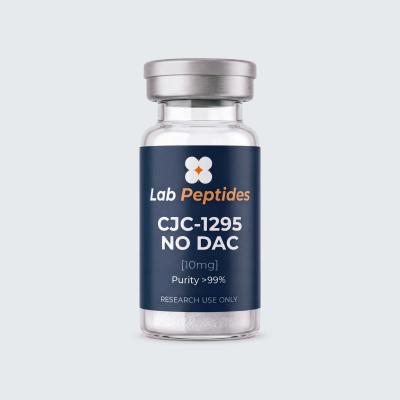
CJC-1295 no DAC 10 mg vial:
- 2 ml of bacteriostatic water gives 5 mg/ml: 100 µg = 0.02 ml = 2 units.
- 4 ml gives 2.5 mg/ml: 100 µg = 0.04 ml = 4 units. A larger dilution makes small volumes easier to read.
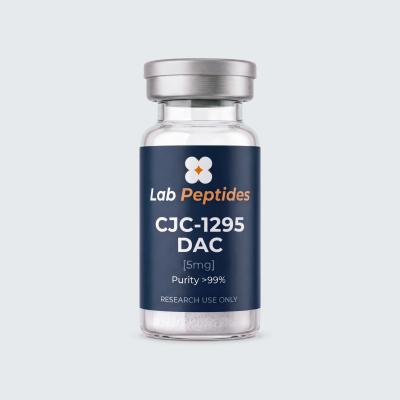
CJC-1295 DAC 5 mg vial:
- 2 ml of bacteriostatic water gives 2.5 mg/ml: 1 mg = 0.4 ml = 40 units; 2 mg = 0.8 ml = 80 units.
- 1 ml gives 5 mg/ml: 1 mg = 0.2 ml = 20 units.
Good practice: let the vial come to room temperature, inject the water slowly against the glass wall, swirl the vial gently without shaking until fully dissolved, then check that the solution is clear and free of particles. Volumes and syringes are covered in detail in our bacteriostatic water guide.
Stability and storage
As lyophilised powder, both forms keep in the refrigerator (2-8 °C) or in the freezer (-20 °C) for long-term storage, protected from light and moisture. Once reconstituted in bacteriostatic water, they are kept refrigerated; common practice for peptides of this size is use within 3 to 4 weeks, with aseptic handling. Do not freeze after reconstitution.
Two points specific to the molecule. The methionine → leucine substitution at position 27 removes one of the oxidation sites of native GHRH, and glutamine at position 8 replaces an asparagine prone to deamidation: these changes make the sequence more robust than sermorelin. For the DAC form, the maleimide group is reactive by nature: keep it away from thiol agents (DTT, beta-mercaptoethanol, free cysteine), which would neutralise it before the experiment.
Safety and reported signals
In Teichman et al. 2006, no serious adverse reactions were reported, and the authors describe relatively good tolerability, especially at 30 and 60 µg/kg, implying lower tolerability at the highest doses. For a related approved molecule, the FDA label for tesamorelin lists as most common reactions (over 5%) joint pain, redness and itching at the injection site, pain in the extremities, peripheral oedema and muscle pain; it also flags a risk of glucose intolerance and calls for glucose monitoring. The label links oedema and joint pain to the action of GH and IGF-1, so they may also concern other GHRH analogs.
The only serious documented signal for CJC-1295 remains the death in 2006 during ConjuChem's phase II, whose relationship to the product was not publicly established. For research, useful markers are IGF-1 (integrated reflection of the effect), baseline GH and its pulses, fasting glucose and insulin.
Regulatory status
CJC-1295, with or without DAC, is not authorised as a medicine in any country. In Europe it is sold as a research reagent (RUO), not intended for human use. In sport, the World Anti-Doping Agency names it in its 2026 Prohibited List, section S2 (growth hormone-releasing factors), alongside sermorelin and tesamorelin, prohibited both in and out of competition.
Frequently asked questions about CJC-1295
What is the difference between CJC-1295 DAC and no DAC?
Both share the same 29-amino-acid sequence. The DAC form also carries a group that binds blood albumin, which extends its half-life to 5.8-8.1 days (Teichman 2006) and continuously raises baseline GH. The form without DAC acts for about half an hour and produces a short pulse after each administration.
Is CJC-1295 without DAC the same as Mod GRF 1-29?
Yes. "Mod GRF 1-29" (modified or tetrasubstituted GRF 1-29) is the scientific name of the molecule; "CJC-1295 no DAC" is the trade name that took hold.
Does CJC-1295 DAC suppress natural GH pulses?
No, according to Ionescu and Frohman 2006: one week after injection, the frequency and amplitude of night-time pulses were unchanged. GH between pulses, however, rose 7.5-fold.
Why combine it with ipamorelin?
Because the two act on two different receptors (GHRH-R and GHS-R1a) and the GHRH + GHRP combination proved synergistic in humans (Bowers 1990). The specific CJC-1295 + ipamorelin combination has not been tested in a published trial.
How does it differ from tesamorelin?
Tesamorelin is a full-length GHRH (44 amino acids) protected at the N-terminus, FDA-approved in 2010 for HIV-associated lipodystrophy, with a half-life of 11 minutes. CJC-1295 has no authorisation, but its DAC form lasts several days.
Conclusion
CJC-1295 is a molecule with two faces. With DAC, it is one of the few GHRH analogs whose action lasts a week, documented by two human trials published in 2006: GH up 2- to 10-fold for six days, IGF-1 raised for up to 28 days, pulsatility preserved but baseline strongly lifted. Without DAC, it is a DPP-4-protected GRF(1-29), short-acting, with no dedicated clinical data, and the natural partner of ipamorelin in protocols looking for a short pulse. Choosing between the two means choosing a secretion profile: a floor raised continuously, or a pulse that falls back.
Order your CJC-1295 no DAC 10 mg: stock in France, fast shipping. For a complete protocol, pair it with ipamorelin 5 mg.