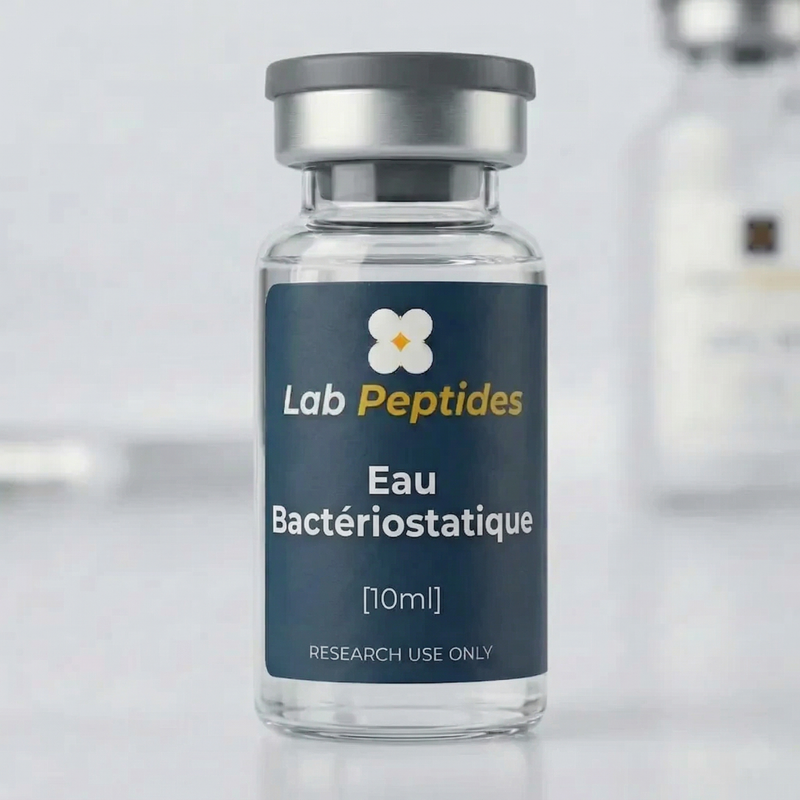
Eau Bactériostatique 10ml Accessoires
Bacteriostatic water 0.9% benzyl alcohol, 10ml format. Standard diluent for reconstituting lyophilized peptides on long protocols.
The pharma-standard reconstitution water. 0.9% benzyl alcohol for bacteriostatic stability up to 28 days. Sterile, pyrogen-free, fits every lyophilized peptide reconstitution. Essential to any serious protocol. 10ml format.
Don't forget the essentials
Bacteriostatic Water for Injection (BWFI, commonly abbreviated BAC) is the reference solvent used in laboratory settings to reconstitute lyophilized peptides intended for research. Our 10 ml multi-dose vial contains USP-quality water for injection supplemented with 0.9% benzyl alcohol as bacteriostatic agent. This very preservation distinguishes BAC from classical sterile water (Sterile Water for Injection, SWFI) and enables the multi-puncture use indispensable to peptide research.
The practical difference is decisive: a vial of SWFI is designed for single use after opening. Each subsequent puncture creates a progressive contamination risk, as no preservative inhibits bacterial or fungal proliferation after the first septum breach. Conversely, BAC tolerates multiple punctures over several days thanks to benzyl alcohol, which maintains bacteriostatic effect against Staphylococcus aureus, Pseudomonas aeruginosa, Escherichia coli, Candida albicans, and the majority of germs of clinical interest. This property makes BAC indispensable for peptide protocols where a single reconstituted vial is used over 14-21 days.
The 10 ml format is the "bulk" standard of research laboratories. It covers multiple reconstitutions (typically 3-5 peptide vials of 2-3 ml each depending on the reference), reduces unit cost compared to 3 ml formats, and allows comfortable management of protocols requiring several peptides in parallel. Our reference meets USP <1207> specifications for parenteral products: water purified by double distillation or reverse osmosis + 0.22 micron filtration, cleanroom ISO 5 filling, terminal autoclaving, LAL (Limulus Amebocyte Lysate) endotoxin testing, USP <71> sterility testing, visual inspection of each vial. Pharmaceutical type-I glass vial, chlorobutyl stopper, aluminum flip-off capsule. Research Use Only (RUO): not intended for human medicine preparation nor direct clinical use.
01Mechanism of action
BAC's bacteriostasis rests on a well-characterized biochemical mechanism: benzyl alcohol (C6H5-CH2-OH, phenylmethanol) is a low-molecular-weight amphipathic molecule (108.14 Da) that freely penetrates microorganism lipid membranes and disrupts membrane fluidity at concentrations in the 0.5-2% range. At 0.9%, the concentration is calibrated to inhibit microbial multiplication (bacteriostatic effect) without reaching the outright bactericidal effect that would require higher concentrations. This window is deliberate: a powerful bactericide in an injection solvent would generate concentrations potentially toxic to recipient tissues.
Activity spectrum. Benzyl alcohol at 0.9% maintains bacteriostatic activity on the majority of gram-positive bacteria (Staphylococcus aureus including coagulase-producing strains, Streptococcus pyogenes) and gram-negative (Escherichia coli, Pseudomonas aeruginosa) commonly implicated in injectable contamination. Activity on yeasts (Candida albicans) and some fungi (Aspergillus) is documented but less powerful: severe fungal contamination of a BAC vial may still proliferate slowly beyond 4-6 weeks. Activity on bacterial spores (Bacillus, Clostridium) is nil: a vial contaminated with viable spores will NOT be decontaminated by BAC, hence the importance of initial sterility of the manufacturing process.
Practical duration of the bacteriostatic effect. The USP pharmacopoeia indicates a maximum multi-dose use duration of 28 days after first puncture, conditioned on appropriate storage (room temperature 15-25 degrees or refrigeration 2-8 degrees) and rigorous aseptic manipulations (septum disinfection with 70% alcohol wipe before each puncture, use of fine sterile needle, no solvent reaspiration into the original vial after contact with a peptide). In peptide research, common practice is to reduce this window to 14-21 days for safety, consistent with the stability of the peptides themselves.
Chemical stability of benzyl alcohol. Benzyl alcohol is remarkably stable under normal storage conditions: little sensitive to ordinary light, little sensitive to temperature variations in the 0-30 degree range, little sensitive to humidity (water miscible). The only significant documented degradation is slow oxidation to benzaldehyde then benzoic acid, which can occur in very old vials (>5 years) or ones stored at high temperature. This degradation can produce a characteristic slightly almond-like odor (benzaldehyde) — a vial smelling of bitter almond must be considered suspect.
Compatibility with peptides. The vast majority of research peptides are chemically compatible with BAC at 0.9% benzyl alcohol. A few documented exceptions: (1) peptides very rich in N-terminal tryptophan residues may undergo slightly accelerated oxidation in the presence of benzyl alcohol (DSIP, some alpha-MSH fragments) — solution stability is then reduced to 10-14 days rather than 21 days; (2) some complex protein formulations (insulin, recombinant GH) may interact with benzyl alcohol, but these industrial biologics have their own dedicated diluents; (3) metal-peptide complexes (GHK-Cu notably) are stable in BAC. In daily peptide laboratory practice, BAC 0.9% benzyl alcohol is universally compatible.
Comparison BAC vs sterile water (SWFI) vs saline solutions. SWFI (sterile water for injection): strict single use after opening, no preservative, used in hospital settings to reconstitute single-dose antibiotics and dilute before perfusion. 0.9% saline solution (NaCl 0.9%): isotonic, used in perfusion, available in bacteriostatic versions (NaCl 0.9% + benzyl alcohol) or not. In peptide research, BAC is the standard because its coupling of multi-dose + preservative + near-zero osmolarity (slight hypotonicity negligible at SC injection volumes) matches the dominant use case.
Similar peptides
The choice of reconstitution solvent for research peptides is simple but deserves explicitness, as several alternatives exist and each has specific use cases.
BAC 0.9% benzyl alcohol vs sterile water for injection (SWFI). SWFI is ultrapure sterilized water without preservative, typically packaged in single-dose ampoules or 10 ml vials. Use: strict single-dose after opening. Theoretical advantage over BAC: total absence of preservative, therefore zero risk of chemical interaction between preservative and peptide. Major disadvantage in peptide research: a 10 ml SWFI vial opened to reconstitute 2 ml of peptide must be DISCARDED after puncture, even if 8 ml remain. Economically and practically, SWFI is unsuited to multi-day protocols. Relevant SWFI use: analytical validation protocols, comparative stability studies, cases where benzyl alcohol exclusion is necessary (documented allergic subject, targeted metabolism study).
BAC 0.9% benzyl alcohol vs 0.9% saline solution (bacteriostatic NaCl). NaCl 0.9% (i.e., 9 g/L or 154 mEq/L) is isotonic with human plasma, which theoretically reduces local irritation at the injection site. Bacteriostatic version: NaCl 0.9% + benzyl alcohol 0.9%, multi-dose use possible as with BAC. Why does simple BAC (without NaCl) remain dominant in peptide research? Because injected volumes are small (typical 0.1-0.3 ml), the osmolarity difference is insignificant at these volumes, and some sensitive peptides may form complexes with sodium-chloride ions. Simple BAC is therefore the default choice, and bacteriostatic NaCl is only indicated for larger injection volumes (>1 ml) or peptides specifically validated in saline formulation.
BAC vs manufacturer-specific diluent. Some industrial biological peptides (insulin, recombinant GH, certain therapeutic GLP-1 analogs) are supplied with their own proprietary diluent, formulated specifically for their target peptide (often with pH adjustment, phosphate buffers, zinc for crystalline insulins). These diluents are not interchangeable with standard BAC for their target product. HOWEVER, for standard research peptides we offer, BAC is the universally valid diluent.
BAC vs non-sterile demineralized or reverse-osmosis water. Frequent question: can demineralized, reverse-osmosis, or distilled non-sterile water be used as an economic alternative? CATEGORICAL ANSWER: NO. Non-sterile water, even of very high chemical purity, contains microorganisms, bacterial endotoxins, and particles that make it strictly unsuitable for reconstitution of injectable solutions. Injection of non-sterile water = major risk of contamination, febrile reaction (pyrogenic endotoxins), local or systemic infection. The quality of USP injectable water is radically different from standard laboratory quality.
BAC vs clean topical cosmetic diluents. For topical cosmetic applications (incorporation into cream, serum), BAC can be used but a dedicated pharmaceutical cosmetic base (lanolin cold cream base, 1% injection-grade hyaluronic acid, glycerol phosphate buffer serum) is often preferable for formulation stability reasons rather than microbiological purity.
Typical use case BAC 10 ml. Laboratory or researcher working on multiple peptides in parallel or on long cycles. A 10 ml vial typically allows reconstitution of 3-5 peptide vials over 14-21 days. Economical format vs 3 ml vials (lower BAC unit price, reduction in packaging count). Default choice for cosmetic laboratory, multi-peptide MSK research (BPC-157 + TB-500), or protocols with peptide combinations.
Typical use case BAC 3 ml. Occasional use, single peptide, need for more frequent rotation to maximize BAC freshness at each reconstitution. Ideal for initial exploratory testing of a peptide before commitment to a full cycle.