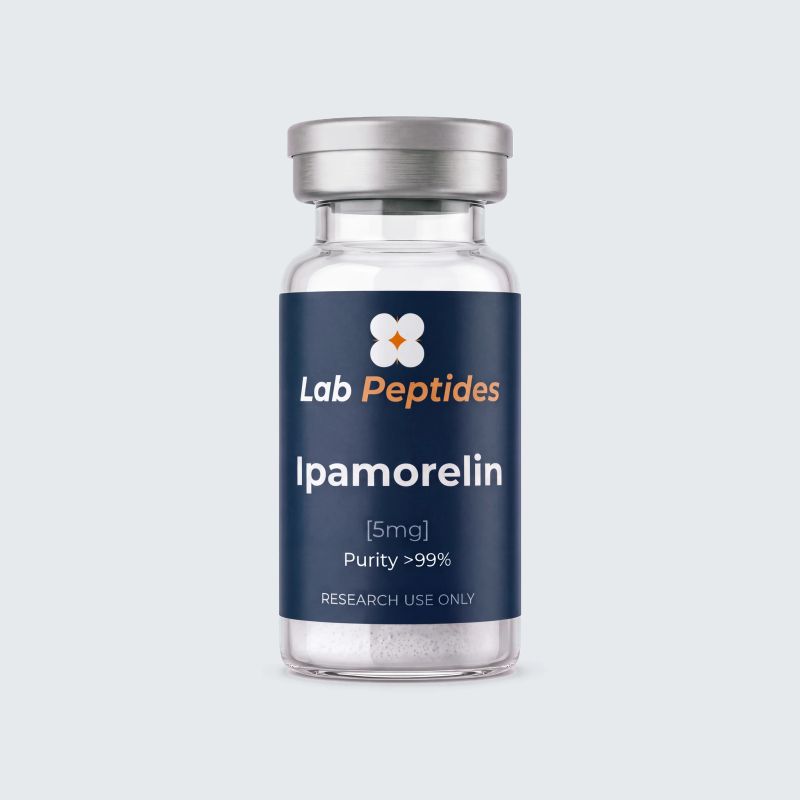
Ipamorelin 5mg GH / IGF-1 axis
The benchmark selective pentapeptide.
- In stock in France
 Ordered with its water: shipped in a magnetic box
-10 % for life on each cyclePause, skip or cancel in 1 clickNo commitment, no hidden fees
No card: each delivery is paid in Bitcoin (extra -5%) or by bank transfer
Your complete kit
The vial alone cannot be used as is. Add what you need to prepare it:
Frequently bought together


Research Use Only (RUO) · Prohibited for human or veterinary use.
Key facts
Protocol and preparation
| Water added | Concentration | Reading marker |
|---|---|---|
| 1 ml | 5 mg/ml | 40 UI = 2 mg |
| 2 ml | 2,5 mg/ml | 40 UI = 1 mg |
The volume of water does not change the product, only its concentration. Add the water slowly along the vial wall, then swirl without shaking.
Asepsis
Disinfect surfaces and stoppers (70% alcohol).
Solvent
Draw the required volume of bacteriostatic water.
Introduction
Add gently against the vial wall (avoid a direct jet on the powder).
Solubilization
Roll the vial gently. Do not shake vigorously (degradation risk).
Solution storage Once reconstituted: 2-8°C (refrigerator).
Warning Theoretical tool for chemical handling. Does not constitute medical advice.
I open the dilution calculator- The amount of powder looks tiny. A lyophilisate takes up a few millimetres at the bottom of the vial, sometimes just a translucent film. The stated weight is there.
- The powder is compact, stuck to the wall or to the stopper. Transport moves the freeze-dried cake around. It changes nothing to reconstitution.
- The vial carries no individual label. That is our standard packaging, not a downgraded vial.
- After reconstitution, deposits or filaments appear. This is common, especially with small molecules. Let it settle and roll the vial between your palms, never shake it.
- The parcel is plain. Nothing on the outside indicates the contents or the brand name.
What is not normal: a cracked vial, an uncrimped cap or a stopper that moves, powder that has liquefied or changed colour. In those specific cases, write to us with a photo and we take the vial back.
Technical data
- Reconstitution
- 2 ml d'eau → 2,5 mg/ml. 8 UI = 200 mcg ; 12 UI = 300 mcg.
- Peptide sequence
- Aib-His-D-2-Nal-D-Phe-Lys-NH2
- Molecular formula
- C38H49N9O5
- Molecular weight
- 711.9 g/mol
- CAS number
- 170851-70-4
- Physical form
- Poudre lyophilisée
- Recommended solubility
- Eau bactériostatique, NaCl 0,9%
- Storage conditions
- Au réfrigérateur (+2 à +8 °C), à l'abri de la lumière. En poudre, possible au congélateur pour une conservation longue. Une fois préparé : réfrigérateur, jamais au congélateur.
- Use
- Research reagent, in vitro only (RUO)
Storage & handling
Lyophilized unreconstituted Ipamorelin is stored in the fridge (+2 to +8 °C) in its original sealed packaging, protected from light and humidity; for long-term storage (over 3 months), a -20 °C freezer keeps it for up to 24 months. At refrigerated temperature (2-8 degrees Celsius), documented stability covers a minimum of 12 months. At room temperature (below 25 degrees Celsius), recommended duration for transport or temporary storage: 3 weeks maximum. Once reconstituted with bacteriostatic water, Ipamorelin must be stored between 2 and 8 degrees Celsius. Documented post-reconstitution stability: 28 days with bacteriostatic (benzyl alcohol 0.9%), 7 days with preservative-free sterile water. Specific sensitivities: like all short pentapeptides, Ipamorelin is sensitive to repeated freeze-thaw cycles (limit to a maximum of three), histidine oxidation (avoid contact with non-inert metals), and prolonged acidic or basic hydrolysis. Avoid direct UV exposure and thermal shocks. Lyophilised Ipamorelin shows excellent stability at -20°C under desiccation (> 24 months with no measurable RP-HPLC purity loss). In reconstituted solution (0.9% benzyl alcohol bacteriostatic water, 1-5 mg/mL), documented 28-day stability at 2-8°C in amber vial. Optimal pH is 5.5-7.0: avoid highly acidic (pH < 4) or basic (pH > 8) solutions favouring deamidation of C-terminal Lys-NH2 residue and hydrolysis of D-Phe-Lys amide bonds. N-terminal Aib confers superior exopeptidase resistance but remains sensitive to oxidative conditions: strictly protect from UV light and avoid exposure to residual hydrogen peroxide in diluents. Unlike more complex peptides, Ipamorelin contains no Cys (no disulfide dimer risk) nor Met (no oxidation), simplifying storage logistics. Repeated freeze/thaw cycles must be avoided as they generate aggregates detectable by SEC-HPLC.
Mechanism of action
Ipamorelin is a synthetic pentapeptide with sequence Aib-His-D-2-Nal-D-Phe-Lys-NH2 (amino-isobutyric acid - histidine - D-naphthylalanine - D-phenylalanine - amidated lysine), molecular weight 711.85 Da. The sequence integrates non-natural residues (Aib, D-2-Nal, D-Phe) conferring increased metabolic stability and optimizing affinity for the target receptor.
At the molecular level, Ipamorelin is a selective agonist of the GHS-R1a receptor (Growth Hormone Secretagogue Receptor 1a), also known as the ghrelin receptor. This Gq/11-coupled receptor is expressed primarily in somatotropic cells of the anterior pituitary and in certain hypothalamic areas (arcuate nucleus, paraventricular nucleus). Receptor activation triggers a PLC-IP3-Ca2+ cascade leading to rapid pulsatile release of GH stored in secretion granules.
The distinctive characteristic of Ipamorelin is its exceptional SELECTIVITY: unlike other GHRPs (GHRP-6, GHRP-2, Hexarelin), Ipamorelin does NOT induce significant increases in prolactin, cortisol, ACTH, or aldosterone at studied therapeutic doses. This selectivity was documented in the foundational Raun et al. study (1998) and confirmed by subsequent independent work. It makes Ipamorelin the preferred GHRP for research protocols where GH effect specificity is a priority.
Studies and references
The scientific corpus on Ipamorelin primarily comes from the founding work of the Raun group (Novo Nordisk) in the 1990s, then from European and American academic teams studying the selective GHRP class.
Gonzalez-Lopez et al. (Growth Hormone & IGF Research 2000) explored the chronic response of the somatotropic axis under Ipamorelin administered 2-3 times daily for 4 weeks in adult rats, documenting a sustained IGF-1 increase without notable GHS-R1a receptor desensitization.
Beck et al. (Hormone Research 2001) studied the Ipamorelin + GHRH 1-29 combination in dogs, providing the first data on GHRP + GHRH synergy that would later be explored with CJC-1295 DAC. GH increase was significantly superior to the sum of individual effects.
Several human phase 2 clinical trials (indicationsPost-operative ileus, cachexia, elderly undernutrition) were conducted between 2000 and 2010 by various sponsors. Results showed good tolerance but mixed clinical efficacies, leading to discontinuation of most commercial programs. Helixmith/Bachem currently holds rights on certain research indications.
Corpus limitationsHuman studies are essentially phase 1-2 with cohorts <100 subjects, long-term data (>6 months) are rare, and no marketing authorization has been obtained. Ipamorelin remains strictly an exploratory research peptide outside validated clinical protocols.
- 1Sécrétagogue GHIpamorelin, the first selective growth hormone secretagogue
Frequently asked questions
Why combine Ipamorelin with CJC-1295 DAC in research?
What is the delivery lead time in Europe?
Ipamorelin + CJC-1295: which combination to recommend in research?
 The complete guideCJC-1295: complete guide to DAC vs no DAC (Mod GRF 1-29) in researchCJC-1295 with or without DAC: structure, half-life (8 days versus 30 minutes), GH pulsatility, the Teichman and Ionescu 2006 trials, the ipamorelin combination, comparison with sermorelin and tesamorelin, and reconstitution.Read the guide
Also read:Solid-phase peptide synthesis (SPPS): complete guide to Merrifield, Fmoc, Boc, resins, coupling reagents and quality controlPeptide analytics: high-resolution LC-MS, NMR, HPLC and Edman - Complete research guide