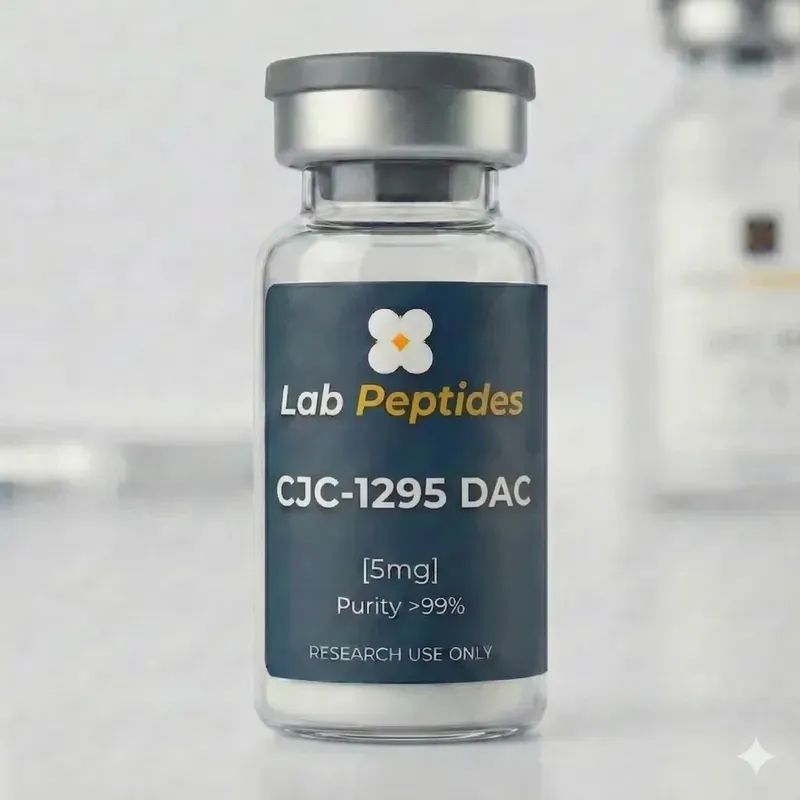
CJC-1295 DAC 5mg Muscle Growth
Ultra-extended half-life GHRH analog. The DAC technology that turns a short-acting peptide into a multi-day molecule.
GH in long-acting mode. CJC-1295 DAC is the albumin-binding GHRH analog — a single injection releases GH for 6-8 days. Stable peak, no hormonal yo-yo. Multiply your IGF-1 2-3x without daily injections. The standard for long-term protocols.

Our CJC-1295 DAC 5 mg vial is the reference format for exploratory research protocols on the somatotropic axis and prolonged stimulation of growth hormone (GH) and IGF-1. CJC-1295 with Drug Affinity Complex (DAC) is a synthetic GHRH (Growth Hormone Releasing Hormone) analog modified for an extended plasma half-life of 6-8 days, a unique characteristic within the secretagogue class.
With 5 mg of lyophilized peptide per vial at HPLC purity >=99 percent, this format covers approximately 5 weeks of protocol at the standard weekly dose (1 mg/week). Each Atlas Lab vial comes with a detailed Certificate of Analysis (COA): HPLC profile, mass spectrum, endotoxin tests, full batch traceability.
CJC-1295 DAC is often associated in research with Ipamorelin (selective GHRP) to explore the GHRH + GHRP synergy documented in literature. Dispatched Tuesday and Friday from our European warehouse, France delivery within 2 to 3 days in secure isothermal packaging, digital COA shipped with every order. The flagship of extended-duration GHRH analogs for serious laboratories.
01Mechanism of action
CJC-1295 is a tetra-substituted analog of GHRH 1-29 (Growth Hormone Releasing Hormone, the active N-terminal 29-amino-acid fragment). The four strategic substitutions — D-Ala2, Gln8, Ala15, Leu27 — confer protease resistance (notably to dipeptidyl peptidase IV, DPP-IV) and increased plasma stability. The major modification is the addition of the Drug Affinity Complex (DAC): a maleimidopropionate chain covalently binding cysteine-34 of human serum albumin, dramatically increasing plasma half-life from 30 minutes to 6-8 days.
At the molecular level, CJC-1295 activates the GHRH receptor (GHRH-R) expressed on somatotropic cells of the anterior pituitary. Receptor binding triggers a Gs-cAMP-PKA cascade leading to synthesis and pulsatile release of GH. Unlike short-acting native GHRH, CJC-1295 DAC maintains sustained plasma concentration and amplifies the amplitude of endogenous physiological GH pulses without suppressing their pulsatile character — a critical point since pulses are essential to tissue response (IGF-1, lipolysis, protein turnover).
Pharmacokinetic studies have documented, after a single 60-250 mcg/kg injection in healthy humans, a sustained increase in mean GH (2-10 times baseline) for at least 6 days, and an IGF-1 increase of 1.5 to 3 times baseline for 7-11 days. This extended kinetics allows weekly or bi-weekly injection frequencies, unlike classical GHRH or GHRP requiring 2-3 daily injections.
The documented route of administration is primarily subcutaneous. The DAC-free version (CJC-1295 "modified GRF 1-29") presents a half-life of only 30 minutes and requires 2-3 daily administration — not to be confused with the DAC version in protocols. As with any research peptide, these data come from preclinical studies and exploratory clinical trials: CJC-1295 DAC is not approved for human therapeutic use and remains an exploratory research tool.
Structurally, CJC-1295 with DAC (Drug Affinity Complex) is a 30-amino-acid analogue derived from the human active GHRH(1-29) fragment, bearing four canonical stabilising substitutions — D-Ala2, Gln8, Ala15, Leu27 — designed to block degradation by dipeptidyl peptidase-4 (DPP-4) and serum trypsin, plus a maleimido-propionyl-lysine group added at the C-terminus after SPPS. This modified lysine forms in vivo a covalent thioether bond with the free Cys34 residue of human serum albumin via Michael addition on the maleimide. Albumin thus becomes a plasma carrier protecting the peptide from renal filtration and proteolysis, conferring CJC-1295 DAC a documented 6-8 day half-life in primates, versus ~30 minutes for the non-DAC version. Pharmacologically, the released peptide remains an agonist of the GHRHR receptor (class B1 GPCR, Gαs coupling) on anterior pituitary somatotrophs, raising intracellular cAMP and triggering exocytosis of pre-stored GH granules. This pattern produces a sustained "GH-bleed" elevation (mildly elevated chronic baseline) rather than classical endogenous pulsatility, with distinct hepatic STAT5b transcriptomic consequences documented in rodent models.
Similar peptides
CJC-1295 DAC occupies a distinctive position in the GH secretagogue class thanks to its 6-8 day plasma half-life, unique among GHRH analogs. Compared to CJC-1295 without DAC (also called "modified GRF 1-29"), the DAC version multiplies duration of action by approximately 300 (30 minutes vs 6-8 days), enabling weekly injections instead of 2-3 per day.
Compared to Sermorelin (historical truncated GHRH 1-29, marketed as Geref), CJC-1295 DAC offers significantly superior stability and duration of action: Sermorelin has only a 10-15 minute half-life and requires daily administration, limiting its use in extended research. Tesamorelin (GHRH analog marketed for HIV lipodystrophy) has an intermediate half-life of 26-38 minutes and remains daily-administered.
Compared to classical GHRPs — Ipamorelin, GHRP-6, Hexarelin — CJC-1295 DAC acts on a completely different pathway: GHRH-R (GHRH receptor) versus GHS-R1a (ghrelin receptor). The two pathways are independent and synergistic: the CJC-1295 DAC + Ipamorelin combination is the most studied duo in secretagogue research to maximize GH release without cross-side effects (Ipamorelin being the most selective GHRP, without cortisol or prolactin increase).
Compared to exogenous recombinant GH (somatropin), CJC-1295 DAC preserves the physiological pulsatility of endogenous GH secretion, which according to literature maintains better tissue response and avoids GH receptor desensitization. Exogenous GH conversely produces supra-physiological non-pulsatile levels.
On the research peptide market, CJC-1295 DAC is one of the most demanded secretagogues, particularly for combined protocols with Ipamorelin. Its commercialization for human therapeutic use is prohibited in France, Europe, and the United States — strict research use.
CJC-1295 with DAC clearly distinguishes itself from other GHRH analogues by its extended kinetics. Compared to sermorelin (native GRF 1-29, 3358 Da, 10-15 min half-life): 500-700x more persistent, but loses endogenous physiological pulsatility. Compared to CJC-1295 without DAC (aka Modified GRF 1-29, same substitutions without maleimide linker, ~30 min half-life): weekly vs multi-daily kinetics, but chronic "GH-bleed" profile rather than pulsatile. Choice between the two depends on experimental question: hepatic IGF-1 chronicity (CJC-1295 DAC) or physiological pulsatility (sermorelin, Modified GRF). Compared to tesamorelin (trans-3-hexenoyl-GHRH(1-44), SC half-life ~25-40 min): tesamorelin retains full 1-44 human sequence while CJC-1295 DAC is based on 1-29. Compared to peptide GHRPs (Ipamorelin, GHRP-2, hexarelin): different mechanism (GHRHR Gαs vs GHS-R1a Gαq/Gαs), complementary targeting justifying documented CJC-1295 DAC + Ipamorelin co-administrations in rodent protocols. Compared to MK-677 (ibutamoren PO): CJC-1295 DAC acts on GHRHR via weekly injection, MK-677 acts on GHS-R1a orally daily — orthogonal tools for pharmacological dissection of the somatotropic axis.