Melanotan 2 (MT-II): complete guide, receptors, studies, side effects, status
Melanotan 2 (MT-II, Melanotan II) is a cyclic analogue of alpha-melanocyte-stimulating hormone (α-MSH), designed in the late 1980s at the University of Arizona by the team of chemist Victor Hruby and physiologist Mac Hadley. A heptapeptide closed by a lactam bridge, it activates four of the five melanocortin receptors (MC1R, MC3R, MC4R, MC5R) without selectivity. Robert Dorr and colleagues tested it in humans in the mid-1990s as a way to pigment the skin without sun exposure, and found an unexpected effect on erection that led to PT-141 (bremelanotide).
This guide gathers the published data on MT-II: structure, receptors, the Arizona trials, differences from Melanotan 1 and PT-141, doses studied, reconstitution, adverse effects and regulators' warnings. The products mentioned are intended exclusively for in vitro and in vivo research (RUO), not for human use. For an overview of the whole family, see also our guide to melanocortins in research.

Molecular identity and pharmaceutical chemistry
MT-II is a shortened, cyclised fragment of α-MSH, the 13-amino-acid hormone cleaved from pro-opiomelanocortin (POMC). Its sequence is Ac-Nle-cyclo[Asp-His-D-Phe-Arg-Trp-Lys]-NH2: seven residues, N-acetylation, C-amidation and a lactam bridge between the side chains of aspartate (position 5) and lysine (position 10).
| Parameter | Value |
|---|---|
| Common names | Melanotan 2, Melanotan II, MT-II, MT2 |
| Nomenclature | Ac-[Nle4, Asp5, D-Phe7, Lys10]-α-MSH(4-10)-NH2, cyclic (lactam 5→10) |
| Molecular formula | C50H69N15O9 |
| Molecular weight | 1,024.2 g/mol (monoisotopic 1,023.54 Da) |
| CAS number | 121062-08-6 |
| Class | Non-selective melanocortin receptor agonist |
Three design choices explain its potency. Norleucine at position 4 replaces the native methionine, which is prone to oxidation. D-phenylalanine at position 7, inherited from the linear analogue [Nle4, D-Phe7]-α-MSH (later afamelanotide), stabilises the His-Phe-Arg-Trp turn that carries the activity. The lactam bridge locks the conformation and protects against proteases.
The founding paper is Al-Obeidi, Castrucci, Hadley and Hruby (Journal of Medicinal Chemistry, 1989). Guided by molecular dynamics simulations, the authors prepared seven cyclic analogues and measured their potency in lizard and frog skin bioassays. The analogue Ac-[Nle4, Asp5, D-Phe7, Lys10]-α-MSH(4-10)-NH2, that is MT-II, was 90 times more potent than α-MSH in the lizard model. 23-membered rings gave the highest potency and prolonged activity; enlarging or shrinking the ring reduced activity.
Mechanism of action: the melanocortin receptors
Melanocortins act on five receptors coupled to the Gs protein and cyclic AMP (MC1R to MC5R). MC2R is the ACTH receptor of the adrenal gland. It does not respond to MT-II; the other four do, hence the variety of its effects.
| Receptor | MT-II affinity (Ki) | Main location | Associated effect |
|---|---|---|---|
| MC1R | 0.67 nM | Skin melanocytes | Eumelanin synthesis (pigmentation) |
| MC4R | 6.6 nM | Hypothalamus, brainstem, spinal cord | Appetite, energy expenditure, sexual response |
| MC3R | 34 nM | Hypothalamus, limbic system | Energy homeostasis |
| MC5R | 46 nM | Exocrine (sebaceous) glands | Exocrine secretions |
Ki values from Tocris reference datasheets (recombinant human receptors, COS cells). The MC1R-then-MC4R order sums up the dual nature of MT-II: a pigmenting agent in the skin, an active agent in the brain.
Pigmentation (MC1R). In the melanocyte, MC1R activation raises cAMP and steers melanogenesis towards eumelanin, the brown-black pigment, rather than red-yellow pheomelanin. This is the tanning mechanism, triggered here without UV.
Central effects (MC3R, MC4R). Hypothalamic MC4R is a major brake on food intake. Fan et al. (Nature, 1997) showed that MT-II injected into the cerebral ventricles reduced food intake in four hyperphagic mouse models (fasted, ob/ob, Ay, neuropeptide Y), an effect abolished by the antagonist SHU9119. MC4R also takes part in sexual response through central and spinal pathways: this is the target PT-141 aims at.
Pharmacokinetics
To be frank: published human pharmacokinetic data on MT-II are very thin. The Arizona trials were small early-phase studies, and the available abstracts give no full half-life profile. Lactam cyclisation gives far greater protease resistance than native α-MSH; Al-Obeidi et al. (1989) already described "prolonged" activity for the 23- and 24-membered rings.
The best numerical benchmark comes from its close relative, bremelanotide. According to the US Vyleesi label, subcutaneous bremelanotide peaks in plasma at about 1 hour (0.5 to 1 h). Its absolute bioavailability is about 100%, its mean terminal half-life is about 2.7 hours (1.9 to 4.0 h), and it is broken down by hydrolysis of peptide bonds. The two molecules differ only at the C-terminus: this is an order of magnitude, not a measurement of MT-II.
Dorr et al. (1996) report spontaneous erections 1 to 5 hours after injection, consistent with an action lasting a few hours. Pigmentation, by contrast, depends on melanin synthesis and persists after the peptide has gone.
The Arizona studies: Dorr, Hadley, Wessells (1991-2000)
The "Melanotan" programme aimed to tan without UV to reduce skin cancer risk in fair skin: first with Melanotan 1, then with MT-II.
Levine et al., JAMA 1991 (Melanotan 1). Randomised, double-blind, placebo-controlled trial in 28 men of skin types I to IV: ten subcutaneous injections over 12 days, under sunscreen. Skin darkened significantly on treatment, not on placebo, peaking one to three weeks after the last injection.
Dorr et al., Life Sciences 1996 (first administration of MT-II). This single-blind pilot phase I study alternated MT-II and saline in 3 male volunteers. The starting dose was 0.01 mg/kg, increased in 0.005 mg/kg steps to 0.025 or 0.03 mg/kg over two weeks. Results:
- increased pigmentation of the face, upper body and buttocks in 2 of 3 subjects, measured by reflectance one week after the last dose;
- mild nausea, needing no antiemetic, at most dose levels;
- grade II (WHO) somnolence and fatigue in 1 of 2 subjects at 0.03 mg/kg;
- a yawning-stretching complex associated with spontaneous erections, intermittent for 1 to 5 hours after injection.
The authors recommended 0.025 mg/kg/day as the single dose for later phase I studies.
Wessells et al., Journal of Urology 1998. The unexpected erectogenic effect became a research topic of its own. This double-blind, placebo-controlled crossover trial enrolled 10 men with psychogenic erectile dysfunction, monitored by RigiScan for 6 hours. At 0.025 mg/kg, 8 of 10 men had clinically apparent erections. Mean duration of tip rigidity above 80% was 38.0 minutes on MT-II versus 3.0 minutes on placebo (p = 0.0045). Nausea, yawning-stretching and reduced appetite were more frequent on MT-II.
Wessells et al., Urology 2000. Same design (10 men, 0.025 mg/kg, two active and two placebo injections each), this time in men with organic risk factors. Erections were reported after 12 of 19 MT-II injections versus 1 of 21 placebo doses. Rigidity above 80% lasted 45.3 minutes versus 1.9 minutes (p = 0.047), and reported sexual desire was higher. The downside: 4 of 19 injections caused severe nausea.
These trials remain the only controlled human data on MT-II. They cover a few dozen men over a few weeks. No phase III trial has ever been run on MT-II itself.
MT-1, MT-2, PT-141: three molecules, three fates
"Melanotan" actually refers to two different peptides, and PT-141 is a third.
| Melanotan 1 (afamelanotide) | Melanotan 2 (MT-II) | PT-141 (bremelanotide) | |
|---|---|---|---|
| Structure | Linear, 13 amino acids, [Nle4, D-Phe7]-α-MSH | Cyclic, 7 residues, C-terminal amide | Cyclic, 7 residues, free C-terminal acid |
| Mass | 1,646.8 g/mol | 1,024.2 g/mol | 1,025.2 g/mol |
| Selectivity | Mainly an MC1R agonist | Non-selective (MC1R, MC3R, MC4R, MC5R) | Designed for the central effect (MC4R); still pigments |
| Approved medicine | Scenesse, 16 mg implant (EU 2014, USA 2019) | None | Vyleesi, 1.75 mg SC (USA 2019 only) |
| Indication | Erythropoietic protoporphyria (adults) | — | Hypoactive sexual desire disorder, premenopausal women |
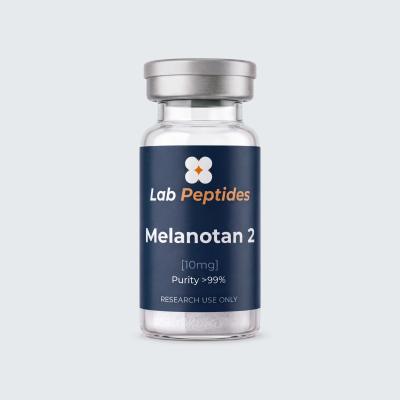
| Our product | Melanotan 1 10 mg | Melanotan 2 10 mg | PT-141 10 mg |
Melanotan 1: the regulatory success
Melanotan 1 became afamelanotide, developed by Clinuvel as Scenesse. It is a 16 mg resorbable subcutaneous implant inserted by a trained professional. The European Medicines Agency (EMA) authorised it on 22 December 2014, "under exceptional circumstances", to prevent phototoxicity in adults with erythropoietic protoporphyria (EPP). The FDA followed on 8 October 2019.
The pivotal trials were published by Langendonk et al. (New England Journal of Medicine, 2015). In the European trial (74 patients), median pain-free time in the sun was 6.0 hours on afamelanotide versus 0.8 hours on placebo. In the US trial (93 patients), it reached 69.4 hours versus 40.8 hours. The number of phototoxic reactions was halved in the European trial (77 versus 146), but not in the US trial. The EMA lists nausea, headache and implant-site reactions in about one patient in five, generally mild.
PT-141: the MT-II derivative that became a medicine
Bremelanotide (PT-141) differs from MT-II by one detail: the C-terminal amide is replaced by a free carboxylic acid (C50H68N14O10). It is a probable metabolite of MT-II, developed by Palatin Technologies to exploit the sexual effect observed in Tucson. The intranasal form, first tested in men, was abandoned in the late 2000s because of blood pressure increases. The subcutaneous form was approved by the FDA in June 2019 as Vyleesi, at 1.75 mg about 45 minutes before sexual activity, with no more than one dose per 24 hours and eight doses per month. It has no authorisation in the European Union.
The RECONNECT trials (Kingsberg et al., Obstetrics & Gynecology, 2019) were two identical 24-week phase III trials. They randomised 1,267 premenopausal women with hypoactive sexual desire disorder. Desire (FSFI) and related distress improved significantly more than on placebo (p < 0.001), but in the FDA's published analysis the share of responders was only 25% versus 17% on placebo for desire, and 35% versus 31% for distress. Nausea affected 40.0% of patients (versus 1.3% on placebo) and led to 8% of discontinuations.
A useful point for understanding MT-II: the Vyleesi label reports focal hyperpigmentation (face, gums, breasts) in 1% of patients using up to eight doses per month. In another study, the rate rose to 38% after eight days of daily injections. Pigmentation did not always resolve after stopping. Even designed for MC4R, this derivative still pigments.
Doses studied in the literature
The only documented human doses of MT-II come from the Arizona trials. They are expressed in mg per kg of body weight, by subcutaneous injection.
| Study | Population | MT-II dose | Equivalent for 70 kg |
|---|---|---|---|
| Dorr et al., 1996 (start) | 3 healthy volunteers | 0.01 mg/kg/day | 0.7 mg |
| Dorr et al., 1996 (recommended dose) | 3 healthy volunteers | 0.025 mg/kg/day | 1.75 mg |
| Dorr et al., 1996 (highest step) | 2 volunteers | 0.03 mg/kg/day | 2.1 mg |
| Wessells et al., 1998 and 2000 | 2 × 10 men (erectile dysfunction) | 0.025 mg/kg, single injection | 1.75 mg |
These figures describe what was administered, not recommendations: 0.03 mg/kg already produced grade II somnolence, and 0.025 mg/kg severe nausea after roughly one injection in five (2000 trial). The toxicology case described below involves a 6 mg injection, more than three times the 0.025 mg/kg dose for a 70 kg adult.
Reconstitution protocol (research use only)
MT-II is supplied lyophilised in a 10 mg vial. It is reconstituted with bacteriostatic water (water for injection with 0.9% benzyl alcohol). The volume chosen sets the concentration. The table converts to units on a U-100 insulin syringe, where 100 units equal 1 ml.
| Water added | Concentration | 1 unit (0.01 ml) | 10 units (0.1 ml) | 0.7 mg | 1.75 mg |
|---|---|---|---|---|---|
| 1 ml | 10 mg/ml | 0.1 mg | 1 mg | 7 units | 17.5 units |
| 2 ml | 5 mg/ml | 0.05 mg | 0.5 mg | 14 units | 35 units |
The 2 ml dilution is the easiest to read: each 10-unit mark equals 0.5 mg. Good handling practice:
- disinfect the septum with isopropyl alcohol;
- inject the water slowly down the vial wall, never directly onto the powder;
- swirl the vial gently until fully dissolved, without shaking or vortexing;
- check for particles or cloudiness before drawing any volume.
Stability and storage
Lyophilised MT-II keeps best at -20 °C, protected from light and moisture. Once reconstituted, it is kept at 2 to 8 °C, still protected from light. There is no published solution-stability study specific to MT-II. In laboratory practice, peptides reconstituted in bacteriostatic water are used within the following weeks, under aseptic handling. Repeated freeze-thaw cycles are avoided.
Tryptophan remains sensitive to photo-oxidation, hence the protection from light; the lactam ring, with no disulfide bridge, is chemically robust. For the detail of degradation mechanisms, see our guide to storing lyophilised peptides.
Safety: what the trials and the literature report
Safety data come from two very different sources: a few supervised trials from the 1990s, and case reports linked to products bought online, of uncertain composition and dosage.
Expected effects, observed in trials. Nausea (frequent, sometimes severe), yawning and stretching, reduced appetite, somnolence and fatigue at high doses, spontaneous erections in men. They follow from the non-selective profile.
Moles and melanoma. This is the best-documented signal. The review by Habbema et al. (International Journal of Dermatology, 2017) reports changes in existing naevi and new, sometimes dysplastic, naevi in users of Melanotan 1 and 2. It also lists four cases of melanoma arising from pre-existing naevi during or shortly after use. The authors stress that conclusive evidence of causation is lacking. The systematic review by Burian and Jemec (American Journal of Clinical Dermatology, 2019) covers 179 patients with eruptive naevi. Immunosuppressants, chemotherapy or melanotan accounted for 41% of suspected causes.
Systemic toxicity. Nelson et al. (Clinical Toxicology, 2012) describe a 39-year-old man who injected 6 mg of MT-II bought online. He developed sympathomimetic toxicity (heart rate up to 146/min, tremors, sweating) and rhabdomyolysis with CPK at 17,773 IU/L, requiring three days in intensive care. The product was confirmed by mass spectrometry. Peters et al. (CEN Case Reports, 2020) report a renal infarction most likely attributable to MT-II. Dreyer et al. (BMJ Case Reports, 2019) and Mallory et al. (Sexual Medicine, 2021) describe ischaemic priapism, one case requiring surgical decompression.
The underlying problem: quality. The 2017 review stresses the uncertainties of preparation and dosage of products sold outside any framework, nasal sprays included. For the researcher, the only answer is traceability: identity confirmed by mass spectrometry, purity by HPLC, a certificate of analysis per batch. These are the criteria to demand from any supplier, ours included.
Regulatory status in Europe and elsewhere
No MT-II medicine is authorised, in the European Union or anywhere else. Only its cousin, afamelanotide (Scenesse), holds a European authorisation, and only for erythropoietic protoporphyria.
- United Kingdom (MHRA): as early as 2008-2009, the agency warned against melanotan, "not tested for safety, quality or effectiveness", and told 18 companies that selling it was illegal.
- Ireland (HPRA): in August 2023, the agency restated that Melanotan 2 is not authorised by any medicines regulator. It listed as risks new moles, darkening of existing moles and freckles, reduced eyesight, tremors, stroke and severe allergic reaction. It also states that it is not a cosmetic product: a product that is injected, inhaled or absorbed under the tongue cannot be one.
- Australia (TGA): MT-II is a prescription-only medicine there. No product is on the Australian register, and the agency regularly warns against sprays and injectables sold online, citing the risk of serious skin cancers.
- France: there is no marketing authorisation for MT-II; the EU definition of a cosmetic, cited by the HPRA, also rules out selling it as a tanning cosmetic.
MT-II remains a reference agonist in melanocortin research (food intake, energy expenditure, sexual function in animals). It is offered as a research product (RUO) in that context only.
Frequently asked questions about Melanotan 2
What is the difference between Melanotan 1 and Melanotan 2?
Melanotan 1 (afamelanotide) is linear, with 13 amino acids, and mainly targets MC1R. It became an approved medicine, Scenesse. Melanotan 2 is cyclic, with 7 residues, more potent and non-selective. It also acts on the central MC3R and MC4R receptors, hence its effects on appetite, nausea and sexual function. It has never been approved.
Are PT-141 and Melanotan 2 the same molecule?
Almost. PT-141 (bremelanotide) has the same cyclic sequence, but its C-terminus carries a free acid instead of an amide. It was developed for its effect on sexual desire and approved in the United States in 2019 (Vyleesi). It retains a pigmenting capacity, noted in its label.
Which MT-II doses have been studied in humans?
0.01 to 0.03 mg/kg per day (Dorr et al., 1996, who recommended 0.025 mg/kg, i.e. 1.75 mg for 70 kg), and 0.025 mg/kg as a single injection in Wessells (1998, 2000).
Does the resulting tan protect against the sun?
No study has measured any sun protection conferred by MT-II. The demonstrated photoprotection of afamelanotide concerns one specific disease, erythropoietic protoporphyria, with a controlled pharmaceutical product. It does not carry over to MT-II.
Is Melanotan 2 authorised in Europe?
No. No MT-II medicine is authorised in the European Union, and it cannot be sold as a cosmetic. It is marketed as a research reagent, not intended for human use.
Conclusion
Melanotan 2 is a success of peptide chemistry: a seven-residue ring, 90 times more potent than the natural hormone, which opened up the pharmacological study of MC3R and MC4R. Its lack of selectivity makes it an excellent laboratory tool, and explains why it never became a medicine. Its two relatives, afamelanotide and bremelanotide, took the regulatory route. MT-II remains a research reagent, and the regulators' warnings and published cases show why it should stay that way.
Order your Melanotan 2 10 mg: lyophilised vial, stock in France, shipped from France. For comparative protocols, PT-141 10 mg and Melanotan 1 10 mg are also available.