Epitalon (Epithalon): complete guide to the telomerase peptide in research
Epitalon (also spelled Epithalon, or AEDG) is a synthetic tetrapeptide of four amino acids, Ala-Glu-Asp-Gly, designed from the composition of epithalamin, an extract of bovine pineal gland. It comes from the work of Vladimir Khavinson and the Saint Petersburg Institute of Bioregulation and Gerontology, who made it the flagship of the so-called "bioregulator" peptides. Its reputation rests on a 2003 study: added to human fibroblasts, it reportedly reactivated telomerase and lengthened telomeres. In mice, rats and fruit flies, several studies report a longer maximum lifespan and fewer spontaneous tumours.
This guide goes through these data one by one, with their figures and their limits: origin, structure, proposed mechanisms, cell studies, animal studies, human data, comparison with MOTS-c and NAD+, doses studied, reconstitution and status. One point outweighs all the others and comes back at every step: almost the entire literature comes from a single team, and independent replication has barely begun. For in vitro and in vivo research use only (RUO).
Origin: from pineal extract to synthetic tetrapeptide
In the 1970s, Khavinson, Vladimir Anisimov and their colleagues studied peptide extracts from animal organs. The pineal gland (epiphysis) extract, named epithalamin, was one of their first subjects; a 1973 paper describes its effect on the sensitivity of the hypothalamic-pituitary axis in old female rats. The group defends a general theory: each organ produces short peptides that regulate gene expression in its own cells, and ageing reduces that production.
Since epithalamin is a poorly defined mixture, the team looked for a synthetic equivalent. It analysed the amino acid composition of the extract and derived a tetrapeptide, Ala-Glu-Asp-Gly, patented in Russia in 2000-2001. According to the review by Araj et al. (International Journal of Molecular Sciences, 2025), the sequence was first inferred from that composition, and its actual presence in the pineal peptide complex was only reported in 2017, by mass spectrometry, by the same team.
A key distinction: epithalamin and epitalon are not the same substance. Most long-term human studies concern epithalamin, the extract. Results from one do not automatically transfer to the other, and many consumer-facing texts mix them up.
Molecular identity
| Parameter | Value |
|---|---|
| Sequence | Ala-Glu-Asp-Gly (AEDG), L-amino acids |
| Molecular formula | C14H22N4O9 |
| Molar mass | 390.35 g/mol |
| CAS number | 307297-39-8 |
| PubChem CID | 219042 |
| Computed XLogP | -5.5 (highly hydrophilic molecule) |
| Synonyms | Epitalon, Epithalon, Epithalone, AEDG |
With two acidic residues (glutamate, aspartate) and a free C-terminus, epitalon carries several carboxyl groups: it is very water-soluble. Molecular dynamics simulations (Rogachevskii et al., 2006) describe two internal salt bridges between the alanine amine and the side chains of the two acids, which limit its flexibility.
In 2015, Belgian researchers (Vanhee et al., Drug Testing and Analysis) developed an LC-MS/MS method to identify epitalon in two seized illegal preparations and to distinguish it from its isomer Glu-Ala-Asp-Gly. Only mass analysis can confirm the identity of such a short tetrapeptide.
Proposed mechanisms
The mechanism of epitalon is not established. According to Araj et al. (2025), it is still unknown whether the effects described share a single pathway. Four leads recur.
Telomerase. Telomeres shorten with each division until proliferation stops (the Hayflick limit); telomerase (catalytic subunit hTERT) can extend them but remains switched off in most adult cells. The Khavinson team's hypothesis is that epitalon reactivates this gene. A 2005 modelling study by the same group proposes that it binds a DNA sequence (ATTTC) present in the telomerase gene promoter, with no experimental structure to back it.
The pineal gland and melatonin. Epitalon is said to stimulate night-time melatonin production when it is weakened by age, through the AANAT enzyme and the pCREB transcription factor in rat pinealocytes. This point is discussed below, because one study found the opposite.
Antioxidant effect. In fruit flies, rats and mice, several studies report lower lipid peroxidation and higher antioxidant enzymes (superoxide dismutase, catalase, glutathione peroxidase).
Epigenetic regulation. When fluorescently labelled, epitalon enters the nucleus of HeLa cells and reportedly interacts with DNA and H1 histones. Preliminary data, from the same network.
The 2003 telomerase study and what followed
The founding paper is by Khavinson, Bondarev and Butyugov, published in 2003 in the Bulletin of Experimental Biology and Medicine (vol. 135, pp. 590-592). In a culture of telomerase-negative human fetal fibroblasts, adding epitalon induced expression of the catalytic subunit, telomerase enzyme activity measured by the TRAP assay, and telomere elongation. The paper is three pages long.
In 2004, the same authors (Khavinson, Bondarev, Butyugov, Smirnova) published the follow-up in the same journal: lung fibroblasts from a 24-week fetus stopped dividing at passage 34; treated with epitalon, they regained a telomere length comparable to early passages and performed 10 extra divisions (44 passages), still dividing at the end of observation.
In 2019, a study on stimulated human blood lymphocytes (Khavinson et al., 11 men aged 18-22 and 49-54) gave a more mixed result: relative telomere length changed significantly in 7 of 11 people, rising in 5 (by 18% to 156%) but falling in 2 (by 15% and 37%). The authors read this as "normalisation": an increase in those with short telomeres, a decrease in those with long ones.
The first independent replication dates from 2025. Al-Dulaimi, Thomas, Matta and Roberts (Brunel University London, Biogerontology, 2025), with no link to the Russian team, treated normal mammary epithelial cells (HMEC), fibroblasts (IBR.3) and two breast cancer lines (21NT, BT474) with 0.1 to 1 µg/ml of epitalon. In normal cells they observed dose-dependent telomere lengthening, with increased hTERT mRNA and telomerase activity. In cancer cells, telomeres also lengthened, but through another route, ALT (alternative lengthening of telomeres). A later correction replaced three erroneous figures. The result confirms the phenomenon in culture; it also raises a safety question, since tumour cells lengthened their telomeres.
Also in 2025, a Korean team (Ullah et al., Life Sciences) used epitalon as a telomerase activator on bovine oocytes, with improved maturation.
Animal studies on longevity
The animal studies come mostly from Anisimov's team in Saint Petersburg, in collaboration with Khavinson. They use very low doses, in the microgram-per-animal range.
| Model (study) | Regimen | Main result |
|---|---|---|
| Canton-S fruit fly (Khavinson et al., Mech Ageing Dev, 2000) | Epitalon in the culture medium, at the larval stage only | Adult lifespan +11 to 16%, with no dose relationship |
| Female CBA mice, 50 per group (Anisimov et al., Mech Ageing Dev, 2001) | 0.1 µg/mouse s.c., 5 days per month, from 6 months to death | Mean survival +5.3%, maximum survival +10 months, fewer spontaneous tumours |
| Female SHR mice, 54 per group (Anisimov et al., Biogerontology, 2003) | 1 µg/mouse (about 30-40 µg/kg) s.c., 5 days per month, from 3 months to death | Mean lifespan unchanged; +13.3% for the last 10% of survivors, +12.3% maximum lifespan; chromosome aberrations -17.1%; leukaemia reduced 6-fold |
| Senescence-accelerated SAMP-1 mice (Rosenfeld et al., 2002) | From 2 months of age | Bone marrow chromosome aberrations -20% (SAMP-1), -30.1% (SAMR-1), -17.9% (SHR) |
| LIO rats, induced colon cancer (Anisimov et al., Cancer Letters, 2002) | 1 µg s.c., 5 days per week | Colon tumours per rat: 2.7 versus 4.1 in controls |
| C3H/He mice (Kossoy et al., In Vivo, 2006) | 0.1 µg, 5 times per week for 6.5 months | Fewer malignant tumours, no metastases versus 3 of 9 in controls |
Two observations stand out. First, mean lifespan moves little or not at all: in the 2003 SHR study it is unchanged; it is the tail of the distribution (the oldest survivors) that lengthens. Second, group sizes are modest (50 to 54 animals per group), which makes maximum-lifespan estimates fragile. None of these survival studies has been reproduced by an independent laboratory.
In aged rhesus monkeys, epitalon increased evening melatonin and normalised the cortisol rhythm (Khavinson, Goncharova and Lapin, 2001).
Human data
Published human studies are almost all authored or co-authored by Khavinson, and carried out in Saint Petersburg or at the Institute of Gerontology in Kyiv. Those on the extract (epithalamin) must be separated from those on the tetrapeptide.
Epithalamin (extract): the geriatric follow-ups
In the study by Khavinson and Morozov (Neuroendocrinology Letters, 2003), 266 elderly people were followed for 6 to 8 years, receiving thymalin (thymus extract), epithalamin or both during the first 2 to 3 years. The authors report mortality 1.6 to 1.8 times lower under epithalamin, 2.5 times lower with the combination, and 4.1 times lower in a subgroup treated every year for 6 years.
In the study by Korkushko, Khavinson et al. (Bulletin of Experimental Biology and Medicine, 2006 and 2011), elderly coronary patients with "accelerated ageing" of the cardiovascular system received, on top of their treatment, 6 courses of epithalamin over 3 years (39 treated, 40 controls). After 12 years, mortality was 28% lower in the treated group and cardiovascular mortality was halved; the 15-year follow-up confirms lower mortality. These trials remain small, mostly open-label, and have never been replicated outside this network.
Epitalon (tetrapeptide): melatonin, retina, rhythms
Korkushko et al. (Advances in Gerontology, 2007) report that epithalamin and epitalon increase night-time melatonin in elderly people with weakened pineal function, whereas it tends to decrease in those with normal function.
In retinitis pigmentosa, Khavinson et al. (Neuroendocrinology Letters, 2002) describe a positive clinical effect in 90% of cases. According to the review by Araj et al., the study included 162 patients aged 18 to 72, receiving 5 µg per eye by parabulbar injection for 10 days, compared with conventional treatment; visual acuity reportedly improved by 0.15 to 0.20 on average. This was not a randomised double-blind trial.
A study in 75 women (Ivko et al., Advances in Gerontology, 2021), described in the same review, gave 0.5 mg per day sublingually for 20 days: urinary excretion of 6-sulfatoxymelatonin, a marker of melatonin production, was 1.6 times higher than with placebo, with changes in expression of the circadian genes Clock, Cry2 and Csnk1e.
No trial is registered on ClinicalTrials.gov under the terms "epitalon", "epithalon" or "AEDG" (search of 10/10/2026). No published study has measured telomere length in humans before and after epitalon versus placebo.
The central problem: one team, little replication
This is the most important fact in this guide. Among the publications on epitalon and epithalamin, the vast majority bear the signature of Khavinson or Anisimov, and many appear in translated Russian journals (Bulletin of Experimental Biology and Medicine, Advances in Gerontology) or in Neuroendocrinology Letters, where the group publishes regularly. Several consequences follow:
- No independent replication of the longevity effects. No outside laboratory has reproduced the lifespan gains in mice or fruit flies.
- Small, open-label, unregistered human trials, run by the team that develops the product, with no protocol published in advance.
- A known contradiction. In 2003, Yvan Touitou's team in Paris, with Khavinson and Anisimov as co-authors, perifused pineal glands from young and old rats with 1 to 100 µM of epitalon: no effect on melatonin secretion, basal or stimulated (Djeridane et al., Journal of Endocrinological Investigation, 2003). The melatonin effects described in vivo are therefore not found in vitro.
- Heterogeneous signals: telomeres shortened in 2 of 11 people in the 2019 study; in a transgenic mouse model, maximum lifespan fell or rose depending on the dosing regimen (Semenchenko et al.).
This does not invalidate the results: they are numerous and consistent hypotheses that others have not yet reproduced. The Brunel study (2025) is a milestone in that respect: it confirms telomerase activation in culture, without yet saying anything about the whole animal or about humans.
To place epitalon among the other molecules studied in senescence research, see also peptides and longevity: epitalon, humanin and cellular senescence.
Epitalon, MOTS-c and NAD+: three longevity leads
| Criterion | Epitalon | MOTS-c | NAD+ |
|---|---|---|---|
| Nature | Synthetic tetrapeptide (4 amino acids) | 16-amino-acid peptide encoded by mitochondrial DNA | Coenzyme (dinucleotide), not a peptide |
| Main proposed target | Telomerase, pineal gland, gene expression | Folate cycle, AMPK, skeletal muscle | Redox reactions, sirtuins, PARP |
| Diversity of teams | Very low (one dominant team) | Several teams since 2015 | Very broad, many laboratories |
| Human data | Small open-label, unregistered studies | Analogue CB4211 tested; phase 2a MOTS-MET ongoing | Many trials with precursors (NR, NMN) |
MOTS-c, described in 2015 in Cell Metabolism by the team of Changhan Lee and Pinchas Cohen, acts on muscle energy metabolism; its more recent file already involves several groups (see our complete MOTS-c guide and the MOTS-c 10 mg product page). NAD+ is a coenzyme whose levels decline with age; the review by Rajman, Chwalek and Sinclair (Cell Metabolism, 2018) brings together the animal data showing that restoring it improves several health parameters (NAD+ 500 mg product page).
Pharmacokinetics: what is not known
No pharmacokinetic study of epitalon in humans has been published: no half-life, no bioavailability, no elimination route. The review by Araj et al. points out that short peptides of this kind are generally unstable and rapidly degraded in vivo, and that no stabilised form (acetylated, amidated) has been evaluated. The routes used in the literature are subcutaneous, intramuscular or intraperitoneal injection in animals, the parabulbar route in ophthalmology, and intranasal, oral or sublingual routes in a few studies.
Doses studied in the literature
- Mice: 0.1 to 1 µg per animal subcutaneously (about 30-40 µg/kg for 1 µg), 5 consecutive days per month or 5 days per week, until natural death (Anisimov et al., 2001 and 2003).
- Rats: 0.1 to 1 µg per animal subcutaneously in carcinogenesis studies.
- Cells: 0.1 to 1 µg/ml in the Brunel study (2025).
- Humans, retina: 5 µg per eye by parabulbar injection, 10 days (Khavinson et al., 2002, according to the review by Araj et al.).
- Humans, circadian rhythms: 0.5 mg per day sublingually, 20 days (Ivko et al., 2021).
The regimens of several milligrams per day by injection that circulate online do not come from any published study we have been able to identify. These are literature doses, not recommendations.
Reconstitution protocol (research use only)
Lyophilised epitalon is reconstituted in bacteriostatic water (0.9% benzyl alcohol), which limits bacterial growth between draws. Being highly hydrophilic, it dissolves easily. On a U-100 syringe, 1 ml = 100 units, so 1 unit = 0.01 ml.
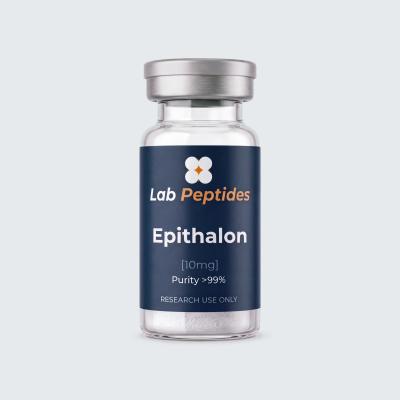
10 mg vial (Epithalon 10 mg): with 1 ml of water, 10 mg/ml, i.e. 1 unit = 100 µg and 10 units = 1 mg; with 2 ml, 5 mg/ml, i.e. 10 units = 0.5 mg and 20 units = 1 mg.
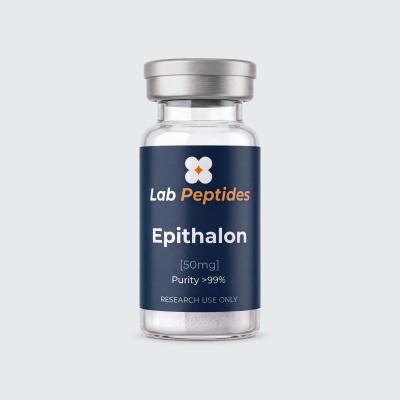
50 mg vial (Epithalon 50 mg): with 5 ml, 10 mg/ml, i.e. 10 units = 1 mg and 50 units = 5 mg; with 2.5 ml, 20 mg/ml, i.e. 25 units = 5 mg.
General rule: concentration (mg/ml) = peptide (mg) ÷ water (ml), then volume to draw (ml) = desired amount (mg) ÷ concentration. Let the vial reach room temperature, disinfect the stopper, inject the water slowly down the wall, swirl gently without shaking, and wait for a clear solution.
Stability and storage
Lyophilised, epitalon is stored at -20 °C, protected from light and moisture. Once reconstituted, it is kept at 2 to 8 °C; common practice for peptides in bacteriostatic water is to use them within about four weeks, with aseptic handling. No solution-stability study specific to epitalon has been published. With no methionine or cysteine, it is not very sensitive to oxidation; its acidic residues mainly expose it to hydrolysis and isoaspartate formation over time. General principles: how to store lyophilised peptides.
Safety and reported signals
Studies by the Khavinson team report no notable adverse effects, and the 2003 SHR study concludes that long-term administration was well tolerated in mice. But no regulatory toxicology programme (genotoxicity, carcinogenicity, interactions) has been published; Araj et al. list it as an essential prerequisite. The signal to watch comes from the Brunel study: a molecule that lengthens the telomeres of breast cancer cells, even through the ALT pathway, calls for caution. The animal studies of the same team report fewer tumours instead; these two observations have not yet been reconciled.
Regulatory status
Epitalon is not approved as a medicine by the FDA or the EMA. In Europe it falls under research use (RUO). It does not appear by name in the World Anti-Doping Agency sources we consulted; however, class S0 of the WADA list prohibits at all times pharmacological substances without approval for human therapeutic use.
Frequently asked questions about epitalon
Epitalon, Epithalon, Epithalone: is it the same molecule?
Yes. These are transcriptions of the same tetrapeptide Ala-Glu-Asp-Gly, also written AEDG. Epithalamin, on the other hand, is the pineal gland extract from which it is derived.
Does epitalon lengthen telomeres in humans?
This has not been shown. The effect is observed in cell culture (Khavinson 2003, Brunel 2025); no controlled study has measured telomeres in treated people.
Why talk about a single team?
Because the vast majority of studies, animal and human alike, are signed by Khavinson, Anisimov and their collaborators. The first independent confirmation on telomeres dates from 2025 and concerns cells.
Which doses have been studied?
From 0.1 to 1 µg per mouse subcutaneously; in humans, 5 µg per eye in ophthalmology and 0.5 mg per day sublingually for 20 days in a circadian rhythm study.
How do you reconstitute a 10 mg vial?
With 1 ml of bacteriostatic water you get 10 mg/ml: on a U-100 syringe, 10 units = 1 mg. With 2 ml, 5 mg/ml: 10 units = 0.5 mg.
Conclusion
Epitalon is one of the most cited molecules in the longevity field, and one of the least replicated. Telomerase activation in culture is now confirmed by an independent laboratory; the lifespan gains in animals and the mortality reductions in humans remain the work of a single network, on small numbers. It is an interesting research tool for studying telomeres, the pineal gland and circadian rhythms, to be read with the caution that a still barely contested literature requires.
Order your epitalon: 10 mg and 50 mg vials, stocked in France, fast shipping. Research use only.