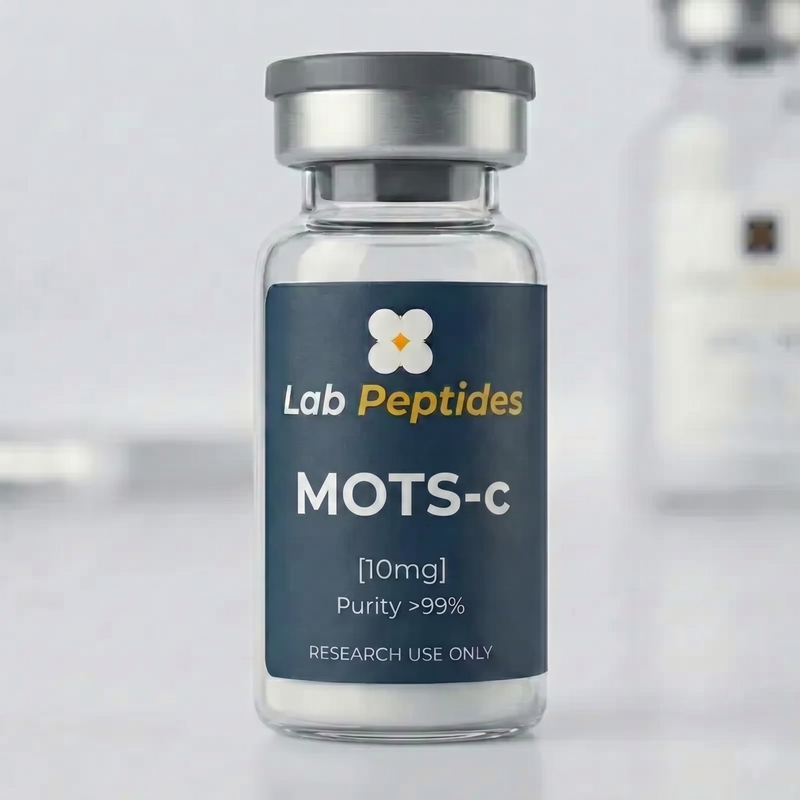
MOTS-c 10mg Anti-Aging
16 amino acid mitochondrial peptide. Recent discovery of a new signaling axis between mitochondria and nuclear metabolism.
Direct mitochondrial anti-aging. Peptide encoded by the mitochondrial genome — 2015 discovery, USC. MOTS-c reprograms your cellular metabolism, improves insulin sensitivity and boosts documented longevity in animal models. The future of cellular anti-aging.
-10 % for life on each cyclePause, skip or cancel in 1 clickNo commitment, no hidden fees
One sealed vial of MOTS-c 10mg, lyophilised, without individual labelling.
Bacteriostatic water for reconstitution and 1 ml precision syringes graduated in 100 units, sold separately. The vial alone cannot be used as is.
Don't forget the essentials

MOTS-c 10mg represents one of the most innovative peptides identified over the past decade. This acronym designates the Mitochondrial Open Reading frame of the Twelve S rRNA type c, a 16 amino acid peptide unexpectedly encoded in the mitochondrial genome rather than the nuclear genome. This discovery, published by Changhan David Lee and Pinchas Cohen in Cell Metabolism in 2015, revolutionized the understanding of communication between mitochondria and the rest of the cell.
Mitochondria possess their own genome (mtDNA, approximately 16,569 base pairs in humans) encoding 13 respiratory chain proteins, 2 ribosomal RNAs and 22 transfer RNAs. The discovery that this DNA also contained sequences coding for small secreted bioactive peptides (called mitokines) opened an entirely new field of research. MOTS-c is encoded in the MT-RNR1 gene (12S rRNA) via an alternative reading frame, joining Humanin (identified in 2001) as major mitochondrial-encoded peptide.
Atlas Lab formulates MOTS-c 10mg as high-purity lyophilizate (>98% HPLC) for research applications exclusively. Each lot is accompanied by a certificate of analysis documenting chromatographic purity, exact molecular mass, peptide content and sterility and endotoxin tests. Strict RUO — not intended for human, veterinary, diagnostic or therapeutic use. Circulating levels of endogenous MOTS-c progressively decline with age, an observation that initially positioned the molecule as a tool for studying metabolic aging and sarcopenia.
01Mechanism of action
The mechanism of action of MOTS-c rests on a distinctive retrograde mitochondrion-to-nucleus hormetic signaling. Unlike classical peptides that act via cell surface receptors, MOTS-c exerts its biological effects primarily via activation of the AMPK pathway (AMP-activated protein kinase), the cellular conductor of energy homeostasis.
AMPK activation by MOTS-c was established by Lee 2015 (Cell Metabolism) in several target tissues including skeletal muscle, liver, adipose tissue and central nervous system. This activation triggers a signaling cascade that inhibits mTOR (mechanistic Target of Rapamycin), activates autophagy and mitophagy, increases mitochondrial biogenesis via PGC-1alpha, promotes fatty acid oxidation and increases insulin-independent muscle glucose uptake via GLUT4 translocation.
The insulin-sensitizing effect of MOTS-c constitutes one of the most documented aspects. In mice obese induced by fat diet, chronic MOTS-c administration restores insulin sensitivity, reduces visceral fat mass, and improves glucose tolerance, without adverse hypoglycemic effect in standard diet animals. This action selectivity in insulin resistance context, and not in normal euglycemic state, is a remarkable pharmacological characteristic.
Exercise-mimetic action was characterized by Reynolds 2021 (Nature Communications), who demonstrated that MOTS-c administration in aged mice partially restored exercise capacity, increased muscle mitochondrial density, and modulated expression of nuclear stress genes such as NRF2 and FOXO. MOTS-c is thus described as an endogenous exercise mimetic, emerging pharmacological concept designating molecules reproducing the metabolic benefits of exercise without physical exercise.
Nuclear translocation of MOTS-c after metabolic stress represents a second distinct mechanism. Kim 2018 (Cell Reports) showed that under conditions of glucidic restriction or metabolic stress, MOTS-c migrated from cytosol to cell nucleus, where it directly modulated transcription of genes regulating stress response, autophagy and fatty acid metabolism. This stress-modulated transcription factor function represents an unprecedented mechanism for a small peptide.
The decline of circulating MOTS-c levels with human age was documented by Lee 2015 and correlated with metabolic aging parameters (HOMA-IR, abdominal circumference, HbA1c). The K14Q polymorphism in the MOTS-c sequence, studied by Fuku 2015 (Aging Cell) in Japanese centenarian cohorts, was associated with increased prevalence of exceptional longevity, suggesting a functional role of this peptide in the human aging trajectory. These observations stimulated research on MOTS-c as potential modulator of metabolic longevity.
Similar peptides
MOTS-c occupies a distinctive position in the research peptide landscape, being one of the rare peptides encoded in the mitochondrial genome (mitokines) with Humanin. Its comparison to relevant alternatives depends on the experimental context: metabolic research, insulin sensitivity, aging, longevity, or exercise mimetic.
Versus Humanin, the other main peptide mitokine (24 amino acids, discovered in 2001), MOTS-c presents primarily metabolic activity (insulin sensitivity, AMPK, fatty acid oxidation) while Humanin is recognized for its anti-apoptotic and neuroprotective properties (BAX inhibition, Alzheimer neuronal protection). The two peptides are complementary in the study of integral mitochondrial biology and are frequently studied together. The MOTS-c plus Humanin combination therefore covers two distinct aspects of mitochondrion-to-nucleus signaling.
Versus SS-31 (Elamipretide), mitochondrial peptide of synthetic origin targeting cardiolipin of the inner membrane, MOTS-c acts on retrograde signaling rather than mitochondrial structural integrity. SS-31 stabilizes respiratory chain complexes and prevents lipid peroxidation; MOTS-c activates AMPK and modulates nuclear transcription. The two molecules are mechanistically different and pharmacologically complementary. Their combination covers mitochondrial function (SS-31) and communication (MOTS-c).
Versus metformin and other non-peptide AMPK activators (berberine, resveratrol, AICAR), MOTS-c offers a mitochondrial specificity that these agents do not have. Metformin also acts at the mitochondrial level (modest inhibition of complex I) but has broad intestinal and pleotropic effects. Resveratrol activates SIRT1 and secondarily AMPK. MOTS-c would theoretically represent a more specific and more physiological AMPK activator (endogenous signaling), even if metformin retains an advantage in terms of accumulated clinical evidence (decades of diabetes data, cardiovascular prevention, longevity potential).
Versus incretins and GLP-1 analogs (semaglutide, tirzepatide, liraglutide), MOTS-c acts through a completely different mechanism. GLP-1 analogs stimulate glucose-dependent insulin secretion and slow gastric emptying via specific surface receptors; MOTS-c activates AMPK without identified canonical receptor. Experimental indications overlap (insulin resistance, type 2 diabetes) but mechanisms are distinct. A theoretical incretin plus MOTS-c combination could amplify metabolic effects but remains unstudied in clinical use.
Versus GH axis peptides (CJC-1295 DAC, Ipamorelin, Tesamorelin), MOTS-c acts on energy metabolism and insulin sensitivity rather than the somatotropic axis. CJC-1295 DAC plus Ipamorelin increase IGF-1 and favor protein anabolism; MOTS-c activates AMPK and favors lipid oxidation. The two approaches are potentially complementary in protocols combining muscular anabolism (GH axis) and metabolic recomposition (MOTS-c), even if the precise interaction between the two pathways remains complex and partially characterized.
Versus neuroprotective peptides (Semax, Selank, Cerebrolysin), MOTS-c has a global metabolic action rather than CNS-targeted, even if effects on the aging brain are documented (Reynolds 2021 observed transcriptional modulations in the aged murine cortex). Neuroprotective peptides act more directly on neurotransmitters and synaptic plasticity.
The major differentiating characteristic of MOTS-c remains its mitochondrial origin (peptide encoded in mtDNA), its systemic AMPK activation, and its positioning as endogenous exercise mimetic with correlation to exceptional human longevity (Japanese cohorts Fuku 2015). This combination of properties makes it a unique research tool for metabolic, aging and longevity studies.