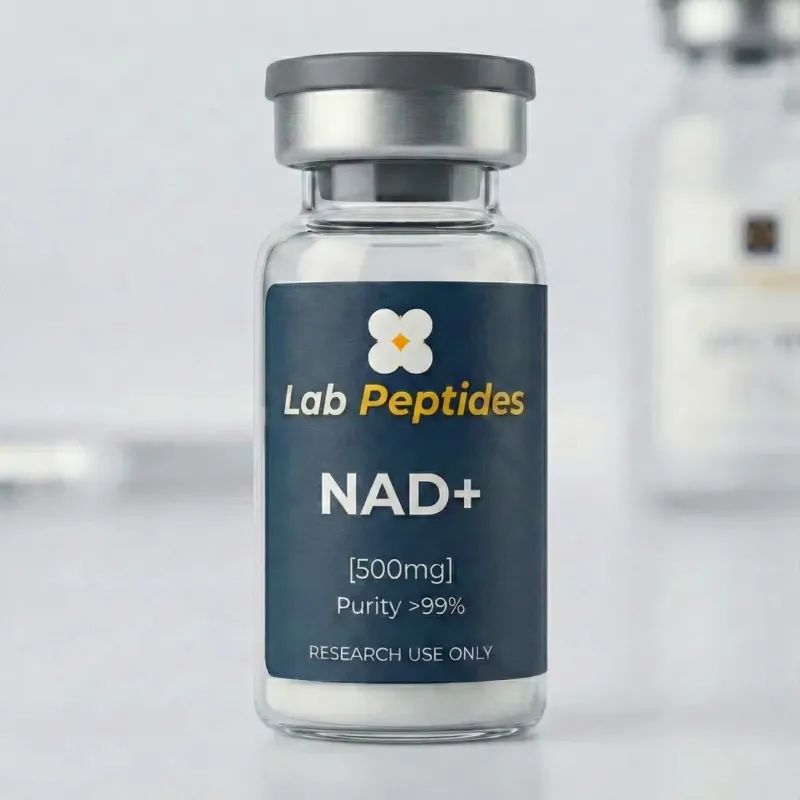
NAD+ 500mg Anti-Aging
Nicotinamide Adenine Dinucleotide. Central coenzyme of cellular metabolism, now one of the major targets of longevity research.
The cellular fuel that declines with age. NAD+ levels drop 50% between 30 and 60 — fatigue, aging, cognitive decline. Direct restoration by injection: boosted cellular energy, repaired mitochondria, protected DNA. Rejuvenation at the source.
-10 % for life on each cyclePause, skip or cancel in 1 clickNo commitment, no hidden fees
One sealed vial of NAD+ 500mg, lyophilised, without individual labelling.
Bacteriostatic water for reconstitution and 1 ml precision syringes graduated in 100 units, sold separately. The vial alone cannot be used as is.
Don't forget the essentials

NAD+ (Nicotinamide Adenine Dinucleotide, MW 663.43 Da) is not strictly a peptide: it is a dinucleotide coenzyme present in every living cell, the obligatory catalyst of more than 500 enzymatic reactions linking energy metabolism, DNA repair, calcium signalling and epigenetics. It is also one of the best-documented biological markers of ageing: intracellular NAD+ levels drop by roughly 50 % between ages 20 and 60 in human tissues, and this erosion correlates directly with loss of mitochondrial function, insulin resistance, cognitive decline and frailty in older subjects.
NAD+ research exploded after 2013, when Shin-ichiro Imai, David Sinclair and their teams crystallised the NAD+/sirtuin hypothesis: restoring the NAD+ pool reactivates SIRT1-SIRT7, NAD+-dependent enzymes that deacetylate substrates as critical as PGC-1alpha, FOXO3, p53 and histone H3K9. Three supplementation strategies now coexist: oral precursors (NR nicotinamide riboside, NMN nicotinamide mononucleotide), direct subcutaneous injection of NAD+, and long clinical IV infusions (250-1000 mg over 2-8 hours). Subcutaneous injection of pure NAD+ offers a compromise between the limited bioavailability of oral forms (major hepatic first-pass effect) and the logistical burden of IV protocols.
This vial delivers 500 mg of high-purity NAD+ (>98 %, HPLC), type I glass, fluorinated butyl stopper, inert seal. Lyophilisation protects the molecule from hydrolysis: as anhydrous solid at -20 C, stability exceeds 24 months. After reconstitution in bacteriostatic water, the solution remains usable for 14 days refrigerated at 4-8 C, provided warming-cooling cycles and light exposure are minimised. In accordance with European regulations, this product is intended exclusively for in vitro research and preclinical studies on non-human models: it is neither a medicinal product, a food supplement, nor a medical device.
01Mechanism of action
NAD+ participates in four major families of enzymatic reactions. First, as a redox coenzyme: glycolysis, the Krebs cycle and beta-oxidation convert NAD+ into NADH, whose reducing equivalents feed the mitochondrial respiratory chain (complex I) to generate ATP. The cytoplasmic and mitochondrial NAD+/NADH ratio is a real-time metabolic sensor: a high ratio signals efficient energy status, a low ratio indicates metabolic saturation or relative hypoxia.
Second, NAD+ is the obligatory substrate of sirtuins (SIRT1 to SIRT7), deacetylases and ADP-ribosyltransferases described by Shin-ichiro Imai in 2000 (Nature). SIRT1 deacetylates PGC-1alpha (mitochondrial biogenesis), FOXO3 (longevity, autophagy), p53 (senescence) and numerous histones. SIRT3 is the major mitochondrial sirtuin: it deacetylates SOD2 (antioxidant defence), the respiratory chain and several Krebs cycle enzymes. When NAD+ falls, sirtuin activity collapses in cascade, accelerating the epigenetic and metabolic drift associated with ageing.
Third, NAD+ is consumed by PARPs (Poly-ADP-Ribose Polymerases) during DNA break repair. PARP1 can consume up to 100 NAD+ molecules per second during massive genotoxic stress, literally depleting the cellular pool. The PARP/sirtuin competition for NAD+ explains why chronic inflammatory states or radiation exposure accelerate NAD+ decline.
Fourth, NAD+ is hydrolysed by CD38, an ectonucleotidase expressed on immune cells and senescent tissues. CD38 increases with age (Camacho-Pereira 2016 Cell Metabolism), to the point of becoming the main driver of NAD+ decline in older subjects. CD38 inhibitors (apigenin, 78c) are studied as complementary strategies to NAD+ precursors.
After subcutaneous injection, NAD+ does not cross the cell membrane directly: it is hydrolysed into nicotinamide riboside (NR) and AMP by extracellular CD73/CD38, then precursors re-enter the cell via ENT/SLC transporters and are reconverted into intracellular NAD+ through the salvage pathway (NAMPT, NMNAT1-3). This indirect pharmacokinetics explains why plasma NAD+ rise is modest but tissue rise can be significant depending on the model.
Similar peptides
Injectable NAD+ differs radically from oral precursors and other metabolic strategies. Versus oral NR (Nicotinamide Riboside): NR 500-1000 mg/day is very well documented (Trammell 2016, Martens 2018, Elhassan 2019) but undergoes partial hepatic conversion and intracellular bioavailability depends on ENT transporters. NR is the most studied form in human clinical trials but requires 3-6 weeks to significantly elevate tissue NAD+.
Versus oral NMN (Nicotinamide Mononucleotide): NMN 250-500 mg/day has shown clinical effects (Yoshino 2021 Science) but its absorption pathway is still debated (Slc12a8 transporter proposed by Grozio 2019, controversial). NMN is increasingly available as a dietary supplement in the USA (after the FDA removed it from NDI category in 2022).
Versus direct NAD+ injection: SC NAD+ bypasses hepatic first-pass metabolism, but NAD+ does not directly cross the cell membrane and must be hydrolysed into precursors by extracellular CD38/CD73. Plasma rise is rapid and robust but tissue uptake depends on the same salvage pathways as oral precursors. The main injection advantage is guaranteed systemic bioavailability and high plasma peaks.
Versus metformin and resveratrol: metformin activates AMPK and lowers the NAD+/NADH ratio through complex I inhibition (paradoxically beneficial), resveratrol activates SIRT1 without increasing NAD+. Neither restores the NAD+ pool: they act downstream. Strategies are complementary.
Versus caloric restriction and intermittent fasting: these interventions physiologically increase NAD+ and activate sirtuins without supplementation. NAD+ precursors are often described as partial mimetics of caloric restriction, without reproducing all its benefits (autophagy, ketones, mTOR signalling).
Versus the mitochondrial trilogy (SS-31, MOTS-c, Urolithin A): NAD+ acts at the redox coenzyme pool and sirtuin level. SS-31 protects mitochondrial membranes via cardiolipin. MOTS-c activates AMPK and metabolic signalling. Urolithin A induces mitophagy. These four strategies are not redundant: they target distinct nodes of mitochondrial biology. Experimental protocols combining NAD+ + MOTS-c + SS-31 are empirically documented but not yet validated in randomised trials.
Final limitation: no NAD+ precursor (nor direct NAD+) has demonstrated in randomised human trials prolongation of lifespan, prevention of major chronic diseases, or reversal of biological ageing markers over durations >12 months. Data are promising but preliminary.