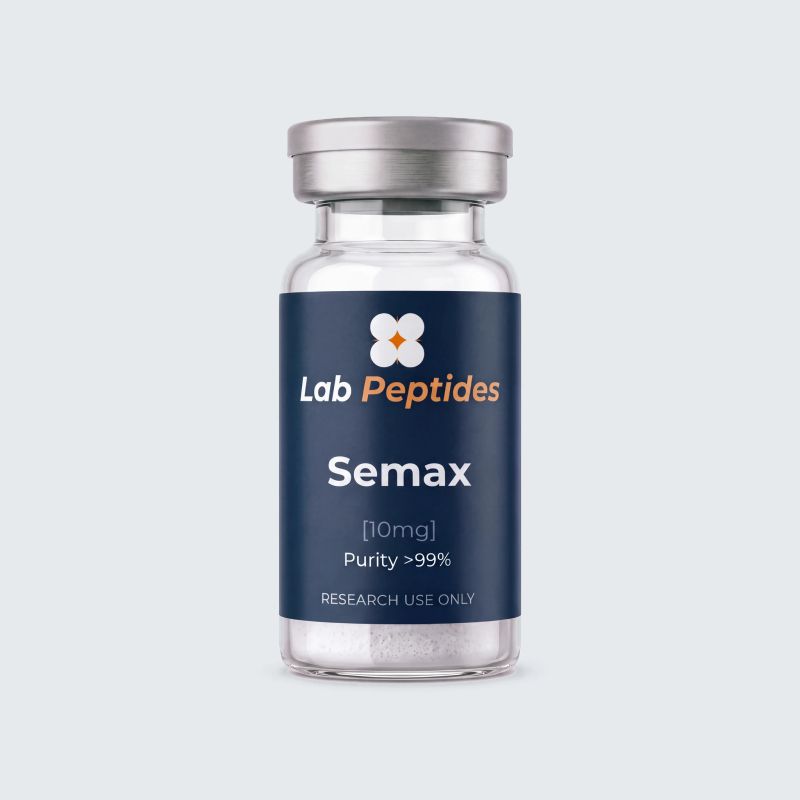
Semax 10mg Neuropeptides
ACTH 4-10, 10 mg vial. Tested at 99.0%.
- Certificate of analysis
- In stock in France
 Ordered with its water: shipped in a magnetic box
-10 % for life on each cyclePause, skip or cancel in 1 clickNo commitment, no hidden fees
No card: each delivery is paid in Bitcoin (extra -5%) or by bank transfer
Your complete kit
The vial alone cannot be used as is. Add what you need to prepare it:
Frequently bought together


Research Use Only (RUO) · Prohibited for human or veterinary use.
Key facts
Semax 10mg is a synthetic heptapeptide with the sequence Met-Glu-His-Phe-Pro-Gly-Pro (MEHFPGP), developed in Moscow by the Institute of Molecular Genetics of the Russian Academy of Sciences during the 1980s. As a structurally truncated analog of the 4-10 fragment of adrenocorticotropic hormone (ACTH 4-10), Semax was specifically engineered to retain the neurotrophic, mnestic, and neuroprotective properties of the parent peptide while completely eliminating its corticotropic hormonal activity.
In detail
Officially approved in Russia in 1994 as an intranasal spray (Semax 0.1% for prevention, Semax 1% for acute stroke), it has since been listed on the Russian government's Vital and Essential Medicines register, used routinely in hospital practice for ischemic stroke, hypoxic encephalopathy, traumatic brain injury, pediatric ADHD, and asthenodepressive syndromes.
Protocol and preparation
| Water added | Concentration | Reading marker |
|---|---|---|
| 1 ml | 10 mg/ml | 10 UI = 1 mg |
| 2 ml | 5 mg/ml | 40 UI = 2 mg |
The volume of water does not change the product, only its concentration. Add the water slowly along the vial wall, then swirl without shaking.
Asepsis
Disinfect surfaces and stoppers (70% alcohol).
Solvent
Draw the required volume of bacteriostatic water.
Introduction
Add gently against the vial wall (avoid a direct jet on the powder).
Solubilization
Roll the vial gently. Do not shake vigorously (degradation risk).
Solution storage Once reconstituted: 2-8°C (refrigerator).
Warning Theoretical tool for chemical handling. Does not constitute medical advice.
I open the dilution calculator- The amount of powder looks tiny. A lyophilisate takes up a few millimetres at the bottom of the vial, sometimes just a translucent film. The stated weight is there.
- The powder is compact, stuck to the wall or to the stopper. Transport moves the freeze-dried cake around. It changes nothing to reconstitution.
- The vial carries no individual label. That is our standard packaging, not a downgraded vial.
- After reconstitution, deposits or filaments appear. This is common, especially with small molecules. Let it settle and roll the vial between your palms, never shake it.
- The parcel is plain. Nothing on the outside indicates the contents or the brand name.
What is not normal: a cracked vial, an uncrimped cap or a stopper that moves, powder that has liquefied or changed colour. In those specific cases, write to us with a photo and we take the vial back.
The Semax 10mg vial from Atlas Lab is reconstituted with 2 ml of bacteriostatic water to reach a final concentration of 5 mg/ml, equivalent to 5,000 mcg/ml. For intranasal administration approximating Russian clinical formulations, prepare a secondary dilution in a 10 ml intranasal spray bottle with 0.9% NaCl from 2 mg of reconstituted peptide, obtaining a concentration of 0.2 mg/ml (approximate equivalent of Russian Semax 0.1%).
For combined use with its cousin Selank, favor sequential administration with Semax in the morning (pro-attentional and energizing effect) and Selank in late afternoon or evening (anxiolytic and sleep-promoting effect). Never mix the two in the same syringe or spray bottle: pharmacodynamic ratios balance differently and kinetic profiles must be respected independently.
Essential precautions includeRespecting chronobiology (no evening administration), avoiding association with classical psychostimulants like amphetamines or modafinil to limit risks of tachyarrhythmias, not using in cases of uncontrolled hypertension or known cardiac arrhythmias, and prohibiting any use in pregnant or breastfeeding women (absence of Western clinical research data).
Technical data
- Reconstitution
- 2 ml d'eau → 5 mg/ml. 5 UI = 0,25 mg ; 10 UI = 0,5 mg.
- Peptide sequence
- Met-Glu-His-Phe-Pro-Gly-Pro
- Molecular formula
- C37H51N9O10S
- Molecular weight
- 813.9 g/mol
- CAS number
- 80714-61-0
- Physical form
- Poudre lyophilisée blanche
- Recommended solubility
- Eau bactériostatique, NaCl 0.9%, acide acétique 0.1%
- Storage conditions
- Au réfrigérateur (+2 à +8 °C), à l'abri de la lumière. En poudre, possible au congélateur pour une conservation longue. Une fois préparé : réfrigérateur, jamais au congélateur.
- Use
- Research reagent, in vitro only (RUO)
Storage & handling
Le flacon lyophilisé de Semax 10mg se conserve entre 2 et 8 degrés Celsius dans son emballage d'origine, à l'abri de la lumière directe et de toute source d'humidité. Sous ces conditions optimales, un lyophilisat reste en général stable jusqu'à 24 mois. Le tripeptide C-terminal Pro-Gly-Pro confère au Semax une robustesse structurale supérieure à la plupart des neuropeptides, mais la forme lyophilisée reste sensible à l'humidité atmosphérique: refermer soigneusement le flacon après manipulation et éviter les ouvertures prolongées en environnement humide. Après reconstitution avec 2 ml d'eau bactériostatique (alcool benzylique 0,9 pour cent), la solution obtenue se conserve entre 2 et 8 degrés Celsius pendant 30 à 60 jours avec une stabilité supérieure à 95 pour cent, ce qui place le Semax parmi les peptides les plus stables en solution disponibles. Éviter la congélation du flacon reconstitué: les cycles gel-dégel peuvent entraîner une agrégation partielle et une perte de 5 à 10 pour cent de bioactivité par cycle. Pour la formulation intranasale diluée dans NaCl 0,9 pour cent sans conservateur, la durée de conservation raccourcit à 7 à 10 jours au réfrigérateur en raison du risque de contamination bactérienne. Utiliser de préférence des flacons spray stérilisés et renouveler la préparation régulièrement. Si une conservation plus longue est souhaitée, ajouter du chlorure de benzalkonium 0,01 pour cent comme conservateur, pratique standard des formulations magistrales russes. À réception, contrôler l'intégrité du pack froid et placer immédiatement le flacon au réfrigérateur. Une exposition brève à température ambiante lors du transport n'altère pas significativement la bioactivité du produit lyophilisé grâce à sa stabilité structurale inhérente, mais prolonger cette exposition au-delà de 96 heures consécutives est déconseillé. Ne jamais diluer le Semax avec de l'eau non stérile, des solutions contenant des ions métalliques divalents en forte concentration (calcium, magnésium) pouvant précipiter les formes acides, ou des solutions tamponnées à pH fortement alcalin (au-dessus de 9) ou fortement acide (en dessous de 3). Les dilutions dans NaCl 0,9 pour cent, eau pour préparation injectable et eau bactériostatique sont compatibles et recommandées. Le certificat d'analyse est publié sur cette fiche, consultable avant de commander.
Mechanism of action
The mechanism of action of Semax integrates five complementary biological pathways that explain its unique nootropic-neuroprotective-mild anxiolytic profile.
Second, Semax modulates monoaminergic neurotransmission through a sophisticated mechanism. Like its cousin Selank, it inhibits enkephalinase (EC 3.4.24.11), a brain metallopeptidase that normally degrades endogenous enkephalins. By prolonging enkephalin action, Semax indirectly increases cortical dopaminergic and serotonergic tone, with consequent improvements in vigilance, motivation, and concentration without rebound effect or withdrawal syndrome. This gentle modulation explains its non-stimulant nootropic profile, radically distinct from classical psychostimulants.
Third, anti-ischemic neuroprotective activity appears to rely on several converging sub-mechanisms: stabilization of mitochondrial membranes in neurons of the peri-infarct zone, inhibition of calcium-dependent apoptosis, reduction of free radical and pro-inflammatory cytokine production (IL-1 beta, TNF-alpha, IL-6), and modulation of the glutamate-mediated excitotoxic cascade. Gusev and Skvortsova (2000, Stroke) documented in humans a significant reduction of final CT-measured infarct volume at day 7 when Semax was administered within 6 hours of stroke onset.
Fifth, a mild anxiolytic-antidepressant axis completes the profile. Eremin and colleagues (2005) documented imipramine-type antidepressant effects in the rodent forced swim test, attributable to monoaminergic modulation.
Studies and references
The scientific literature on Semax is almost exclusively Russian and has been subject to limited English-language publication, which explains its relative obscurity in the Western neuropharmacology community despite more than thirty years of official clinical use in Russia. Foundational work traces to Ashmarin and Myasoedov at the Institute of Molecular Genetics in Moscow during the 1980s, with initial demonstrations that truncating ACTH 4-10 to the tetrapeptide MEHF, stabilized by the C-terminal PGP, completely eliminated corticotropic activity while retaining and amplifying neurotrophic effects.
Kaplan and colleagues (2002, Russian Ministry of Health) conducted an open-label pediatric study on 52 children with ADHD (ages 8-12), treated with intranasal Semax 0.1% 1 mg twice daily for 30 days. Results: significant improvement of sustained attention scores, reduction of impulsivity measured by Conners-parent scales, partial normalization of frontal EEG. This study underpinned the pediatric indication for attentional disorders in Russia.
Medvedeva and colleagues (2014, BioMed Res Int) documented in hippocampal cultures a CREB- and ERK1/2-dependent increase in BDNF protein synthesis, confirming the central transcriptional mechanism. Kolomin and colleagues (2012, Front Pharmacol) published an English-language integrative review demonstrating that Semax modifies expression of over 1,000 brain genes related to plasticity, inflammation, and energy metabolism.
Frequently asked questions
What is the difference between Semax and Selank?
Can Semax be combined with other nootropics like modafinil or racetams?
Is Semax identical to what is marketed in Russia?
What is the shelf life after reconstitution?
 The complete guideSemax: the complete guide to the cognition peptide in research (2026)Read the guide
Also read:Cognitive peptides in research: Semax, Selank, Dihexa and the new generation of peptide nootropics