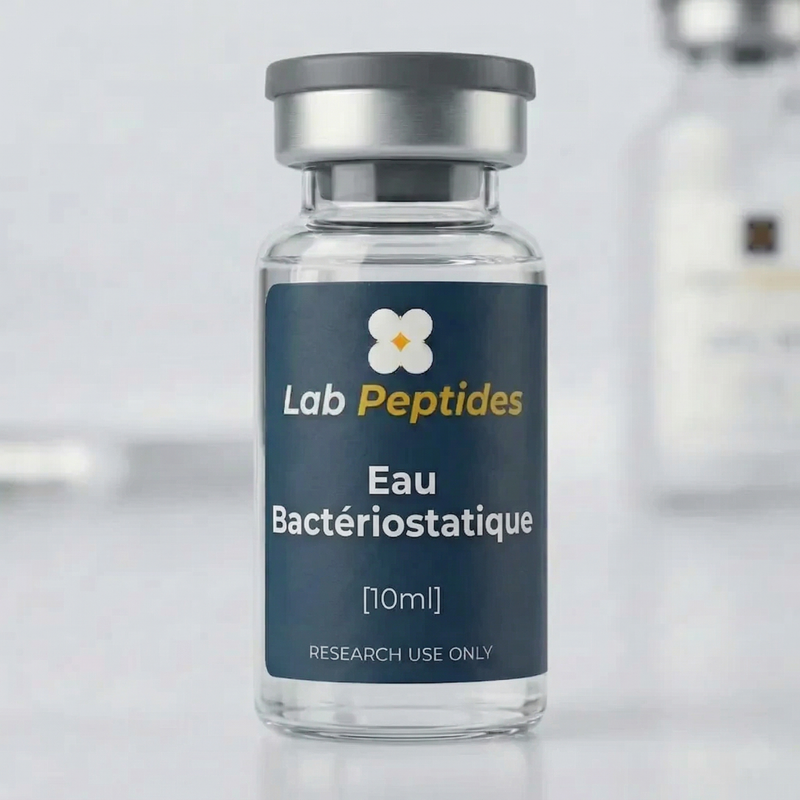
Eau Bactériostatique 3ml Accessoires
Bacteriostatic water 0.9% benzyl alcohol, 3ml format. Reference diluent for reconstituting lyophilized peptides in laboratory.
The pharma-standard reconstitution water. 0.9% benzyl alcohol for bacteriostatic stability up to 28 days. Sterile, pyrogen-free, fits every lyophilized peptide reconstitution. Essential to any serious protocol. 3ml format.
Don't forget the essentials
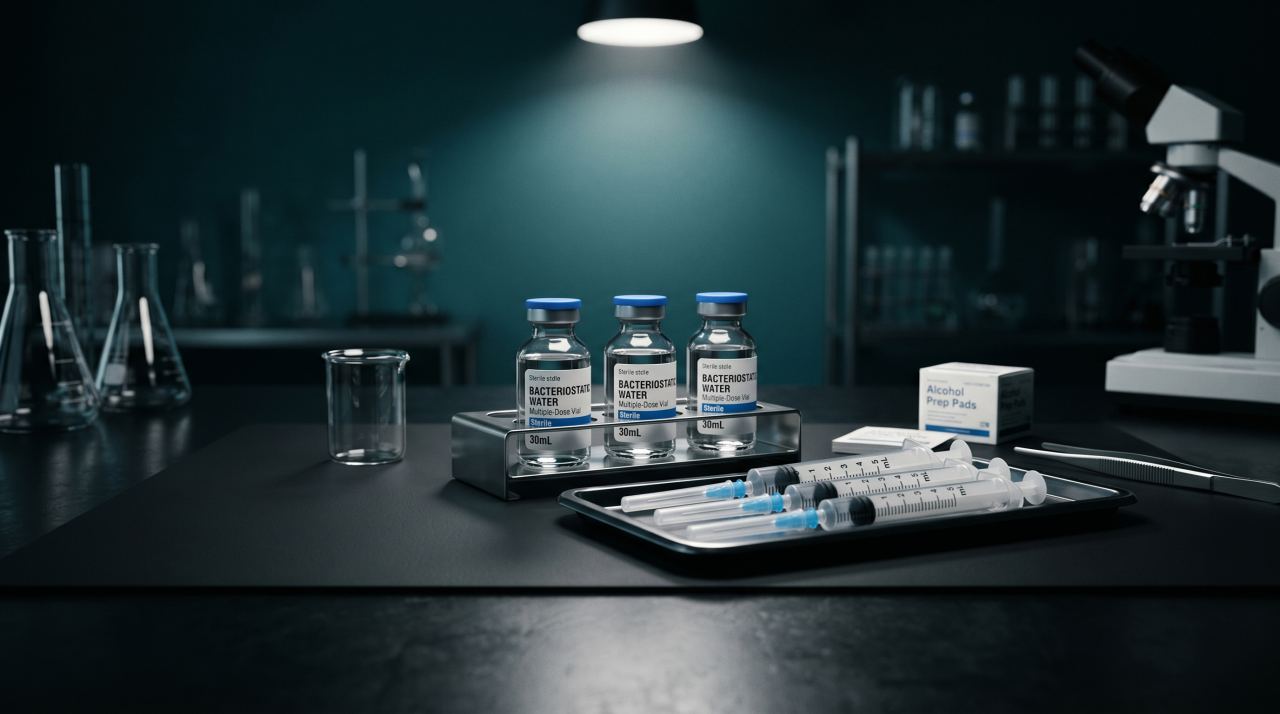
Bacteriostatic water USP 3ml is the compact and rotation-friendly format for targeted peptide research. Where the 10ml vial serves dense multi-peptide protocols spanning several weeks, the 3ml format answers a radically different logic: maximal freshness, near-zero contamination risk, perfect volume precision. A 3ml vial corresponds exactly to one or two reconstitutions of a single peptide, consumed in 7 to 14 days — well below the USP 28-day multi-dose limit. No doubt about storage, no grey zone on accumulated microbial load, no peptide loss in a questionable diluent.
The 3ml targets four precise use cases: exploratory testing of a new molecule where the user wants to validate tolerance and kinetics on a mini-cycle, short cycles of 14 to 21 days on a single peptide (think BPC-157 after a localised injury, or DSIP during an identified sleep-deprivation window), laboratory sampling for analytical characterisation of a batch or cross-reference, and travel or mobility scenarios where a 10ml multi-dose vial becomes penalising in terms of needle rotation and cold-chain compliance over several weeks.
Composition is rigorously identical to the 10ml format: water for injection USP + 0.9% benzyl alcohol (C6H5-CH2-OH, 108.14 Da) as the bacteriostatic agent. Same pharmacopoeia, same standard, same type I pharmaceutical glass quality, same chlorobutyl stopper, same flip-off aluminium cap. The only difference is the nominal volume and what it implies: faster diluent turnover, a limited number of septum punctures, almost no prolonged environmental exposure once opened. For demanding peptide research, 3ml is often the cleaner choice than 10ml — at the price of an unfavourable mL/euro ratio that must be accepted.
01Mechanism of action
The bacteriostatic mechanism of 0.9% benzyl alcohol is identical regardless of format: amphipathic disruption of bacterial membrane fluidity, inhibition of transmembrane transport, slowing of microbial metabolism. It is a bacteriostatic, not a bactericidal agent — it prevents multiplication but does not actively sterilise. Any bacterial load introduced (dirty finger on septum, reused needle, vial left open) will be held at a threshold of a few tens to hundreds of CFU/ml for 14 to 28 days depending on initial inoculum and strain.
What changes with the 3ml format is the temporal exposure profile. A 10ml vial opened on day D potentially undergoes 30 to 50 successive punctures, each introducing micro-trauma to the septum and residual aerosol when the needle is withdrawn. By day 28, even with impeccable puncturing technique, cumulative microbial load can approach the limit tolerated by the 0.9% benzyl alcohol system. A 3ml vial consumed in 2 to 6 punctures over 7-14 days never reaches that threshold: the microbiological safety margin is five to ten times greater.
The second parameter modified by the format is the chemical stability of the reconstituted peptide itself. Many sensitive peptides (pure lyophilised BPC-157, DSIP with its N-terminal tryptophan, TB-500 with oxidisable methionine) measurably lose activity beyond 14 to 21 days in solution, even at 2-8°C. When the 10ml diluent implicitly pushes toward delayed reconstitution (not to waste), research sometimes over-extends peptide storage in solution. The 3ml format mechanically aligns with the peptide's biological shelf-life: reconstitute, use over 14 days, discard residue, restart fresh. No chemical compromise imposed by the diluent's economic logic.
Third effect: volumetric precision. Peptides are generally reconstituted in 1, 2 or 3ml depending on target concentration. The 3ml vial allows full-volume pipetting into a 10mg peptide vial (3ml target → 3.3 mg/ml, clean reading on U100 syringe) with no remainder or waste. The 10ml vial, used the same way, generates a 7ml remainder that must be managed over time — bringing us back to the prolonged exposure problem. For a researcher handling a single peptide at a time, 3ml is sized for the task.
Similar peptides
BAC 3ml vs BAC 10ml: 3ml is the precision and rotation format, 10ml is the production and economy format. The mL/euro ratio always favours 10ml, but 3ml wins on three axes: microbiological margin x5-10, natural alignment with reconstituted peptide shelf-life, perfect fit for single peptide. A serious laboratory ideally owns both formats: 10ml for dense multi-peptide cycles over 8-16 weeks, 3ml for exploratory tests, sensitive peptides (DSIP, pure BPC-157), mobility and short mono-cycles.
BAC 3ml vs SWFI (Sterile Water For Injection) 3ml single-dose: single-dose SWFI is sterile but not bacteriostatic — once opened, discard immediately. 3ml BAC can be re-punctured 2 to 6 times over 14 days thanks to benzyl alcohol. For a researcher who reconstitutes exactly 3ml in a single manipulation without any residue, SWFI is theoretically equivalent — but in peptide practice, the slightest residual volume (0.2 to 0.5ml) justifies BAC.
BAC 3ml vs bacteriostatic 0.9% NaCl: same preservation principle (benzyl alcohol) but plasma-isotonic solution (154 mmol/L NaCl). Theoretically interesting for less painful SC injection. In peptide practice, volumes are so small (typical 0.1-0.3ml SC) that the osmotic difference is negligible at local tissue scale. BAC remains the reference for its chemical neutrality and USP pharmacopoeia traceability.
BAC 3ml vs manufacturer proprietary diluent: some commercial peptides ship with a specific diluent (semaglutide Ozempic with its proprietary diluent in the pen, HGH Genotropin with integrated BAC water). These proprietary diluents are optimised for the specific molecule with particular stabilisers and buffers. USP pharmacopoeia 3ml BAC is universal and compatible with 95% of research peptides, but for specific cases (insulins, certain commercial peptide hormones), the original diluent remains preferable.
BAC 3ml vs demineralised, distilled, filtered water: no comparison possible. These non-sterile waters contain thermostable bacterial endotoxins (LPS) even after boiling, and are never acceptable for peptide reconstitution intended for injection. Absolute rule: only certified USP pharmacopoeia water, 3ml or 10ml BAC format, single-dose SWFI, injectable 0.9% NaCl. Any other source = categorical rejection.
BAC 3ml vs non-bacteriostatic 0.9% saline: isotonic salt solutions in 5-10ml ampoules, non-preserved. Opening = strict single use, discard immediately. Never re-puncture. Unsuited to peptide format where 7-14 day storage is often necessary.