Semax: the complete guide to the cognition peptide in research (2026)
Watch the video breakdown
5 minutes, sources cited, in French. Open on YouTube and subscribe
Semax is a synthetic heptapeptide (Met-Glu-His-Phe-Pro-Gly-Pro) designed at the Institute of Molecular Genetics of the Russian Academy of Sciences in Moscow: the first four amino acids of ACTH 4-10, the adrenocorticotropic hormone fragment, extended with the tripeptide Pro-Gly-Pro. Used as a medicine in Russia, as nasal drops, after ischemic stroke and in some optic nerve diseases, it is now one of the most searched "cognitive" peptides in Europe. Its scientific file deserves a careful reading: a lot of rodent work, human studies that are mostly Russian and small, and no trial registered on ClinicalTrials.gov.
This guide covers the structure and stability of Semax, the intranasal route, the mechanisms studied (BDNF, melanocortin receptors, serotonin and dopamine), its medical use in Russia, the real quality of the studies, the "N-acetyl Semax amidate" variant sold online, the difference with Selank, the doses described in the literature and reconstitution. For in vitro and in vivo research use only (RUO).
Origin: fifteen years of work in Moscow
Semax was born in the early 1980s in the team of Igor Ashmarin and Nikolai Myasoedov at the Institute of Molecular Genetics. The starting point: the ACTH 4-10 fragment, known to act on attention and memory in animals. That fragment has one major flaw: blood enzymes degrade it quickly.
In 1997, Ashmarin et al. published a review of fifteen years of research (Zh Vyssh Nerv Deiat, 1997): in their words, Semax is "one of the rare analogues of regulatory peptides" to have gone through every stage from basic research to medical use. They describe, in animals and humans, stimulation of working memory and attention, better resistance to hypoxia and prolonged effects lasting 20 to 24 hours after intranasal doses of 0.015 to 0.050 mg/kg. This reference text, however, comes from the designers themselves.
Molecular identity and pharmacochemistry
Semax has the sequence Met-Glu-His-Phe-Pro-Gly-Pro (MEHFPGP), the molecular formula C37H51N9O10S, a molecular weight of 813.9 g/mol (PubChem, CID 9811102) and CAS number 80714-61-0. It is a linear seven-amino-acid peptide, with no disulfide bridge and no lipid chain.
- Met-Glu-His-Phe: residues 4 to 7 of ACTH, which carry the central nervous system activity described for the 4-10 fragment.
- Pro-Gly-Pro: the tripeptide added at the C-terminus in place of Arg-Trp-Gly. According to its designers, this proline-rich motif slows down peptidases; the same "tail" was reused for Selank.
- The N-terminal methionine can be oxidized (sulfoxide formation), the first point to watch for storage.
The stability gain has been measured. In rat blood and serum, Potaman et al. (Biochem Biophys Res Commun, 1991) showed that a bestatin-sensitive aminopeptidase first removes methionine, then glutamate, and that Semax resists the other degrading enzymes better than ACTH 4-10. After nasal administration in rats, Shevchenko et al. (Bioorg Khim, 2006) found the tripeptide Pro-Gly-Pro to be the predominant fragment in biological samples.
Intranasal route: what reaches the brain
In the Russian literature, Semax is given through the nose. The idea is to use a highly vascularized mucosa, close to the brain, to reach the central nervous system quickly. The available measurements were made in rats with tritium-labeled Semax.
- Shevchenko et al., 2006: 50 µg/kg intranasally (20 µl of solution); two minutes after dosing, the brain contains 0.093% of the administered radioactivity per gram of tissue, 80% of it as intact Semax. Enzymatic degradation is rapid.
- Shevchenko et al., 2019 (Pharmaceutical Chemistry Journal): peaks reach 1.69% of the dose in plasma and 0.13% in the brain for Semax (0.16% for Selank).
- Sheremet et al., 2004 (Vestn Oftalmol): tritiated Semax given through the nose also enters the rat's eyes, the rationale for its use in optic nerve diseases.
Two conclusions follow. The nasal route does bring the peptide into the rodent brain, very fast. But the fraction is small, and no published human study measures how much Semax reaches the brain.
Mechanisms studied
BDNF and the TrkB receptor
The most cited mechanism is an increase in BDNF (brain-derived neurotrophic factor), a protein that supports neuron survival and synaptic plasticity. Dolotov et al. (Journal of Neurochemistry, 2006) showed in rats that tritiated Semax binds specifically and reversibly to basal forebrain membranes (KD 2.4 nM, calcium-dependent binding), and that a nasal dose of 50 or 250 µg/kg raises BDNF in this region within three hours, but not in the cerebellum. The nature of these binding sites is not specified.
The same team (Dolotov et al., Brain Research, 2006) measured in the rat hippocampus, after a single 50 µg/kg dose, a maximum 1.4-fold rise in BDNF, a 1.6-fold increase in TrkB receptor phosphorylation, and 3-fold and 2-fold increases in BDNF (exon III) and TrkB messenger RNA. Shadrina et al. (J Mol Neurosci, 2010) also observed a marked increase of BDNF in the retina 90 minutes after Semax.
Melanocortin receptors
ACTH belongs to the melanocortin family, which acts on five receptors (MC1R to MC5R). Adan et al. (European Journal of Pharmacology, 1994) tested several ACTH 4-10 analogues in human HEK cells, including [Pro8,10,Gly9]ACTH-(4-10), whose sequence is that of Semax. This peptide antagonized the action of α-MSH at the MC4 and MC5 receptors, but not at MC3, and blocked α-MSH-induced excessive grooming in rats. The role of these receptors in its cognitive effects has not been established.
Serotonin and dopamine
Eremin et al. (Neurochemical Research, 2005) measured the effect of Semax (0.15 mg/kg intraperitoneally) in rodents. 5-HIAA, the main serotonin metabolite, rose by 25% in striatal tissue at 2 hours, and its extracellular level climbed up to 180% between 1 and 4 hours. On the other hand, Semax alone did not change dopamine or its metabolites. Injected 20 minutes before D-amphetamine, it strongly amplified the dopamine release and hyperactivity caused by the stimulant. "Semax and dopamine" therefore means the modulation of a stimulant in animals, not a dopaminergic effect of its own.
Immune and vascular genes in ischemia
Medvedeva et al. (BMC Genomics, 2014) analyzed the genes expressed in the rat cortex after permanent middle cerebral artery occlusion. Semax mainly altered immune system genes, which made up more than half of the modulated genes at 24 hours (immunoglobulins, chemokines), and vascular genes: 24 at 3 hours, 12 at 24 hours. The authors see this as the likely mechanism behind the neuroprotective effect described in clinical use.
Medical use in Russia
Semax is registered in Russia as 0.1% nasal drops (1 mg/ml) and 1% nasal drops (10 mg/ml), in 3 ml vials, with methylparaben as the only excipient besides purified water (manufacturer's leaflet, Peptogen, as reproduced by the RLS encyclopedia). One drop of the 0.1% solution contains 50 µg, one drop of the 1% solution contains 500 µg.
- 1% solution: one use only, acute ischemic stroke.
- 0.1% solution: cognitive disorders of vascular origin, encephalopathy, after head injury, neurosurgery or anesthesia, recovery after stroke, adaptation to extreme conditions, optic nerve atrophy and optic neuritis, and in children from age 5, minimal brain dysfunction including attention deficit disorder.
Clinical data and the real quality of the studies
Ischemic stroke
The founding study is Gusev et al. (Zh Nevrol Psikhiatr, 1997): 30 patients in the acute phase of hemispheric stroke received Semax on top of usual care, compared with 80 patients of similar severity treated conventionally. The authors report faster recovery of motor deficits; the most effective doses were 12 mg per day in moderate strokes and 18 mg per day in severe strokes, over 5 and 10 days. The abstract describes neither randomization nor placebo.
In 2018, Gusev et al. followed 110 patients in rehabilitation after stroke, with or without Semax (two 10-day courses at 6,000 µg/day, 20 days apart). Semax raised plasma BDNF, which stayed high throughout the study, and sped up improvement of the Barthel index. Here again, the abstract mentions neither randomization nor blinding.
The most useful synthesis is a Russian meta-analysis (Shmonin et al., Vestnik Vosstanovitelnoy Meditsiny, 2018). Out of 167 PubMed and 197 eLibrary articles, 8 studies (654 patients) were usable and only 3 studies, 181 patients, could be pooled. Semax 1% (12 to 18 mg/day) reduced stroke severity on the NIHSS scale at days 10-14 and 21 in moderate and severe forms, and improved mobility in every subgroup. The authors themselves conclude that the evidence is insufficient and call for a multicenter double-blind trial.
Optic nerve
Polunin et al. (Vestn Oftalmol, 2000) added Semax to the treatment of vascular, toxic or inflammatory optic nerve diseases and partial optic atrophy, as nasal drops or endonasal electrophoresis, against a control group. They describe better visual acuity, a wider visual field and better color vision. Patient numbers are not given in the abstract; recent work combines Semax with other techniques (magnetic stimulation, oxygen therapy): in 2022, Dragon et al. obtained better results in 30 patients treated with a set of four methods than in 30 controls on vitamins, which makes it impossible to isolate the share of Semax.
Healthy volunteers
In healthy humans, two imaging studies stand out. Lebedeva et al. (Bull Exp Biol Med, 2018) compared 14 volunteers given nasal Semax 1% with 10 given placebo: resting-state functional MRI showed a larger frontal part of the default mode network. Panikratova et al. (Dokl Biol Sci, 2020) studied 52 volunteers given Semax or Selank. These studies measure brain connectivity, not an improvement in memory or concentration.
What the data are worth
- Origin: almost all studies are Russian, published in Russian, often by the teams that designed the molecule.
- Method: small samples, randomization or placebo rarely described in the abstracts.
- Replication: no large Western study has reproduced these results.
- Registry: as of 10 October 2026, a search for "semax" on ClinicalTrials.gov returns no trial.
In 2021, Doyno and White (Journal of Clinical Pharmacology) classified Selank, Semax's cousin, among "poorly studied" Russian drugs. The observation applies to both molecules.
"N-acetyl Semax amidate": what is known
A variant circulates online under the names "N-acetyl Semax amidate" or "NA-Semax-NH2": the same sequence, with an acetyl group on the N-terminus and an amide at the C-terminus. It is marketed as stronger and longer-lasting.
- N-terminal acetylation targets aminopeptidases, which attack precisely the N-terminal methionine; the original team measured the resistance of acetyl-Semax to proteolysis in several biological media (Shevchenko et al., Dokl Biol Sci, 2013). In their 2019 review, the authors rated N-acetyl-Semax as the most promising stabilization option, ahead of liposomes.
- Acetylation also changes the chemistry of the peptide: Magrì et al. (J Inorg Biochem, 2016) showed that it alters the way Semax binds copper, and that Ac-Semax, unlike Semax, does not protect neuroblastoma cells from copper toxicity. The free amine group therefore matters for at least one of the peptide's properties.
- C-terminal amidation: no published study on the amidated form was found.
- In humans: no data. The Russian medicine is unmodified Semax, and every clinical study cited here concerns it.
Better stability in a test tube does not demonstrate better efficacy: unmodified Semax remains the reference molecule of the literature.
Semax and Selank: two cousins, two profiles
Selank comes from the same institute, developed with the Zakusov Institute of Pharmacology. It shares the Pro-Gly-Pro tail, but its head is different: tuftsin (Thr-Lys-Pro-Arg), a tetrapeptide derived from immunoglobulins. Its full sequence is Thr-Lys-Pro-Arg-Pro-Gly-Pro.
| Criterion | Semax | Selank |
|---|---|---|
| Sequence | Met-Glu-His-Phe-Pro-Gly-Pro | Thr-Lys-Pro-Arg-Pro-Gly-Pro |
| Parent peptide | ACTH 4-7 (adrenocorticotropic hormone) | Tuftsin (immunoglobulins) |
| Profile studied | Attention, recovery after stroke, optic nerve | Anxiety, without sedation according to its designers |
| Main mechanisms | BDNF/TrkB, MC4/MC5 antagonism, serotonin | GABA system, enkephalins |
| Key human studies | Gusev 1997 (30 vs 80), 2018 (110) | Zozulia 2008 (62), Medvedev 2014 (60) |
| Peak brain level in rats (nasal route) | 0.13% of the dose | 0.16% of the dose |
Both peptides inhibit the human serum enzymes that degrade enkephalins (Kost et al., Bioorg Khim, 2001). For Selank, Volkova et al. (Frontiers in Pharmacology, 2016) observed in rats a change in 45 of 84 genes studied, linked to neurotransmission, within one hour. In the trial by Zozulia et al. (2008), Selank matched medazepam in 62 anxious patients, without placebo. In short, Semax is studied as a stimulant of recovery and attention, Selank as an anxiolytic. To go further on the family: cognitive peptides in research, from Semax to Dihexa.
Doses described in the literature
| Source | Model | Dose and duration | Main result |
|---|---|---|---|
| Ashmarin et al., 1997 | Animals and humans | 0.015 to 0.050 mg/kg, nasal route | Effects on memory and attention, 20 to 24 h |
| Dolotov et al., 2006 (J Neurochem) | Rat | 50 and 250 µg/kg, nasal, single dose | BDNF increased at 3 h, basal forebrain |
| Dolotov et al., 2006 (Brain Res) | Rat | 50 µg/kg, single dose | BDNF x1.4, TrkB phosphorylation x1.6 |
| Eremin et al., 2005 | Rodent | 0.15 mg/kg, intraperitoneal | 5-HIAA up to 180%, dopamine unchanged |
| Gusev et al., 1997 | 30 patients, acute stroke | 12 mg/day (moderate), 18 mg/day (severe), 5 to 10 days | Faster motor recovery |
| Gusev et al., 2018 | 110 patients, post-stroke rehabilitation | 6,000 µg/day, 2 courses of 10 days | Plasma BDNF and Barthel index improved |
| Russian leaflet, 0.1% solution | Optic nerve | 600 to 900 µg/day, 7 to 10 days | Registered indication |
| Russian leaflet, 0.1% solution | Children from age 5 | 200 to 400 µg/day, 30 days | Registered indication |
| Russian leaflet, 1% solution | Acute stroke | 6,000 to 20,000 µg/day depending on severity, 10 days | Registered indication |
In the Russian leaflet, the 0.1% solution is given at 200 to 2,000 µg per dose and 500 to 5,000 µg per day, for 3 to 5 days (up to 14), with at most 2 to 3 drops per nostril per dose. These figures describe a Russian medicine within its indications, not a protocol validated elsewhere.
Reconstitution protocol (research use only)
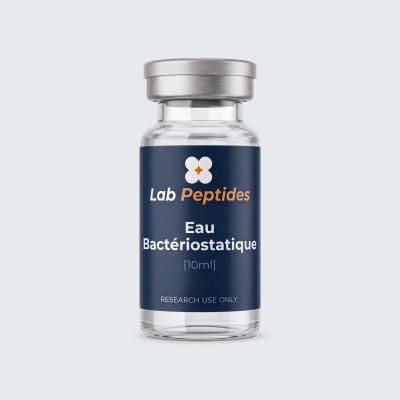
Lyophilized Semax dissolves easily in water. Standard reconstitution uses bacteriostatic water (0.9% benzyl alcohol), which limits bacterial growth between draws. The Russian pharmaceutical formulation, by contrast, uses purified water and methylparaben. On a U-100 syringe, 1 ml = 100 units, so 1 unit = 0.01 ml.
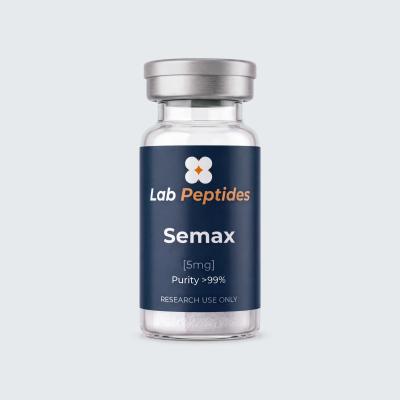
5 mg vial (Semax 5 mg): with 5 ml of water, 1 mg/ml, the concentration of the Russian 0.1% solution, so 1 unit = 10 µg, 10 units = 100 µg, 30 units = 300 µg; with 2 ml, 2.5 mg/ml, so 1 unit = 25 µg, 20 units = 500 µg.
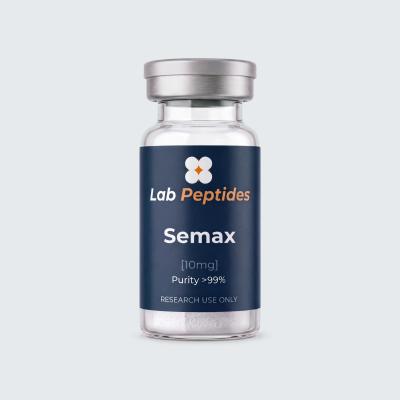
10 mg vial (Semax 10 mg): with 1 ml, 10 mg/ml, the concentration of the Russian 1% solution, so 1 unit = 100 µg, 10 units = 1 mg; with 2 ml, 5 mg/ml, so 1 unit = 50 µg, 20 units = 1 mg; with 10 ml, 1 mg/ml.
General rule: concentration (mg/ml) = peptide (mg) ÷ water (ml), then volume to draw (ml) = desired amount (mg) ÷ concentration. For reference, the Russian leaflet counts 0.05 ml per drop. Let the vial reach room temperature, disinfect the stopper, inject the water slowly against the wall, swirl gently without shaking and wait for a clear solution. Everything about the solvent: the complete guide to bacteriostatic water.
Stability and storage
Lyophilized Semax is stored at -20 °C, protected from light and moisture. The leaflet of the Russian medicine, a ready-to-use aqueous solution, specifies storage at 10 °C or below, protected from light, not frozen, with a 2-year shelf life for the closed vial. For a solution reconstituted in the lab, common practice is storage between 2 and 8 °C and use within about four weeks, with aseptic handling; no published stability study covers Semax reconstituted in bacteriostatic water. The N-terminal methionine means avoiding air, light and freeze-thaw cycles of the solution.
Safety and reported signals
The Russian leaflet reports only mild irritation of the nasal mucosa with prolonged use, and no known overdose. It contraindicates Semax in pregnancy, breastfeeding, acute psychosis, anxiety disorders and a history of seizures, and advises against nasal vasoconstrictors at the same time. Ashmarin et al. (1997) and Gusev et al. (2005, 187 patients with cerebrovascular insufficiency) describe good tolerability, including in older subjects.
Two caveats. These tolerability data come from the same small, short Russian studies: no long-term follow-up has been published. And Semax's amplification of amphetamine-induced dopamine release in rodents (Eremin et al., 2005) calls for caution with any experimental combination with a psychostimulant.
Regulatory status
Semax is a registered medicine in Russia. It is authorized neither by the European Medicines Agency nor by the US FDA, and no trial is registered on ClinicalTrials.gov. In France and the European Union, it falls under research use only (RUO), excluding any human or veterinary use.
Frequently asked questions about Semax
Is Semax effective in humans?
Human data come from Russian studies on stroke (30 patients vs 80 controls in 1997, 110 patients in 2018) and on the optic nerve, with no placebo described, never replicated in the West. In healthy people, no improvement in memory or concentration has been demonstrated.
What Semax dosage has been studied?
In rats, 50 to 250 µg/kg by the nasal route. In the Russian leaflet, 500 to 5,000 µg per day for the 0.1% solution and 6,000 to 20,000 µg per day for the 1% solution in acute stroke, over 10 days.
Semax or Selank: what is the difference?
Same Pro-Gly-Pro tail, but a head derived from ACTH for Semax and from tuftsin for Selank. The first is studied for attention and neurological recovery, the second for anxiety.
Is N-acetyl Semax amidate stronger?
Nothing demonstrates it. Acetylation improves resistance to enzymes in the test tube, but no human study exists, and no published study covers the amidated form.
How do you reconstitute a 5 mg vial?
With 5 ml of bacteriostatic water you get 1 mg/ml: on a U-100 syringe, 10 units = 100 µg. With 2 ml you get 2.5 mg/ml: 10 units = 250 µg.
Conclusion
Semax has a genuine scientific history: a rational design based on ACTH, stability improved by the Pro-Gly-Pro tail, mechanisms documented in rats (BDNF, TrkB, serotonin, immune genes) and the status of a medicine in Russia. Its human evidence remains small, Russian and unreplicated. That is exactly what makes it a fascinating research subject: many questions remain open, starting with how much reaches the human brain.
Order your Semax: 5 mg and 10 mg vials, stock in France, fast shipping. For a comparative protocol, the Semax + Selank duo returns as soon as it is restocked. Research use only.