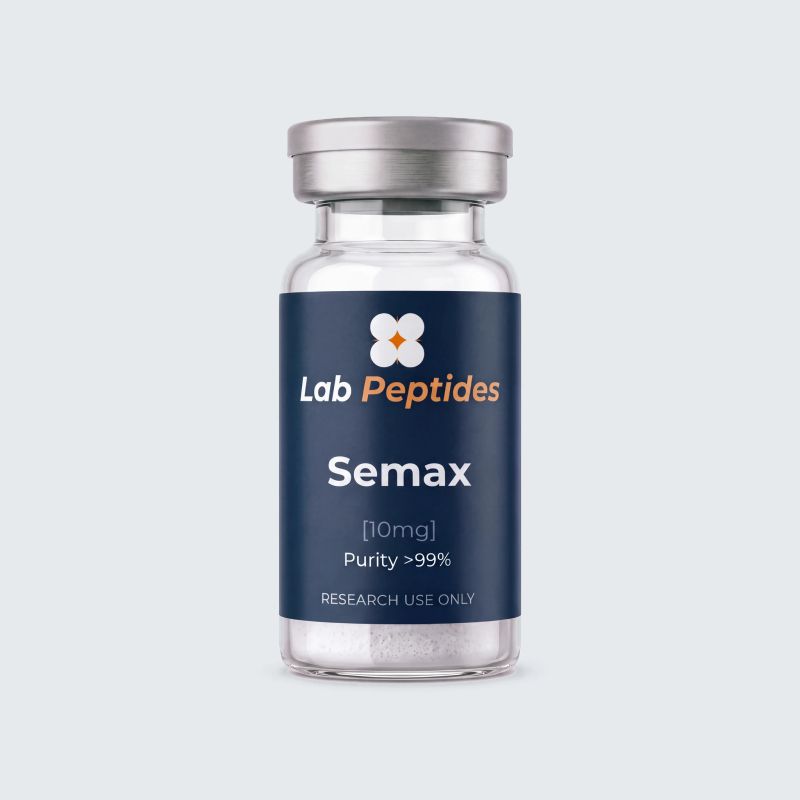
Semax 10mg Neuropéptidos
ACTH 4-10, vial de 10 mg. Analizado al 99,0 %.
- Certificado de análisis
- Stock en Francia
 Pedido con su agua: enviado en estuche imantado
-10 % de por vida en cada cicloPause, salte o cancele en 1 clicSin compromiso, sin gastos ocultos
Sin tarjeta: cada envío se paga en Bitcoin (-5 % adicional) o por transferencia
Tu kit completo
El vial por sí solo no puede usarse tal cual. Añada lo necesario para prepararlo:
Se compran juntos a menudo


Uso exclusivo en investigación (RUO) · Prohibido para uso humano o veterinario.
Lo esencial
Semax 10mg is a synthetic heptapeptide with the sequence Met-Glu-His-Phe-Pro-Gly-Pro (MEHFPGP), developed in Moscow by the Institute of Molecular Genetics of the Russian Academy of Sciences during the 1980s. As a structurally truncated analog of the 4-10 fragment of adrenocorticotropic hormone (ACTH 4-10), Semax was specifically engineered to retain the neurotrophic, mnestic, and neuroprotective properties of the parent peptide while completely eliminating its corticotropic hormonal activity.
En detalle
Officially approved in Russia in 1994 as an intranasal spray (Semax 0.1% for prevention, Semax 1% for acute stroke), it has since been listed on the Russian government's Vital and Essential Medicines register, used routinely in hospital practice for ischemic stroke, hypoxic encephalopathy, traumatic brain injury, pediatric ADHD, and asthenodepressive syndromes.
Protocolo y preparación
| Agua añadida | Concentración | Marca de lectura |
|---|---|---|
| 1 ml | 10 mg/ml | 10 UI = 1 mg |
| 2 ml | 5 mg/ml | 40 UI = 2 mg |
El volumen de agua no cambia el producto, solo su concentración. Introduzca el agua despacio por la pared del vial y gírelo sin agitar.
Asepsia
Desinfecte las superficies y los tapones (alcohol al 70%).
Disolvente
Extraiga el volumen necesario de agua bacteriostática.
Introducción
Vierta suavemente contra la pared del vial (evite el chorro directo sobre el polvo).
Solubilización
Haga rodar el vial suavemente. No lo agite con fuerza (riesgo de degradación).
Conservación de la solución Una vez reconstituido: 2-8°C (nevera).
Advertencia Herramienta teórica para manipulación química. No constituye un consejo médico.
Abro la calculadora de dilución- La cantidad de polvo parece mínima. Un liofilizado ocupa unos pocos milímetros en el fondo del vial, a veces solo una película translúcida. El peso indicado está ahí.
- El polvo está compacto, pegado a la pared o al tapón. El transporte desplaza la torta liofilizada. No cambia nada en la reconstitución.
- El vial no lleva etiqueta individual. Es nuestro embalaje estándar, no un vial de menor calidad.
- Tras la reconstitución aparecen depósitos o filamentos. Es habitual, sobre todo con moléculas pequeñas. Deje que se asiente y haga rodar el vial entre las palmas, nunca lo agite.
- El paquete es neutro. Nada en el exterior indica el contenido ni el nombre de la marca.
Lo que no es normal: un vial agrietado, una cápsula sin engastar o un tapón que se mueve, polvo que se ha licuado o cambiado de color. En esos casos concretos, escríbanos con una foto y recuperamos el vial.
The Semax 10mg vial from Atlas Lab is reconstituted with 2 ml of bacteriostatic water to reach a final concentration of 5 mg/ml, equivalent to 5,000 mcg/ml. For intranasal administration approximating Russian clinical formulations, prepare a secondary dilution in a 10 ml intranasal spray bottle with 0.9% NaCl from 2 mg of reconstituted peptide, obtaining a concentration of 0.2 mg/ml (approximate equivalent of Russian Semax 0.1%).
For combined use with its cousin Selank, favor sequential administration with Semax in the morning (pro-attentional and energizing effect) and Selank in late afternoon or evening (anxiolytic and sleep-promoting effect). Never mix the two in the same syringe or spray bottle: pharmacodynamic ratios balance differently and kinetic profiles must be respected independently.
Essential precautions includeRespecting chronobiology (no evening administration), avoiding association with classical psychostimulants like amphetamines or modafinil to limit risks of tachyarrhythmias, not using in cases of uncontrolled hypertension or known cardiac arrhythmias, and prohibiting any use in pregnant or breastfeeding women (absence of Western clinical research data).
Datos técnicos
- Reconstitución
- 2 ml d'eau → 5 mg/ml. 5 UI = 0,25 mg ; 10 UI = 0,5 mg.
- Secuencia peptídica
- Met-Glu-His-Phe-Pro-Gly-Pro
- Fórmula molecular
- C37H51N9O10S
- Peso molecular
- 813.9 g/mol
- Número CAS
- 80714-61-0
- Forma física
- Poudre lyophilisée blanche
- Solubilidad recomendada
- Eau bactériostatique, NaCl 0.9%, acide acétique 0.1%
- Condiciones de conservación
- Au réfrigérateur (+2 à +8 °C), à l'abri de la lumière. En poudre, possible au congélateur pour une conservation longue. Une fois préparé : réfrigérateur, jamais au congélateur.
- Uso
- Reactivo de investigación, solo in vitro (RUO)
Conservación y manipulación
Le flacon lyophilisé de Semax 10mg se conserve entre 2 et 8 degrés Celsius dans son emballage d'origine, à l'abri de la lumière directe et de toute source d'humidité. Sous ces conditions optimales, un lyophilisat reste en général stable jusqu'à 24 mois. Le tripeptide C-terminal Pro-Gly-Pro confère au Semax une robustesse structurale supérieure à la plupart des neuropeptides, mais la forme lyophilisée reste sensible à l'humidité atmosphérique: refermer soigneusement le flacon après manipulation et éviter les ouvertures prolongées en environnement humide. Après reconstitution avec 2 ml d'eau bactériostatique (alcool benzylique 0,9 pour cent), la solution obtenue se conserve entre 2 et 8 degrés Celsius pendant 30 à 60 jours avec une stabilité supérieure à 95 pour cent, ce qui place le Semax parmi les peptides les plus stables en solution disponibles. Éviter la congélation du flacon reconstitué: les cycles gel-dégel peuvent entraîner une agrégation partielle et une perte de 5 à 10 pour cent de bioactivité par cycle. Pour la formulation intranasale diluée dans NaCl 0,9 pour cent sans conservateur, la durée de conservation raccourcit à 7 à 10 jours au réfrigérateur en raison du risque de contamination bactérienne. Utiliser de préférence des flacons spray stérilisés et renouveler la préparation régulièrement. Si une conservation plus longue est souhaitée, ajouter du chlorure de benzalkonium 0,01 pour cent comme conservateur, pratique standard des formulations magistrales russes. À réception, contrôler l'intégrité du pack froid et placer immédiatement le flacon au réfrigérateur. Une exposition brève à température ambiante lors du transport n'altère pas significativement la bioactivité du produit lyophilisé grâce à sa stabilité structurale inhérente, mais prolonger cette exposition au-delà de 96 heures consécutives est déconseillé. Ne jamais diluer le Semax avec de l'eau non stérile, des solutions contenant des ions métalliques divalents en forte concentration (calcium, magnésium) pouvant précipiter les formes acides, ou des solutions tamponnées à pH fortement alcalin (au-dessus de 9) ou fortement acide (en dessous de 3). Les dilutions dans NaCl 0,9 pour cent, eau pour préparation injectable et eau bactériostatique sont compatibles et recommandées. Le certificat d'analyse est publié sur cette fiche, consultable avant de commander.
Mecanismo de acción
The mechanism of action of Semax integrates five complementary biological pathways that explain its unique nootropic-neuroprotective-mild anxiolytic profile.
Second, Semax modulates monoaminergic neurotransmission through a sophisticated mechanism. Like its cousin Selank, it inhibits enkephalinase (EC 3.4.24.11), a brain metallopeptidase that normally degrades endogenous enkephalins. By prolonging enkephalin action, Semax indirectly increases cortical dopaminergic and serotonergic tone, with consequent improvements in vigilance, motivation, and concentration without rebound effect or withdrawal syndrome. This gentle modulation explains its non-stimulant nootropic profile, radically distinct from classical psychostimulants.
Third, anti-ischemic neuroprotective activity appears to rely on several converging sub-mechanisms: stabilization of mitochondrial membranes in neurons of the peri-infarct zone, inhibition of calcium-dependent apoptosis, reduction of free radical and pro-inflammatory cytokine production (IL-1 beta, TNF-alpha, IL-6), and modulation of the glutamate-mediated excitotoxic cascade. Gusev and Skvortsova (2000, Stroke) documented in humans a significant reduction of final CT-measured infarct volume at day 7 when Semax was administered within 6 hours of stroke onset.
Fifth, a mild anxiolytic-antidepressant axis completes the profile. Eremin and colleagues (2005) documented imipramine-type antidepressant effects in the rodent forced swim test, attributable to monoaminergic modulation.
Estudios y referencias
The scientific literature on Semax is almost exclusively Russian and has been subject to limited English-language publication, which explains its relative obscurity in the Western neuropharmacology community despite more than thirty years of official clinical use in Russia. Foundational work traces to Ashmarin and Myasoedov at the Institute of Molecular Genetics in Moscow during the 1980s, with initial demonstrations that truncating ACTH 4-10 to the tetrapeptide MEHF, stabilized by the C-terminal PGP, completely eliminated corticotropic activity while retaining and amplifying neurotrophic effects.
Kaplan and colleagues (2002, Russian Ministry of Health) conducted an open-label pediatric study on 52 children with ADHD (ages 8-12), treated with intranasal Semax 0.1% 1 mg twice daily for 30 days. Results: significant improvement of sustained attention scores, reduction of impulsivity measured by Conners-parent scales, partial normalization of frontal EEG. This study underpinned the pediatric indication for attentional disorders in Russia.
Medvedeva and colleagues (2014, BioMed Res Int) documented in hippocampal cultures a CREB- and ERK1/2-dependent increase in BDNF protein synthesis, confirming the central transcriptional mechanism. Kolomin and colleagues (2012, Front Pharmacol) published an English-language integrative review demonstrating that Semax modifies expression of over 1,000 brain genes related to plasticity, inflammation, and energy metabolism.
Preguntas frecuentes
What is the difference between Semax and Selank?
Can Semax be combined with other nootropics like modafinil or racetams?
Is Semax identical to what is marketed in Russia?
What is the shelf life after reconstitution?
 La guía completaSemax: guía completa del péptido de la cognición en investigación (2026)Leo la guía
Lee también:Péptidos cognitivos en investigación: Semax, Selank, Dihexa y la nueva generación de nootrópicos peptídicos