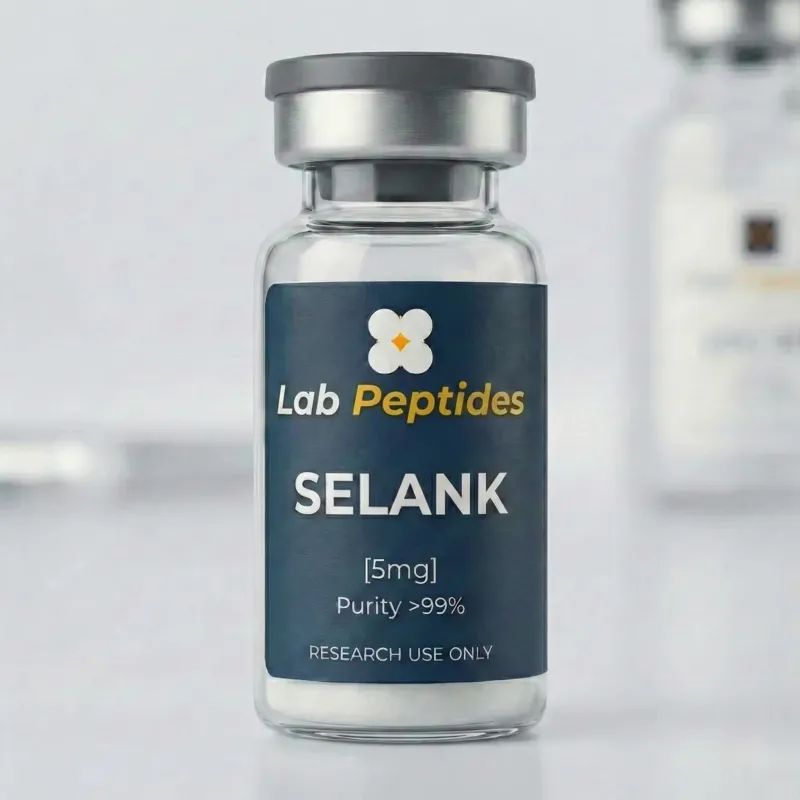
Selank 5mg Focus & Cognition
Synthetic heptapeptide derived from tuftsin. Research anxiolytic developed at the Russian Institute of Molecular Genetics.
The anti-stress that sharpens the mind. Russian heptapeptide, 40 years of R&D at the Academy of Sciences. Anxiolytic without sedation plus a cognitive boost via BDNF modulation. Laser focus, total calm, none of the benzo fog. Next-gen mental performance.
-10 % for life on each cyclePause, skip or cancel in 1 clickNo commitment, no hidden fees
One sealed vial of Selank 5mg, lyophilised, without individual labelling.
Bacteriostatic water for reconstitution and 1 ml precision syringes graduated in 100 units, sold separately. The vial alone cannot be used as is.
Don't forget the essentials

Selank (Thr-Lys-Pro-Arg-Pro-Gly-Pro, 751 Da heptapeptide) is a synthetic stabilised analogue of tuftsin, an endogenous immunomodulatory tetrapeptide produced by the spleen. Developed at the Institute of Molecular Genetics of the Russian Academy of Sciences (Moscow) by the Myasoedov and Ashmarin teams in the 1990s, Selank was approved in Russia as an anxiolytic medication in nasal spray form (commercial name Selanc) for generalised anxiety disorder and adjustment disorders. It represents one of the few anxiolytic peptides to have official regulatory authorisation in a developed country, but remains almost unknown outside the Russian sphere of influence and neuropeptide research.
The specificity of Selank lies in its unique pharmacological profile: an anxiolytic action comparable in magnitude to benzodiazepines (diazepam, medazepam) in Russian comparative trials, but without the characteristic side effects of this class (sedation, amnesia, dependence, withdrawal syndrome, crossed tolerance to alcohol). This fundamental difference is explained by non-benzodiazepine mechanisms: GABAergic system modulation via tuftsin receptors, enkephalinase inhibition, increased BDNF expression, potentiation of cortical noradrenergic and dopaminergic systems. Selank is thus often characterised in Russian literature as an "atypical anxiolytic" or "regulator of neuropsychic homeostasis".
This vial delivers 5 mg of high-purity Selank (>98 %, HPLC) in lyophilised form, type I borosilicate glass, fluorinated butyl stopper. Destined exclusively for in vitro research and preclinical studies on non-human models, in accordance with European regulations; no human, dietary or medical use. The product is not approved as a medication in the European Union.
01Mechanism of action
Selank's mechanism of action unfolds along at least five axes, documented primarily by the Russian school of neuropeptidology.
First axis, indirect GABAergic modulation. Kozlovskaya 2003 showed that Selank, although it does not bind directly to the GABA-A receptor (unlike benzodiazepines), increases GABA-A expression in rat cortex and hippocampus after intranasal administration. This is downstream transcriptional modulation, without direct activation of the chloride channel. This difference explains why Selank is anxiolytic without sedation, without amnesia and without tolerance.
Second axis, enkephalinase (aminopeptidase N) inhibition. Zolotov 1997 Bull Exp Biol Med demonstrated in vitro that Selank inhibits plasma enkephalinase, the enzyme that degrades endogenous enkephalins. The result is an elevation of circulating enkephalin levels (Met-enkephalin, Leu-enkephalin), endogenous opioid pentapeptides that modulate mood, anxiety and pain. This indirect opioid-mimetic action is probably one of the major substrates of the anxiolytic effect.
Third axis, regulation of BDNF (Brain-Derived Neurotrophic Factor) expression. Inozemtseva 2008 and Volkova 2016 Front Pharmacol showed by RT-PCR that Selank increases BDNF expression in rat hippocampus, an effect shared with SSRI antidepressants (fluoxetine) and tricyclic antidepressants. BDNF modulates neuroplasticity, adult neurogenesis and stress resilience circuits. This axis potentially explains the nootropic and pro-cognitive effects reported by users.
Fourth axis, monoaminergic modulation. Medvedev 2014 BioMed Res Int characterised by in vivo cerebral microdialysis in rats that Selank increases extracellular levels of noradrenaline and dopamine in the prefrontal cortex, without significant effect on serotonin. This monoaminergic signature resembles noradrenaline-dopamine inhibitors (bupropion) rather than SSRIs, and corresponds to the "anxiolytic without sedation" clinical profile: preserved attention, preserved wakefulness, concentration possible.
Fifth axis, immunomodulation. As heir to immunoactive tuftsin, Selank retains moderate immunostimulating activity: increase in macrophage phagocytic activity, Th1/Th2 cytokine modulation. Uchakina 2008 documented that Selank in anxious patients with chronic respiratory infections reduced the number of annual infectious episodes, pointing to a neuroimmunological bridge. This dual neuroimmune action is rare among anxiolytics.
Pharmacokinetics: extremely short plasma half-life (<5 minutes), but biological effect persists 12-24 hours thanks to metabolic conversion to tuftsin and other active fragments. By intranasal route, absorption via the olfactory mucosa allows direct CNS uptake with partial bypassing of the blood-brain barrier. By subcutaneous route, superior systemic bioavailability but lower cerebral uptake.
Similar peptides
Selank sits at the unique intersection of anxiolysis, neuromodulation and immunomodulation, a rare combination in the therapeutic arsenal.
Versus benzodiazepines (diazepam, alprazolam, lorazepam): BZDs are positive allosteric modulators of GABA-A, with rapid anxiolytic efficacy but heavy side effects (sedation, amnesia, tolerance, dependence, withdrawal syndrome, chronic cognitive deterioration, alcohol interaction). Selank acts downstream without these effects, but the immediate anxiolytic effect of a benzodiazepine in an acute panic attack cannot be equalled. Selank is rather compared to diazepam in chronic treatment of generalised anxiety, not in acute treatment.
Versus SSRIs (fluoxetine, sertraline, paroxetine): SSRIs are the Western reference for generalised anxiety disorder. Established efficacy, but with onset delay 4-6 weeks, side effects (sexual disorders, weight gain, discontinuation syndrome) and less clean tolerance profile. Selank has a faster onset (days) and a profile without sexual effects. Direct SSRI vs Selank comparative data are practically non-existent.
Versus Semax (other Russian neuropeptide, ACTH 4-10 analogue): both are Russian neuropeptides with complementary mechanisms. Semax is more nootropic/dopaminergic, Selank more anxiolytic/GABAergic. Combinations are common and the combined Semax+Selank product exists in Russian research.
Versus pregabalin and gabapentin: these alpha-2-delta ligands are effective anxiolytics without classical benzodiazepine profile, used for generalised anxiety and neuropathic pain. Acceptable tolerance profile but central side effects (drowsiness, dizziness, weight gain) and modest dependence reported. Selank is "cleaner" on these parameters, but more limited clinical corpus outside Russia.
Versus buspirone (5HT1A partial agonist): another non-benzodiazepine anxiolytic, relatively clean tolerance profile, but clinically modest efficacy. Selank has more robust Russian clinical data on generalised anxiety than buspirone in Western trials.
Versus ashwagandha, passionflower and other phytotherapeutic adaptogens: no direct formal comparison. Adaptogens have a very light profile with modest effects; Selank has more defined and measurable pharmacological activity.
Versus psychotherapies (CBT, mindfulness, EMDR): Selank does not replace the psychotherapeutic approach to anxiety disorders. It can be an adjuvant that reduces anticipatory anxiety and facilitates therapeutic engagement. Integrated approach is superior to each in isolation.
Unique positioning: anxiolytic with remarkably "clean" profile, absence of sedation and dependence, neuroimmune action, established Russian clinical corpus with regulatory approval, but little known in the West. It is one of the few peptides with official medication status in a developed country, which distinguishes its pharmacological credibility.