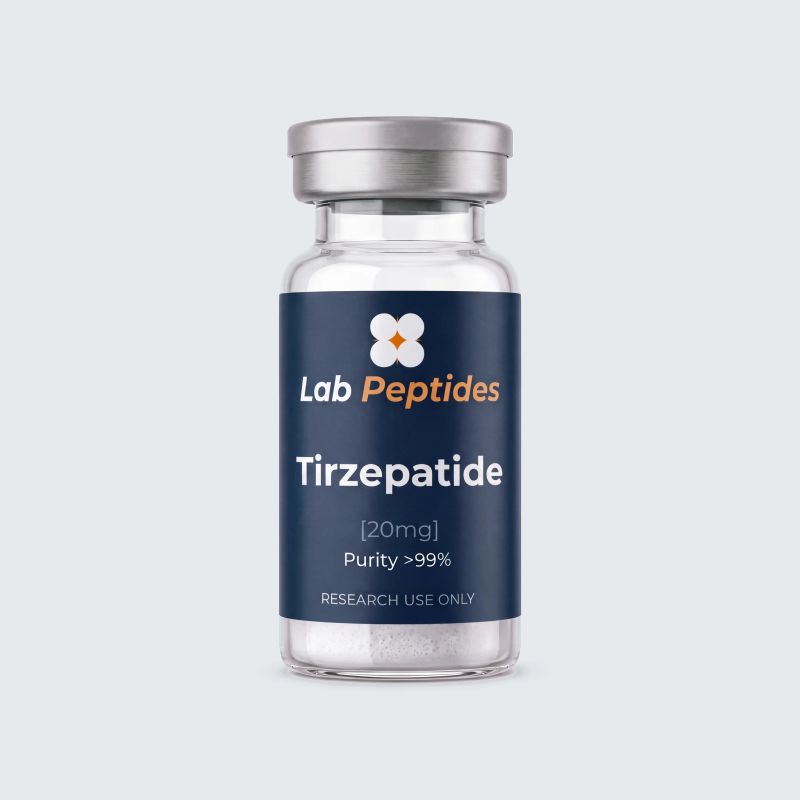
Tirzepatide 20mg Metabolism
Lyophilised · Research use only
- In stock in France
 Ordered with its water: shipped in a magnetic box
-10 % for life on each cyclePause, skip or cancel in 1 clickNo commitment, no hidden fees
No card: each delivery is paid in Bitcoin (extra -5%) or by bank transfer
Your complete kit
The vial alone cannot be used as is. Add what you need to prepare it:
Frequently bought together


Research Use Only (RUO) · Prohibited for human or veterinary use.
Key facts
Protocol and preparation
| Water added | Concentration | Reading marker |
|---|---|---|
| 2 ml | 10 mg/ml | 10 UI = 1 mg |
| 3 ml | 6,67 mg/ml | 40 UI = 2,67 mg |
The volume of water does not change the product, only its concentration. Add the water slowly along the vial wall, then swirl without shaking.
Asepsis
Disinfect surfaces and stoppers (70% alcohol).
Solvent
Draw the required volume of bacteriostatic water.
Introduction
Add gently against the vial wall (avoid a direct jet on the powder).
Solubilization
Roll the vial gently. Do not shake vigorously (degradation risk).
Solution storage Once reconstituted: 2-8°C (refrigerator).
Warning Theoretical tool for chemical handling. Does not constitute medical advice.
I open the dilution calculator- The amount of powder looks tiny. A lyophilisate takes up a few millimetres at the bottom of the vial, sometimes just a translucent film. The stated weight is there.
- The powder is compact, stuck to the wall or to the stopper. Transport moves the freeze-dried cake around. It changes nothing to reconstitution.
- The vial carries no individual label. That is our standard packaging, not a downgraded vial.
- After reconstitution, deposits or filaments appear. This is common, especially with small molecules. Let it settle and roll the vial between your palms, never shake it.
- The parcel is plain. Nothing on the outside indicates the contents or the brand name.
What is not normal: a cracked vial, an uncrimped cap or a stopper that moves, powder that has liquefied or changed colour. In those specific cases, write to us with a photo and we take the vial back.
The SURMOUNT-1 reference protocol (Jastreboff 2022, NEJM) is the usual template. Weekly titration: 2.5mg W1-4, 5mg W5-8, 7.5mg W9-12, 10mg W13-16, 12.5mg W17-20, 15mg W21+. The 20mg vial is built for the 5mg-and-above steps: to start at 2.5mg, take the 10mg vial.
Technical data
- Reconstitution
- 2 ml d'eau → 10 mg/ml. 25 UI = 2,5 mg ; 50 UI = 5 mg ; 75 UI = 7,5 mg. Attention : deux fois plus concentré que le flacon de 10 mg (5 mg/ml), ne pas reprendre ses repères.
- Peptide sequence
- YXEGTFTSDYSIXLDKIAQKAFVQWLIAGGPSSGAPPPS-NH2 (X = Aib ; lysine acylée)
- Molecular formula
- C225H348N48O68
- Molecular weight
- 4813.45 g/mol
- CAS number
- 2023788-19-2
- Physical form
- Poudre lyophilisée blanche
- Recommended solubility
- Eau bactériostatique, NaCl 0.9%, acide acétique 0.1%
- Storage conditions
- Au réfrigérateur (+2 à +8 °C), à l'abri de la lumière. En poudre, possible au congélateur pour une conservation longue. Une fois préparé : réfrigérateur, jamais au congélateur.
- Use
- Research reagent, in vitro only (RUO)
Storage & handling
La stabilité du tirzepatide lyophilisé est robuste tant que la chaîne du froid est respectée. Le produit se conserve jusqu'à 24 mois entre 2 et 8 °C, à l'abri de la lumière et dans son emballage d'origine. La congélation en dessous de -20 °C, bien que parfois pratiquée pour des stocks prolongés, n'apporte pas de bénéfice documenté sur le peptide intact et introduit un risque de cycles gel-dégel si le stockage est instable. Une température ambiante transitoire (24-48h sous 25 °C) est tolérable lors du transport ou d'une rupture brève de frigo, mais toute exposition au-delà de ce seuil doit être tracée.
Au laboratoire, quelques règles opérationnelles sont essentielles. (1) Minimiser les sorties-entrées du frigo : chaque choc thermique accélère la dégradation. Ressortir le flacon juste avant prélèvement, le remettre au froid dans les 10 minutes. (2) Ne jamais agiter vigoureusement : la chaîne C20 génère facilement des oligomères si la solution est soumise à un cisaillement (shaker, vortex). Incliner doucement ou laisser se dissoudre spontanément. (3) Protection lumière : les flacons en verre ambre du packaging d'origine sont efficaces ; si transfert en tubes transparents, envelopper d'aluminium. (4) Documenter la chaîne du froid par un enregistreur de température sur le frigo dédié peptides, avec alerte SMS en cas de dépassement.
En production de cohorte, un protocole de datation strict s'impose. Étiqueter chaque flacon reconstitué avec la date, l'heure, la concentration finale, le lot initial et les initiales du manipulateur. Planifier les prélèvements pour épuiser le flacon avant J28 en priorité, réduire au maximum le pourcentage de rejet. Pour les cycles longs (> 8 semaines), privilégier les formats volumiques adaptés (30mg ou 60mg) plutôt que d'enchaîner les reconstitutions de 10 ou 15mg, qui multiplient les manipulations et les risques de contamination. Le format économique ajusté à la durée du cycle est la meilleure stratégie anti-dégradation et anti-gaspillage.
Mechanism of action
Tirzepatide is the first marketed dual incretin-mimetic agonist. Its 39-residue sequence derives from native human GIP (Glucose-dependent Insulinotropic Polypeptide), with engineered modifications that confer simultaneous high affinity at two G-protein-coupled receptors: GLP-1R and GIPR. Coskun and colleagues (Mol Metab 2018) described the rational design: Aib substitutions at positions 2 and 20 blocking DPP-4 cleavage, and a C20 diacid fatty-acyl chain attached to Lys20 via a gamma-glutamate linker that anchors the molecule to serum albumin and extends the half-life to roughly 117 hours in humans.
Tirzepatide biology is not simply the sum of GLP-1 plus GIP activity. The GIPR-biased sequence (picomolar-range EC50 at GIPR, sub-nanomolar at GLP-1R) creates a qualitatively distinct signaling signature. Willard et al. (JCI Insight 2020) demonstrated that tirzepatide recruits beta-arrestin less strongly at GLP-1R than native GLP-1, producing a bias toward Galpha-s / cAMP signaling that may limit receptor desensitization. At GIPR, conversely, tirzepatide behaves as a full agonist. This signaling architecture partly explains the clinical metabolic superiority observed over single GLP-1 agonists.
Frequently asked questions
How long can reconstituted tirzepatide be stored, and what signs indicate degradation?
 The complete guideTirzepatide: complete guide to the GLP-1R / GIPR co-agonist in preclinical researchTechnical dossier on tirzepatide for research use: hybrid GIP-GLP-1 structure, dual GLP-1R/GIPR activation, pharmacokinetics, incretin synergy, DIO and ZDF models, QC analytics. Strictly RUO use.Read the guide