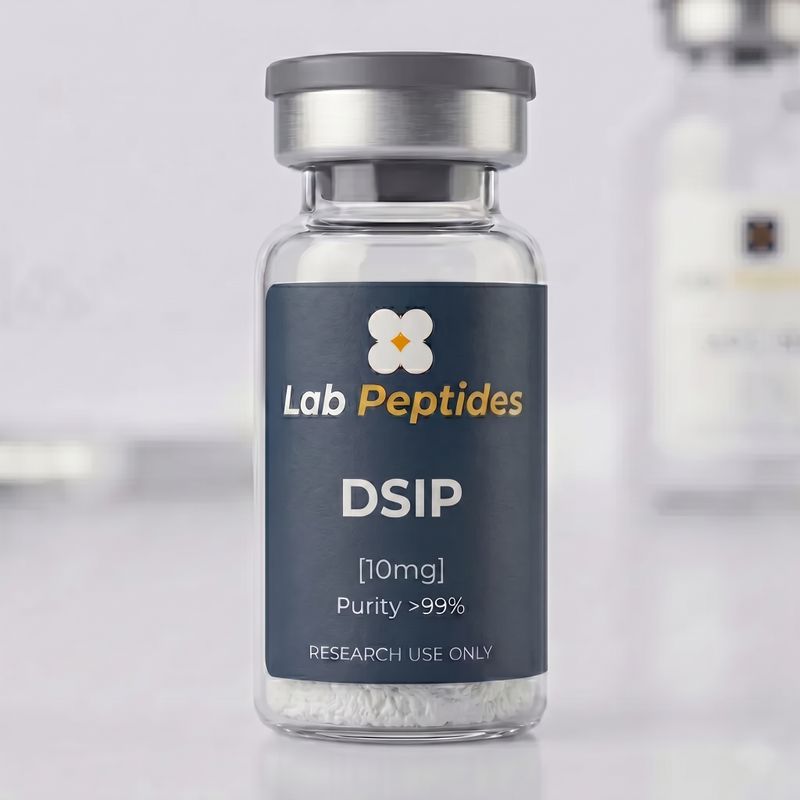
Storage conditions-20°C (lyophilisé), +4°C après reconstitution
No references yet for this peptide — search PubMed for associated scientific literature.
The listed studies are provided for documentation and research purposes only. They do not constitute a therapeutic indication nor a recommendation for human use. This product is strictly for laboratory use only (RUO).
Reconstitution for this format (10 mg)Standard volumes used in laboratory settings
Water added
Concentration
Reading marker
1 ml
10 mg/ml
10 UI = 1 mg
2 ml
5 mg/ml
40 UI = 2 mg
The volume of water does not change the product, only its concentration. Introduce the water slowly along the vial wall, never directly onto the lyophilisate, then swirl without shaking. Markers given on a 1 ml syringe graduated in 100 units.
1
Asepsis
Disinfect surfaces and stoppers (70% alcohol).
2
Solvent
Draw the required volume of bacteriostatic water.
3
Introduction
Inject gently against the vial wall (avoid direct jet on powder).
4
Solubilization
Roll the vial gently. Do not shake vigorously (degradation risk).
What is normal on arrivalThe observations that worry customers, and are not defects
The amount of powder looks tiny. A lyophilisate takes up a few millimetres at the bottom of the vial, sometimes just a translucent film. The stated weight is there.
The powder is compact, stuck to the wall or to the stopper. Transport moves the freeze-dried cake around. It changes nothing to reconstitution.
The vial carries no individual label. That is our standard packaging, not a downgraded vial.
After reconstitution, deposits or filaments appear. This is common, especially with small molecules. Let it settle and roll the vial between your palms, never shake it.
The parcel is plain. Nothing on the outside indicates the contents or the brand name.
What is not normal: a cracked vial, an uncrimped cap or a stopper that moves, powder that has liquefied or changed colour. In those specific cases, write to us with a photo and we take the vial back.
01Quelle est la pureté du DSIP ?
Le DSIP proposé par Lab Peptides France présente une pureté ≥98% vérifiée par analyse. Un certificat d'analyse (COA) est inclus avec chaque commande.
02Comment conserver le DSIP ?
Avant reconstitution, le DSIP lyophilisé est stable plusieurs semaines à température ambiante, et plusieurs mois au réfrigérateur ou au congélateur. Le transport ne le dégrade pas. Une fois reconstitué, conservez la solution entre +2°C et +8°C, à l'abri de la lumière, et ne la congelez pas.
03Comment reconstituer le DSIP 10mg ?
Pour reconstituer le DSIP, utilisez de l'eau bactériostatique ou du NaCl 0.9% stérile. Injectez délicatement le solvant le long de la paroi du flacon, puis faites rouler doucement (ne pas agiter). Consultez notre guide de reconstitution pour les calculs de dosage.
04Le certificat d'analyse (COA) est-il inclus ?
Oui, un certificat d'analyse (COA) est systématiquement inclus avec chaque produit Lab Peptides France. Le COA détaille les tests de qualité effectués et garantit la conformité du produit pour la recherche scientifique.
05Le DSIP est-il destiné à la consommation humaine ?
Non. Le DSIP est exclusivement destiné à la recherche scientifique in vitro et in vivo (Research Use Only - RUO). Il n'est pas approuvé pour un usage humain ou vétérinaire. Son achat est réservé aux laboratoires, chercheurs et institutions scientifiques.
06Quelles sont les applications de recherche du DSIP ?
Le DSIP fait partie de notre gamme Anti-âge. Il est utilisé dans la recherche scientifique pour des études in vitro et in vivo. Les applications spécifiques dépendent du protocole de recherche. Consultez la littérature scientifique (PubMed) pour les publications relatives à ce peptide.