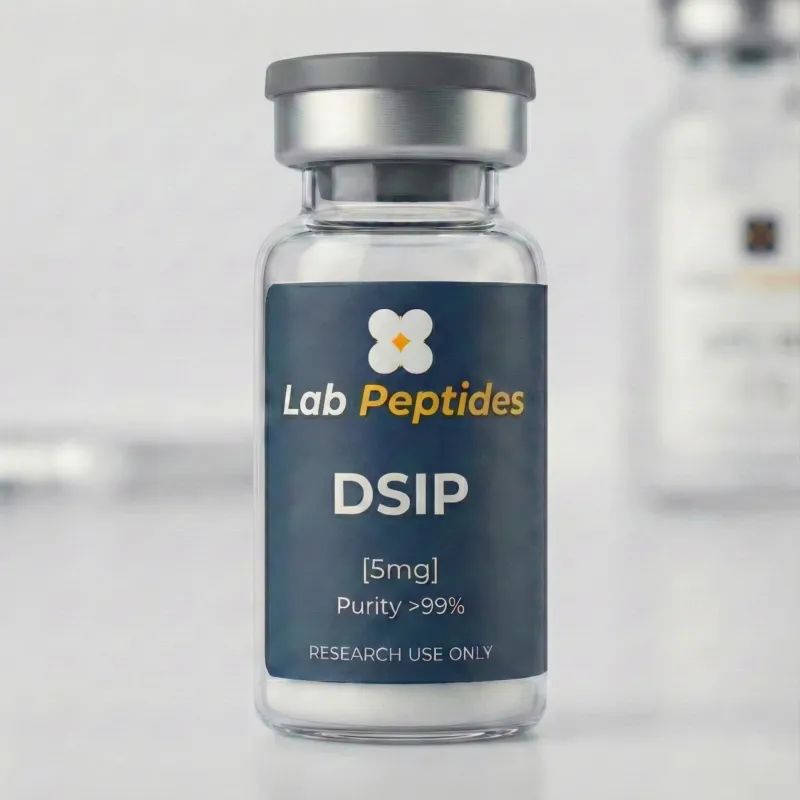
DSIP 5mg Anti-Aging
Delta Sleep-Inducing Peptide. Nonapeptide isolated from rabbit blood in delta sleep, studied on sleep architecture and circadian regulation.
The deep-sleep peptide. Delta Sleep-Inducing Peptide extends slow-wave sleep phases — the ones that truly repair. Restored sleep architecture, erased chronic fatigue. Discovered in 1977 by the University of Basel, backed by 40+ years of research. For those who can't sleep anymore.
-10 % for life on each cyclePause, skip or cancel in 1 clickNo commitment, no hidden fees
One sealed vial of DSIP 5mg, lyophilised, without individual labelling.
Bacteriostatic water for reconstitution and 1 ml precision syringes graduated in 100 units, sold separately. The vial alone cannot be used as is.
Don't forget the essentials

DSIP (Delta Sleep-Inducing Peptide) is an endogenous nonapeptide with the sequence Trp-Ala-Gly-Gly-Asp-Ala-Ser-Gly-Glu, molecular mass 848.81 Da, first isolated in 1977 by Guido Schoenenberger and Marcel Monnier at the University of Bern from the cerebral venous blood of rabbits placed in a sleep state via low-frequency thalamic stimulation. This neuroactive peptide holds a singular place in peptide literature: heavily publicized in the 1980s-1990s as the "deep sleep molecule", it is today studied through a much broader lens encompassing neuroendocrine modulation, stress adaptation, thermoregulation, and neuroprotection under deprivation conditions.
The 5 mg DSIP reference we offer targets laboratories and investigators working on short-chain neuromodulatory peptides, circadian dysregulation models, and exploratory protocols examining delta EEG activity (1-4 Hz). Unlike classical hypnotics (benzodiazepines, Z-drugs, GHB), DSIP acts neither through direct GABAergic facilitation nor through global sedation: animal data suggest a subtle "desynchronization/resynchronization" action on sleep-wake cycles, which differentiates it radically from anesthesia-adjacent hypnotics.
This document synthesizes what forty-seven years of scientific literature allow us today to assert, hypothesize, and question about DSIP: its Bernese historical origin, the never-fully-closed debate about its receptor, preclinical findings on delta sleep, pilot clinical data from the 1980s-1990s (including several Soviet and East-German trials), and the current research positioning of this peptide. Every statement is framed by the Research Use Only (RUO) regulatory framework governing our entire catalog.
01Mechanism of action
The mechanism of action of DSIP remains, to this day, one of the most intriguing in neuropeptidology. Unlike most modern peptides, no specific high-affinity receptor has been cloned and formally characterized for DSIP, despite four decades of investigation. This absence of a structurally isolated receptor long slowed DSIP's acceptance in the academic neuroscience canon, but has not prevented the reproduction of coherent biological phenotypes across dozens of preclinical models.
The Trp-Ala-Gly-Gly-Asp-Ala-Ser-Gly-Glu sequence is remarkably short and devoid of basic residues. This neutral-to-slightly-acidic chemistry confers high conformational flexibility and a documented ability to cross the blood-brain barrier despite its size, attributable to probable transit through circumventricular organs. The 848.81 Da mass, well above the theoretical passive-diffusion limit (400-500 Da), long puzzled neurophysiologists until radiolabeled-fragment studies confirmed cerebral passage (Banks-Kastin 1984).
Electrophysiologically, the seminal work of Monnier and Schoenenberger (1977, 1984) documented a significant increase in delta-band (1-4 Hz) spectral power on the cortical EEG of rabbits and rats, without a preceding phase of behavioral sedation. This delta increase distinguished DSIP from classical hypnotics: sleep architecture was reorganized rather than forcibly imposed, with preservation of REM cycles and absence of rebound insomnia upon withdrawal.
Modern mechanistic hypotheses favor multi-target indirect modulation rather than a single receptor. Three axes emerge from the post-2000 literature. First, modulation of the somatotropic axis: several works (Graf 1984, Iyer 1988) documented a transient elevation of nocturnal GH and an attenuation of the morning cortisol peak, suggesting upstream hypothalamic action. Second, interaction with the endogenous opioidergic system: DSIP modifies responsiveness to opioid agonists without being opioid itself, interpreted as allosteric or indirect action. Third, a documented antioxidant and neuroprotective effect in ischemia models, attributed to partial ROS scavenging by the N-terminal tryptophan motif.
Finally, recent Russian work (Kovalzon, Sudakov, Mikhaleva) has proposed that DSIP acts as an adaptogenic peptide in the strict sense: it normalizes dysregulated parameters (excess cortisol, delta deficit, sympathetic hyperactivity) without significantly modifying already-balanced parameters in healthy subjects. This "bidirectional" signature remains difficult to validate with modern methodology and must be considered a working hypothesis, not an established fact.
Similar peptides
Positioning DSIP relative to other tools of sleep and neuroactive stress modulation is crucial to avoid misinterpretation. DSIP is neither a hypnotic nor an anxiolytic in the classical pharmacological sense: it is a neuromodulatory peptide whose profile does not overlap any competing molecule.
DSIP vs melatonin. Melatonin (N-acetyl-5-methoxy-tryptamine) acts on MT1/MT2 receptors to resynchronize the circadian cycle, primarily upstream of the sleep process (sleep-onset timing). DSIP, by contrast, acts on sleep architecture once installed, by increasing delta power of slow waves (N3 stage). The two molecules are complementary rather than competitive: melatonin dictates WHEN to sleep, DSIP modifies HOW one sleeps.
DSIP vs benzodiazepines (BZD). BZDs (diazepam, lorazepam, alprazolam) facilitate GABAergic transmission via an allosteric site on the GABA-A receptor. They induce rapid sedation but fragment sleep architecture: reduction of REM sleep, paradoxical suppression of deep slow waves, pharmacological tolerance in 2-4 weeks, severe withdrawal syndrome. DSIP shows the inverse profile: progressive effect, increase of slow waves, no documented tolerance on short cycles, absence of withdrawal effect. BZDs are effective hypnotics but degrade sleep quality; DSIP theoretically aims at qualitative improvement without direct hypnotic effect.
DSIP vs Z-drugs (zolpidem, zopiclone). Same logic as BZDs, with stronger selectivity for certain GABA-A subtypes. Totally different mechanism from DSIP, risk of dependency and automatic awakening behaviors (induced sleepwalking) documented with Z-drugs, absent with DSIP.
DSIP vs GHB (gamma-hydroxybutyrate). GHB is a partial agonist of GABA-B receptors and of a specific GHB receptor, producing massive augmentation of delta waves and deep sleep at the cost of dose-dependent anesthesia-adjacent sedation and major misuse potential. While the superficial "delta" effect recalls that of DSIP, the mechanisms are unrelated and the safety profile is incomparable. DSIP is not a peptidic GHB.
DSIP vs Selank and Semax. Selank (anxiolytic) and Semax (cognitive nootropic) are the other two Russian neuroactive peptides in our catalog. Selank targets daytime anxiety via the indirect GABA-oxytocin axis, Semax targets attention and working memory via BDNF increase. DSIP targets a third dimension: deep sleep quality and adaptation to chronic stress. The three peptides form a complementary but non-redundant Russian neuropeptide cluster.
DSIP vs endogenous somatotropic peptides. While DSIP indirectly modulates nocturnal GH (Graf 1984, Iyer 1988), this action is a collateral effect of its central action on sleep architecture, not a direct action on somatotropes. GHRHs (Tesamorelin, CJC-1295) or GHRPs (Ipamorelin, Hexarelin) act directly on the pituitary and produce GH elevations 10-100 times larger. These two families are not interchangeable.
Realistic positioning. DSIP is not the "miracle sleep" that some non-scientific marketing sources long described. It is an exploratory research peptide, interesting for laboratories working on delta-sleep architecture, adaptation to chronic stress, or neuroprotection under deprivation conditions. Expectations must be aligned with the reality of a literature that is mostly preclinical with a few old pilot series: coherent but not spectacular phenotypes, variable individual response, need for well-constructed protocols to observe anything.