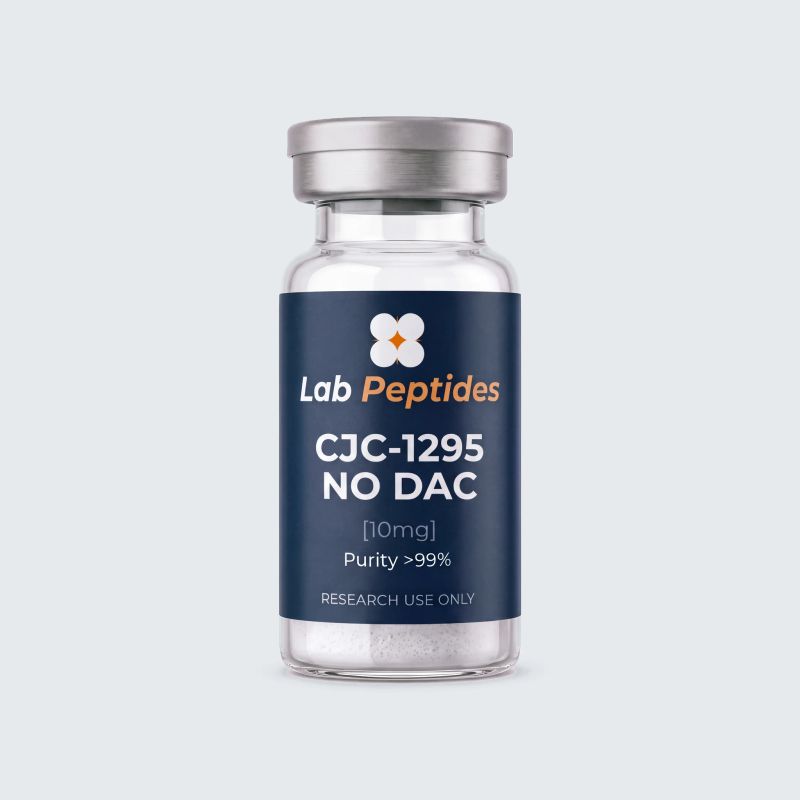
CJC-1295 NO DAC 10mg Eje GH / IGF-1
Análogo GHRH 1-29, sin DAC. Pureza 99,5 %.
El GHRH que respeta el ritmo. Análogo de la GHRH 1-29 modificado en cuatro posiciones, sin el complejo DAC: actúa durante unos treinta minutos en lugar de varios días, y deja a la hipófisis pulsar con normalidad. El compañero de referencia del Ipamorelin. Pureza HPLC ≥98 %, vial de 10 mg. Producto destinado a la investigación.
- Certificado de análisis
- Stock en Francia
 Pedido con su agua: enviado en estuche imantado
-10 % de por vida en cada cicloPause, salte o cancele en 1 clicSin compromiso, sin gastos ocultos
Sin tarjeta: cada envío se paga en Bitcoin (-5 % adicional) o por transferencia
Tu kit completo
El vial por sí solo no puede usarse tal cual. Añada lo necesario para prepararlo:
Se compran juntos a menudo


Uso exclusivo en investigación (RUO) · Prohibido para uso humano o veterinario.
Lo esencial
CJC-1295 without DAC, also known as Mod GRF (1-29), is a synthetic analogue of the first 29 amino acids of human GHRH — the fragment that carries the hormone's activity on its own.
Four substitutions set it apart from the natural sequenceD-Ala2, which protects it from DPP-4 degradation, plus Gln8, Ala15 and Leu27, which improve its stability. The result is a half-life of about thirty minutes, against a few minutes for native GHRH.
En detalle
The whole difference with CJC-1295 with DAC lies in what is missing: the Drug Affinity Complex, which binds the molecule to albumin and stretches its half-life to several days. Without it, action stays brief — and that is precisely what protocols seeking to preserve the natural pulsatility of growth hormone secretion are after, rather than flattening it.
This vial delivers 10 mg of CJC-1295 without DAC at HPLC purity of at least 98%. For research use only.
Protocolo y preparación
| Agua añadida | Concentración | Marca de lectura |
|---|---|---|
| 1 ml | 10 mg/ml | 10 UI = 1 mg |
| 3 ml | 3,33 mg/ml | 40 UI = 1,33 mg |
El volumen de agua no cambia el producto, solo su concentración. Introduzca el agua despacio por la pared del vial y gírelo sin agitar.
Asepsia
Desinfecte las superficies y los tapones (alcohol al 70%).
Disolvente
Extraiga el volumen necesario de agua bacteriostática.
Introducción
Vierta suavemente contra la pared del vial (evite el chorro directo sobre el polvo).
Solubilización
Haga rodar el vial suavemente. No lo agite con fuerza (riesgo de degradación).
Conservación de la solución Una vez reconstituido: 2-8°C (nevera).
Advertencia Herramienta teórica para manipulación química. No constituye un consejo médico.
Abro la calculadora de dilución- La cantidad de polvo parece mínima. Un liofilizado ocupa unos pocos milímetros en el fondo del vial, a veces solo una película translúcida. El peso indicado está ahí.
- El polvo está compacto, pegado a la pared o al tapón. El transporte desplaza la torta liofilizada. No cambia nada en la reconstitución.
- El vial no lleva etiqueta individual. Es nuestro embalaje estándar, no un vial de menor calidad.
- Tras la reconstitución aparecen depósitos o filamentos. Es habitual, sobre todo con moléculas pequeñas. Deje que se asiente y haga rodar el vial entre las palmas, nunca lo agite.
- El paquete es neutro. Nada en el exterior indica el contenido ni el nombre de la marca.
Lo que no es normal: un vial agrietado, una cápsula sin engastar o un tapón que se mueve, polvo que se ha licuado o cambiado de color. En esos casos concretos, escríbanos con una foto y recuperamos el vial.
The vial is then full up to the neckThis is normal, it holds 3 ml at most. The 3 ml bacteriostatic water vial is enough.
Documented pairing. CJC-1295 without DAC combined with Ipamorelin is the most described secretagogue protocol in research literature, the two molecules acting on different receptors.
Datos técnicos
- Reconstitución
- 3 ml d'eau → 3,33 mg/ml. 3 UI = 100 mcg ; 6 UI = 200 mcg ; 9 UI = 300 mcg. Le flacon contient 3 ml au plus : il est plein jusqu'au col, c'est normal.
- Secuencia peptídica
- Tyr-D-Ala-Asp-Ala-Ile-Phe-Thr-Gln-Ser-Tyr-Arg-Lys-Val-Leu-Ala-Gln-Leu-Ser-Ala-Arg-Lys-Leu-Leu-Gln-Asp-Ile-Leu-Ser-Arg-NH2
- Fórmula molecular
- C152H252N44O42
- Peso molecular
- 3367.9 g/mol
- Número CAS
- 863288-34-0
- Forma física
- Poudre lyophilisée blanche
- Solubilidad recomendada
- Eau bactériostatique, NaCl 0.9%, acide acétique 0.1%
- Condiciones de conservación
- Au réfrigérateur (+2 à +8 °C), à l'abri de la lumière. En poudre, possible au congélateur pour une conservation longue. Une fois préparé : réfrigérateur, jamais au congélateur.
- Uso
- Reactivo de investigación, solo in vitro (RUO)
Conservación y manipulación
Unreconstituted lyophilised vial: stable for several months between 2 and 8 °C, several years at -20 °C, protected from light. Ambient-temperature transport does not degrade it.
After reconstitution: refrigerated between 2 and 8 °C, protected from light. The 0.9% benzyl alcohol in bacteriostatic water allows repeated draws over several weeks. Never freeze a reconstituted solution.
At 3 ml for 10 mg, a vial is drawn from over a long periodThis is precisely the case where asepsis quality at each draw matters most. A fresh needle every time, a disinfected septum every time.
Mecanismo de acción
GHRH acts on the GHRH-R receptor of somatotroph cells in the anterior pituitary, a G-protein coupled receptor. Its activation raises intracellular cyclic AMP, activates protein kinase A and triggers both the release of stored growth hormone and the transcription of its gene.
The D-Ala2 modification is the decisive one: it blocks the cleavage site of dipeptidyl peptidase-4, the enzyme that inactivates native GHRH within minutes. The other three substitutions limit oxidation and aggregation in solution.
The point that explains the frequent pairing with a GHRP such as Ipamorelin: the two families act on distinct receptors — GHRH-R on one side, GHS-R1a on the other — and through different signalling pathways. The literature describes a response greater than the sum of each taken alone, which is the documented basis for this combination.
By keeping a short action, the DAC-free analogue also lets somatostatin, the axis's physiological brake, express itself, which preserves the pulsatile character of secretion.
Estudios y referencias
GHRH has been characterised since the 1980s and its 1-29 fragment, the shortest to retain full activity, is the basis of several analogues. Sermorelin, unmodified GHRH 1-29, was marketed as a diagnostic agent for somatotroph function, which solidly documents the overall mechanism.
Work on CJC-1295 clearly distinguishes the two versions. The version with DAC was the subject of early-phase trials showing sustained IGF-1 elevation over several days. The version without DAC, this one, is by contrast overwhelmingly documented in research literature and preclinical work, not by dedicated clinical trials.
Pairing with a GHRP is the best-described pointThe combined effect of a GHRH analogue and a secretagogue acting on GHS-R1a is reported as greater than each taken alone, which remains consistent with the duality of signalling pathways.
Preguntas frecuentes
How much water to reconstitute the 10 mg vial?
What is the difference with CJC-1295 with DAC?
Why is it so often paired with Ipamorelin?
Are Mod GRF (1-29) and CJC-1295 without DAC the same thing?
Must the solution be perfectly clear?
 La guía completaCJC-1295: guía completa DAC vs no DAC (Mod GRF 1-29) en investigaciónCJC-1295 con o sin DAC: estructura, semivida (8 días frente a 30 minutos), pulsatilidad de la GH, ensayos de Teichman e Ionescu 2006, asociación con ipamorelina, comparación con sermorelina y tesamorelina, y reconstitución.Leo la guía