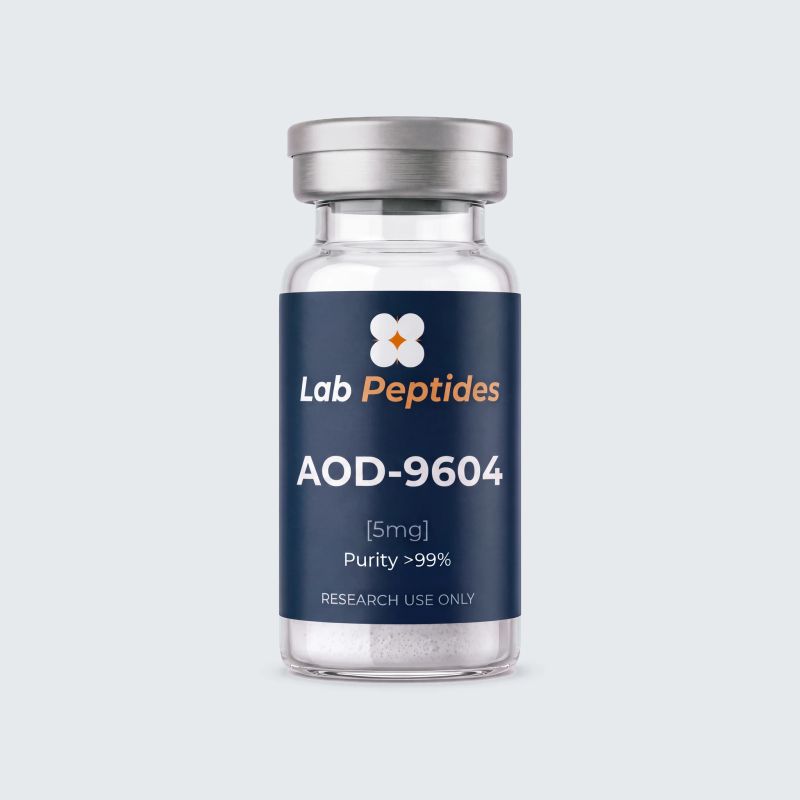
AOD-9604 5mg Metabolism
Fragment 176-191. 99.7% purity.
The lipolytic fragment of growth hormone. AOD-9604 carries sequence 176-191 of human GH, the part that drives lipolysis in laboratory studies, with no IGF-1 and no effect on blood sugar. Tolerance documented in more than 800 volunteers. The reference for lipolysis research protocols.
- Certificate of analysis
- In stock in France
 Ordered with its water: shipped in a magnetic box
-10 % for life on each cyclePause, skip or cancel in 1 clickNo commitment, no hidden fees
No card: each delivery is paid in Bitcoin (extra -5%) or by bank transfer
Your complete kit
The vial alone cannot be used as is. Add what you need to prepare it:
Frequently bought together


Research Use Only (RUO) · Prohibited for human or veterinary use.
Key facts
Protocol and preparation
| Water added | Concentration | Reading marker |
|---|---|---|
| 1 ml | 5 mg/ml | 40 UI = 2 mg |
| 2 ml | 2,5 mg/ml | 40 UI = 1 mg |
The volume of water does not change the product, only its concentration. Add the water slowly along the vial wall, then swirl without shaking.
Asepsis
Disinfect surfaces and stoppers (70% alcohol).
Solvent
Draw the required volume of bacteriostatic water.
Introduction
Add gently against the vial wall (avoid a direct jet on the powder).
Solubilization
Roll the vial gently. Do not shake vigorously (degradation risk).
Solution storage Once reconstituted: 2-8°C (refrigerator).
Warning Theoretical tool for chemical handling. Does not constitute medical advice.
I open the dilution calculator- The amount of powder looks tiny. A lyophilisate takes up a few millimetres at the bottom of the vial, sometimes just a translucent film. The stated weight is there.
- The powder is compact, stuck to the wall or to the stopper. Transport moves the freeze-dried cake around. It changes nothing to reconstitution.
- The vial carries no individual label. That is our standard packaging, not a downgraded vial.
- After reconstitution, deposits or filaments appear. This is common, especially with small molecules. Let it settle and roll the vial between your palms, never shake it.
- The parcel is plain. Nothing on the outside indicates the contents or the brand name.
What is not normal: a cracked vial, an uncrimped cap or a stopper that moves, powder that has liquefied or changed colour. In those specific cases, write to us with a photo and we take the vial back.
Reconstituting the 5mg vial
The lyophilized vial contains 5 mg of pure AOD-9604. Standard reconstitution:
Cycle duration and washouts
- Standard cycle: 8 to 12 weeks of daily administration, modeled on the 12-week Metabolic Pharmaceuticals phase II protocols.
- Washout: 4 to 6 weeks between cycles, to prevent any potential beta-3 adrenergic receptor downregulation (theoretical hypothesis, not clinically documented).
- Maximum recommended duration: tolerance data exist up to 12 weeks (phase II). No robust data beyond 6 continuous months.
Technical data
- Reconstitution
- 2 ml d'eau → 2,5 mg/ml. 12 UI = 0,3 mg ; 20 UI = 0,5 mg.
- Peptide sequence
- YLRIVQCRSVEGSCGF
- Molecular formula
- C78H123N23O23S2
- Molecular weight
- 1815.1 g/mol
- CAS number
- 221231-10-3
- Physical form
- Poudre lyophilisée blanche
- Recommended solubility
- Eau bactériostatique, NaCl 0.9%, acide acétique 0.1%
- Storage conditions
- Au réfrigérateur (+2 à +8 °C), à l'abri de la lumière. En poudre, possible au congélateur pour une conservation longue. Une fois préparé : réfrigérateur, jamais au congélateur.
- Use
- Research reagent, in vitro only (RUO)
Mechanism of action
Functional uncoupling of growth hormone
Full human growth hormone (hGH, 191 aa, 22 kDa) exerts a diversified spectrum of biological activities including:
- Anabolic effects mediated by hepatic IGF-1 synthesis (skeletal growth, muscle protein synthesis);
- Anti-insulin and hyperglycemic effects on adipose tissue and liver (plasma glucose elevation, decreased insulin sensitivity);
- Direct lipolytic effects on adipocytes (hormone-sensitive lipase activation, free fatty acid mobilization);
- Water retention effects (documented peripheral edema);
- Mitogenic effects on various cell lines.
Documented lipolytic mechanisms
Three mechanistic pathways are established in rodents and on isolated adipocytes:
Selectivity vs full GH: absence of anabolic and metabolic effects
The critical and scientifically remarkable point of AOD-9604 is the absence of undesirable collateral effects of full GH:
This pure lipolytic selectivity explains why AOD-9604 obtained self-affirmed GRAS status in the US for dietary use in 2014 — a status inaccessible to recombinant GH.
Studies and references
Foundational preclinical work — Melbourne and Howard Florey Institute
The AOD-9604 scientific corpus begins in the 1970s with Michael Wallis and Ronald Heap (Biochem J 1968) on proteolytic fractionation of hGH and the demonstration that peptide fragments retain differential biological activities. Frank Ng's team at the Howard Florey Institute (Melbourne, Australia) systematically refined this hypothesis:
Human clinical trials — Metabolic Pharmaceuticals program
Metabolic Pharmaceuticals, an ASX-listed Australian biotech startup, conducted clinical development of AOD-9604 between 2001 and 2008. Key stages:
Subsequent work — Osteoarthritis indication
- Kwak et al. (Tissue Eng Regen Med 2015, 12:6) — AOD-9604 stimulates glycosaminoglycan synthesis by human chondrocytes in culture. Reduction of IL-1beta-induced MMP-13 expression.
- Kim et al. (2020 Korean publications) — Murine models of knee osteoarthritis induced by MIA (mono-iodoacetate). Histological reduction of cartilage lesions with local AOD-9604.
- FDA GRAS status (2014) — Self-affirmed GRAS status granted for dietary use in the US, based on phase II tolerance data. AOD-9604 may appear as a dietary supplement ingredient in some US jurisdictions.
Frequently asked questions
Does AOD-9604 raise IGF-1 like recombinant GH or Tesamorelin?
Can AOD-9604 be combined with a GH secretagogue (CJC-1295 + Ipamorelin)?
Is the chondroprotective effect on osteoarthritis real?
 The complete guideAOD-9604: complete guide to the hGH 177-191 fragment in researchRead the guide