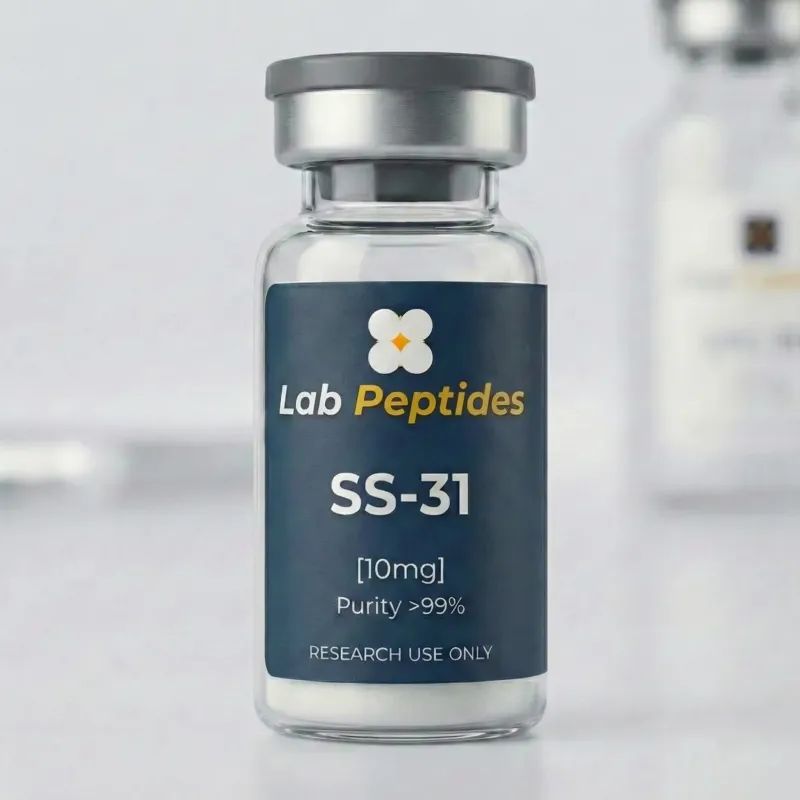
SS-31 10mg Anti-Aging
Mitochondria-targeted tetrapeptide. The reference molecule in literature on cardiolipin stabilization and mitochondrial respiratory function.
The body's mitochondrial shield. Peptide that penetrates the mitochondrial membrane directly and stabilizes cardiolipin — ROS protection, boosted energy output. The gold standard of cellular anti-aging from Stealth BioTherapeutics.
-10 % for life on each cyclePause, skip or cancel in 1 clickNo commitment, no hidden fees
One sealed vial of SS-31 10mg, lyophilised, without individual labelling.
Bacteriostatic water for reconstitution and 1 ml precision syringes graduated in 100 units, sold separately. The vial alone cannot be used as is.
Don't forget the essentials

SS-31 10mg, also known as Elamipretide, MTP-131 or Bendavia, is a mitochondrial tetrapeptide developed in the late 1990s by Hazel Szeto and Peter Schiller at Weill Medical College (Cornell University) as part of the Szeto-Schiller program (hence the SS prefix). The sequence D-Arg-2',6'-dimethylTyr-Lys-Phe-NH2 of 639 Da represents one of the most original pharmacological approaches in mitochondrial research: selectively targeting the inner mitochondrial membrane via affinity for cardiolipin.
Cardiolipin is a phospholipid quasi-exclusively localized in the inner mitochondrial membrane, where it occupies approximately 20% of membrane lipids. It plays a critical structural role in the assembly of respiratory chain complexes (I, III, IV, V) and in the stabilization of cytochrome c oxidase. The accumulation of SS-31 in this membrane via cardiolipin binding allows a local concentration 1000 to 5000 times superior to plasma concentrations, conferring to the molecule an unprecedented tissue pharmacokinetic profile among peptides.
Atlas Lab formulates SS-31 10mg as high-purity lyophilizate (>99% HPLC) for research applications exclusively. Each lot is accompanied by a certificate of analysis documenting chromatographic purity, exact molecular mass, peptide content and sterility and endotoxin tests. Strict RUO — not intended for human, veterinary, diagnostic or therapeutic use. SS-31 has been the subject of more than 300 publications and several phase 2 and 3 clinical trials piloted by Stealth BioTherapeutics, without initial FDA approval for the main indications tested (heart failure, MELAS, Barth syndrome), but the accumulated scientific corpus makes it a reference experimental tool for mitochondrial studies.
01Mechanism of action
The mechanism of action of SS-31 rests on three distinct structural properties that confer to it a unique mitochondrial pharmacodynamic. The net positive charge at physiological pH (D-Arg and Lys residues), combined with membrane permeability conferred by alternation of charged and aromatic residues, allows passive crossing of lipid membranes without requiring an active transporter. This characteristic distinguishes SS-31 from classic CPP (Cell Penetrating Peptide) core peptides by making it specifically tropic for the inner mitochondrial membrane.
Affinity for cardiolipin was demonstrated by Zhao and collaborators in 2004 in the Journal of Biological Chemistry via fluorescence spectroscopy and FRET, establishing a submicromolar dissociation constant. This selective binding concentrates SS-31 in the mitochondrial matrix space according to an electrochemical gradient maintained by the mitochondrial membrane potential (delta Psi m, typically -180 mV). Healthy mitochondria with normal potential accumulate more SS-31, creating a form of self-regulation: depolarized (dysfunctional) organelles capture less molecule.
Stabilization of cardiolipin and associated complexes constitutes the main documented biological effect. Birk 2013 studies (Journal of the American Society of Nephrology) showed that SS-31 preserved cytochrome c oxidase activity (complex IV) in renal ischemia-reperfusion models. Szeto 2014 (British Journal of Pharmacology) synthesized observations on reduction of mitochondrial ROS production (reactive oxygen species) without however acting as a classical antioxidant: SS-31 does not neutralize free radicals directly but prevents their excessive generation by electron transport optimization.
Anti-lipid peroxidation action was specifically characterized by Birk 2014 (Kidney International), with reduction of 4-hydroxynonenal and malondialdehyde formation in mitochondria exposed to oxidative stress. Preservation of mitochondrial cristae crystal structure, essential for electron transport efficiency, was visualized by electron microscopy in several preclinical models (cardiac ischemia, neurodegeneration, nephropathy).
A secondary mechanism would involve modulation of the opening of the mitochondrial permeability transition pore (mPTP), structure involved in cell death by necrosis/apoptosis under severe stress conditions. Prevention of mPTP opening by SS-31 was documented in cardiac ischemia-reperfusion models by Kloner 2012 (JACC). This mechanism could explain cardioprotective effects observed in certain clinical studies, even though results of phase 3 EMBRACE-STEMI (post-infarction) trials did not reach primary endpoints.
Unlike GH secretagogues or growth peptides (BPC-157, PEG-MGF), SS-31 does not act via a cell surface receptor. Its purely intramitochondrial action thus distinguishes itself fundamentally from other research peptides, which influences experimental usage models (metabolic studies, mitochondriopathies, oxidative stress, cellular aging).
Similar peptides
SS-31 occupies a unique position in the research peptide landscape, being one of the rare peptide molecules specifically targeting the inner mitochondrial membrane via affinity for cardiolipin. Its comparison to relevant alternatives depends on the experimental context sought: fundamental mitochondrial research, oxidative stress models, cellular aging, or ischemia-reperfusion.
Versus classical antioxidants (vitamin E, coenzyme Q10/ubiquinone, resveratrol, N-acetyl-cysteine, alpha-lipoic acid), SS-31 presents a radically different mechanism of action. Classical antioxidants neutralize free radicals by electron transfer after their generation; SS-31 prevents excessive free radical generation by optimizing electron transport efficiency of the mitochondrial respiratory chain. This upstream/downstream difference in the oxidative cascade can lead to complementary effects: SS-31 in prevention, classical antioxidants in residual neutralization. Several studies combining SS-31 with CoQ10 have documented synergistic effects in cellular aging models.
Versus other mitochondrial peptides (MOTS-c, Humanin, Gly-His-Lys coupled to copper), SS-31 specifically targets the inner membrane via cardiolipin, while MOTS-c and Humanin act as mitokine peptides encoded in the mitochondrial genome and secreted to modulate systemic signaling (insulin sensitizer for MOTS-c, anti-apoptotic for Humanin). These peptides are complementary in their overall action on mitochondrial biology but do not substitute for each other. An SS-31 plus MOTS-c combination is theoretically relevant for studies covering both intramitochondrial function and mitochondrial-to-nuclear signaling.
Versus regenerative peptides (BPC-157, TB-500, PEG-MGF), SS-31 acts neither on injured tissues by direct cytoprotective action (BPC-157), nor on cell cytoarchitecture (TB-500), nor on muscle satellite cells (PEG-MGF). The purely intramitochondrial action of SS-31 makes it a complementary rather than competitive tool. In complex post-traumatic recovery models (cardiac ischemia-reperfusion for example), an SS-31 plus BPC-157 plus TB-500 combination has been theorized to cover mitochondria, cytoprotection, and vascular regeneration, even if this combination remains experimental without clinical validation.
Versus non-peptide mitochondrial pharmacological agents (metformin, berberine, pioglitazone, rapamycin), SS-31 offers unique cardiolipin specificity and absence of systemic effects outside mitochondria. Metformin modulates complex I of the respiratory chain but also has AMPK and intestinal effects; rapamycin inhibits mTOR with broad immunological effects. SS-31 distinguishes itself by its strict intramitochondrial selectivity. However, metformin and rapamycin have documented clinical longevity evidence, while SS-31 remains for now a research tool.
Versus mitochondrial gene therapies (mitochondrial replacement therapy, mitochondrial DNA supplementation), SS-31 is not an alternative but a palliative pharmacological tool that acts on biochemical function rather than on the genetic cause. For severe genetic mitochondriopathies (MELAS, Leigh syndrome, Barth syndrome), SS-31 has been tested as symptomatic treatment of mitochondrial dysfunction downstream of the genetic mutation.
The major differentiating characteristic of SS-31 remains its cardiolipin-dependent mechanism, not shared by any other molecule currently available in peptide research. This specificity makes it an irreplaceable tool for studies on mitochondrial membrane integrity, respiratory chain complex assembly, and prevention of lipid peroxidation at cristae level.