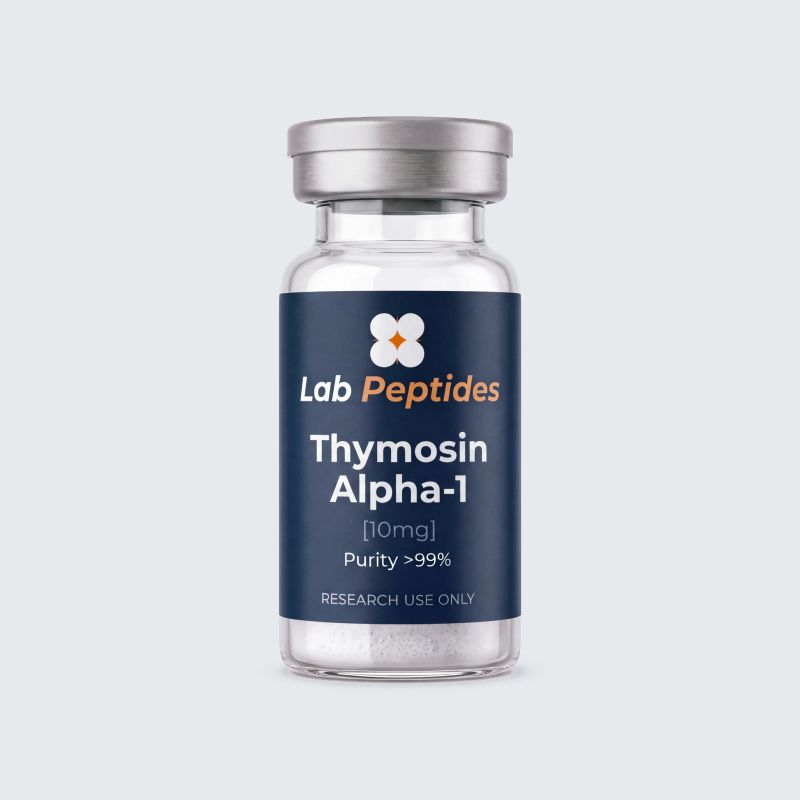
Thymosin Alpha-1 10mg Immunology
28 amino acids, N-terminally acetylated.
- In stock in France
 Ordered with its water: shipped in a magnetic box
-10 % for life on each cyclePause, skip or cancel in 1 clickNo commitment, no hidden fees
No card: each delivery is paid in Bitcoin (extra -5%) or by bank transfer
Your complete kit
The vial alone cannot be used as is. Add what you need to prepare it:
Frequently bought together


Research Use Only (RUO) · Prohibited for human or veterinary use.
Key facts
Thymosin Alpha-1 10mg (Talpha1, thymalfasin) is an N-acetylated 28 amino acid polypeptide, the bioactive fragment of thymosin fraction 5 secreted by the thymus. Identified in the 1970s by Allan Goldstein's team, it is today the most studied thymic peptide in the immunology literature, to the point of having yielded a drug marketed as Zadaxin in over thirty countries as a reference immunomodulator.
Unlike growth or tissue-repair peptides, Thymosin Alpha-1 targets a single system with remarkable precision: cellular immunity. It is the reference tool for studying T lymphocyte maturation, Th1/Th2 balance and dendritic cell response, making it a must-have in immunomodulation protocols and seasonal immune-stress models.
Protocol and preparation
| Water added | Concentration | Reading marker |
|---|---|---|
| 1 ml | 10 mg/ml | 10 UI = 1 mg |
| 2 ml | 5 mg/ml | 40 UI = 2 mg |
The volume of water does not change the product, only its concentration. Add the water slowly along the vial wall, then swirl without shaking.
Asepsis
Disinfect surfaces and stoppers (70% alcohol).
Solvent
Draw the required volume of bacteriostatic water.
Introduction
Add gently against the vial wall (avoid a direct jet on the powder).
Solubilization
Roll the vial gently. Do not shake vigorously (degradation risk).
Solution storage Once reconstituted: 2-8°C (refrigerator).
Warning Theoretical tool for chemical handling. Does not constitute medical advice.
I open the dilution calculator- The amount of powder looks tiny. A lyophilisate takes up a few millimetres at the bottom of the vial, sometimes just a translucent film. The stated weight is there.
- The powder is compact, stuck to the wall or to the stopper. Transport moves the freeze-dried cake around. It changes nothing to reconstitution.
- The vial carries no individual label. That is our standard packaging, not a downgraded vial.
- After reconstitution, deposits or filaments appear. This is common, especially with small molecules. Let it settle and roll the vial between your palms, never shake it.
- The parcel is plain. Nothing on the outside indicates the contents or the brand name.
What is not normal: a cracked vial, an uncrimped cap or a stopper that moves, powder that has liquefied or changed colour. In those specific cases, write to us with a photo and we take the vial back.
Handling. Reconstitute gently, without vortexing, letting the solvent glide down the wall. The 28 amino acid sequence is more sensitive than short peptides: avoid heat and mechanical agitation, draw under aseptic conditions, and maintain the cold chain after reconstitution.
Technical data
- Reconstitution
- 2 ml d'eau → 5 mg/ml. 16 UI = 0,8 mg ; 32 UI = 1,6 mg.
- Peptide sequence
- Ac-SDAAVDTSSEITTKDLKEKKEVVEEAEN
- Molecular formula
- C129H215N33O55
- Molecular weight
- 3108.28 g/mol
- CAS number
- 62304-98-7
- Physical form
- Poudre lyophilisée
- Recommended solubility
- Eau bactériostatique, NaCl 0,9%
- Storage conditions
- Au réfrigérateur (+2 à +8 °C), à l'abri de la lumière. En poudre, possible au congélateur pour une conservation longue. Une fois préparé : réfrigérateur, jamais au congélateur.
- Use
- Research reagent, in vitro only (RUO)
Storage & handling
In lyophilized form, Thymosin Alpha-1 10mg is stored in the fridge (+2 to +8 °C), away from light, and remains stable for several months; in a -20 °C freezer, for several years. The dry powder tolerates a few days of room-temperature transport, but prompt storage in the fridge on receipt is recommended for this polypeptide, longer than tetrapeptides.
After reconstitution, the solution must be kept at +2/+8°C (refrigerator) and used within a short period (a few weeks at most). Bacteriostatic water (0.9% benzyl alcohol) allows multiple draws from the same vial, matching the serial use of the 10mg format. Absolutely avoid freeze/thaw cycles of the solution, which degrade peptide integrity.
Our peptides are HPLC-tested to over 98% purity and vacuum lyophilized.
Mechanism of action
Thymosin Alpha-1's mechanism of action relies on a coordinated activation of innate and adaptive immunity, which sets it apart from single-target immunostimulants.
Toll-like receptor activation. Talpha1 activates the TLR-2 and TLR-9 receptors on the surface of dendritic cells and monocytes. This binding triggers the MyD88 pathway then NF-kappaB translocation, leading to dendritic cell maturation and enhanced antigen presentation. It is the initiating event of the immunomodulatory cascade.
Th1 orientation and T lymphocyte maturation. Talpha1 promotes the differentiation of helper T lymphocytes toward the Th1 profile, with increased production of IL-2 and interferon gamma. It stimulates T lymphocyte maturation within the thymus, increases functional CD4+ and CD8+ populations and restores a favorable Th1/Th2 ratio in documented immunosuppression contexts.
NK activity and rebalancing. Beyond T lymphocytes, Talpha1 increases the cytotoxic activity of NK (natural killer) cells and modulates the production of pro- and anti-inflammatory cytokines, tending to rebalance a dysregulated immune system rather than over-stimulate it. This bidirectional modulation property is the peptide's pharmacological signature and explains its adjuvant use in varied clinical contexts.
Studies and references
Thymosin Alpha-1 has an exceptional clinical corpus for a peptide, accumulated over more than three decades.
Chronic viral hepatitis. This is thymalfasin's (Zadaxin) historical indication: numerous trials on chronic hepatitis B and C show improved virological response, alone or in combination with interferons, founding its approval in over thirty countries.
Sepsis and critical care. Clinical trials on severe sepsis (including Chinese multicenter studies) evaluated Talpha1 as a modulator of the immune response in immunoparalysis states, with signals on the restoration of lymphocyte populations.
Adjuvant oncology and recent data. The literature explores Talpha1 as a chemotherapy adjuvant (lymphocyte recovery, quality of life) and, more recently, its value in lymphocyte-exhaustion contexts of severe viral infections, where restoration of T lymphocyte counts has been observed.
Frequently asked questions
What is the difference between Thymosin Alpha-1 and TB-500 (Thymosin Beta-4)?
How does Thymosin Alpha-1 act on the immune system?
How to store Thymosin Alpha-1?