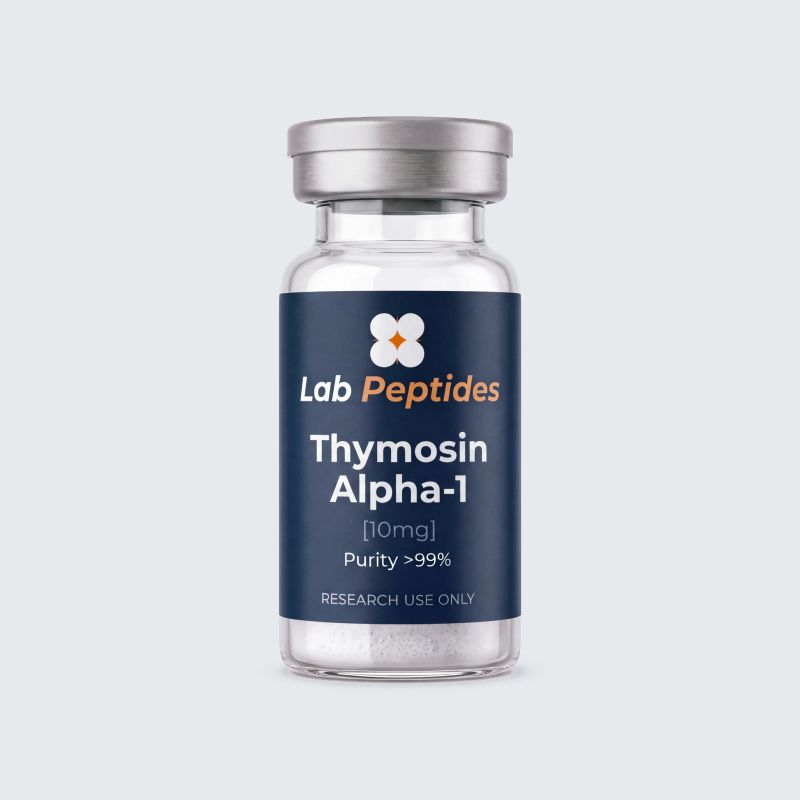
Thymosin Alpha-1 10mg Inmunología
28 aminoácidos, acetilado en N-terminal.
Thymosin Alpha-1 10mg — el escudo inmunitario, formato reforzado. Maduración de los linfocitos T, defensas innatas disparadas, inmunomodulación completa. 70+ ensayos clínicos, usado en 30+ países. El imprescindible de las temporadas de riesgo. HPLC ≥ 98 %.
- Stock en Francia
 Pedido con su agua: enviado en estuche imantado
-10 % de por vida en cada cicloPause, salte o cancele en 1 clicSin compromiso, sin gastos ocultos
Sin tarjeta: cada envío se paga en Bitcoin (-5 % adicional) o por transferencia
Tu kit completo
El vial por sí solo no puede usarse tal cual. Añada lo necesario para prepararlo:
Se compran juntos a menudo


Uso exclusivo en investigación (RUO) · Prohibido para uso humano o veterinario.
Lo esencial
Thymosin Alpha-1 10mg (Talpha1, thymalfasin) is an N-acetylated 28 amino acid polypeptide, the bioactive fragment of thymosin fraction 5 secreted by the thymus. Identified in the 1970s by Allan Goldstein's team, it is today the most studied thymic peptide in the immunology literature, to the point of having yielded a drug marketed as Zadaxin in over thirty countries as a reference immunomodulator.
Unlike growth or tissue-repair peptides, Thymosin Alpha-1 targets a single system with remarkable precision: cellular immunity. It is the reference tool for studying T lymphocyte maturation, Th1/Th2 balance and dendritic cell response, making it a must-have in immunomodulation protocols and seasonal immune-stress models.
Protocolo y preparación
| Agua añadida | Concentración | Marca de lectura |
|---|---|---|
| 1 ml | 10 mg/ml | 10 UI = 1 mg |
| 2 ml | 5 mg/ml | 40 UI = 2 mg |
El volumen de agua no cambia el producto, solo su concentración. Introduzca el agua despacio por la pared del vial y gírelo sin agitar.
Asepsia
Desinfecte las superficies y los tapones (alcohol al 70%).
Disolvente
Extraiga el volumen necesario de agua bacteriostática.
Introducción
Vierta suavemente contra la pared del vial (evite el chorro directo sobre el polvo).
Solubilización
Haga rodar el vial suavemente. No lo agite con fuerza (riesgo de degradación).
Conservación de la solución Una vez reconstituido: 2-8°C (nevera).
Advertencia Herramienta teórica para manipulación química. No constituye un consejo médico.
Abro la calculadora de dilución- La cantidad de polvo parece mínima. Un liofilizado ocupa unos pocos milímetros en el fondo del vial, a veces solo una película translúcida. El peso indicado está ahí.
- El polvo está compacto, pegado a la pared o al tapón. El transporte desplaza la torta liofilizada. No cambia nada en la reconstitución.
- El vial no lleva etiqueta individual. Es nuestro embalaje estándar, no un vial de menor calidad.
- Tras la reconstitución aparecen depósitos o filamentos. Es habitual, sobre todo con moléculas pequeñas. Deje que se asiente y haga rodar el vial entre las palmas, nunca lo agite.
- El paquete es neutro. Nada en el exterior indica el contenido ni el nombre de la marca.
Lo que no es normal: un vial agrietado, una cápsula sin engastar o un tapón que se mueve, polvo que se ha licuado o cambiado de color. En esos casos concretos, escríbanos con una foto y recuperamos el vial.
Handling. Reconstitute gently, without vortexing, letting the solvent glide down the wall. The 28 amino acid sequence is more sensitive than short peptides: avoid heat and mechanical agitation, draw under aseptic conditions, and maintain the cold chain after reconstitution.
Datos técnicos
- Reconstitución
- 2 ml d'eau → 5 mg/ml. 16 UI = 0,8 mg ; 32 UI = 1,6 mg.
- Secuencia peptídica
- Ac-SDAAVDTSSEITTKDLKEKKEVVEEAEN
- Fórmula molecular
- C129H215N33O55
- Peso molecular
- 3108.28 g/mol
- Número CAS
- 62304-98-7
- Forma física
- Poudre lyophilisée
- Solubilidad recomendada
- Eau bactériostatique, NaCl 0,9%
- Condiciones de conservación
- Au réfrigérateur (+2 à +8 °C), à l'abri de la lumière. En poudre, possible au congélateur pour une conservation longue. Une fois préparé : réfrigérateur, jamais au congélateur.
- Uso
- Reactivo de investigación, solo in vitro (RUO)
Conservación y manipulación
In lyophilized form, Thymosin Alpha-1 10mg is stored in the fridge (+2 to +8 °C), away from light, and remains stable for several months; in a -20 °C freezer, for several years. The dry powder tolerates a few days of room-temperature transport, but prompt storage in the fridge on receipt is recommended for this polypeptide, longer than tetrapeptides.
After reconstitution, the solution must be kept at +2/+8°C (refrigerator) and used within a short period (a few weeks at most). Bacteriostatic water (0.9% benzyl alcohol) allows multiple draws from the same vial, matching the serial use of the 10mg format. Absolutely avoid freeze/thaw cycles of the solution, which degrade peptide integrity.
Our peptides are HPLC-tested to over 98% purity and vacuum lyophilized.
Mecanismo de acción
Thymosin Alpha-1's mechanism of action relies on a coordinated activation of innate and adaptive immunity, which sets it apart from single-target immunostimulants.
Toll-like receptor activation. Talpha1 activates the TLR-2 and TLR-9 receptors on the surface of dendritic cells and monocytes. This binding triggers the MyD88 pathway then NF-kappaB translocation, leading to dendritic cell maturation and enhanced antigen presentation. It is the initiating event of the immunomodulatory cascade.
Th1 orientation and T lymphocyte maturation. Talpha1 promotes the differentiation of helper T lymphocytes toward the Th1 profile, with increased production of IL-2 and interferon gamma. It stimulates T lymphocyte maturation within the thymus, increases functional CD4+ and CD8+ populations and restores a favorable Th1/Th2 ratio in documented immunosuppression contexts.
NK activity and rebalancing. Beyond T lymphocytes, Talpha1 increases the cytotoxic activity of NK (natural killer) cells and modulates the production of pro- and anti-inflammatory cytokines, tending to rebalance a dysregulated immune system rather than over-stimulate it. This bidirectional modulation property is the peptide's pharmacological signature and explains its adjuvant use in varied clinical contexts.
Estudios y referencias
Thymosin Alpha-1 has an exceptional clinical corpus for a peptide, accumulated over more than three decades.
Chronic viral hepatitis. This is thymalfasin's (Zadaxin) historical indication: numerous trials on chronic hepatitis B and C show improved virological response, alone or in combination with interferons, founding its approval in over thirty countries.
Sepsis and critical care. Clinical trials on severe sepsis (including Chinese multicenter studies) evaluated Talpha1 as a modulator of the immune response in immunoparalysis states, with signals on the restoration of lymphocyte populations.
Adjuvant oncology and recent data. The literature explores Talpha1 as a chemotherapy adjuvant (lymphocyte recovery, quality of life) and, more recently, its value in lymphocyte-exhaustion contexts of severe viral infections, where restoration of T lymphocyte counts has been observed.
Preguntas frecuentes
What is the difference between Thymosin Alpha-1 and TB-500 (Thymosin Beta-4)?
How does Thymosin Alpha-1 act on the immune system?
How to store Thymosin Alpha-1?