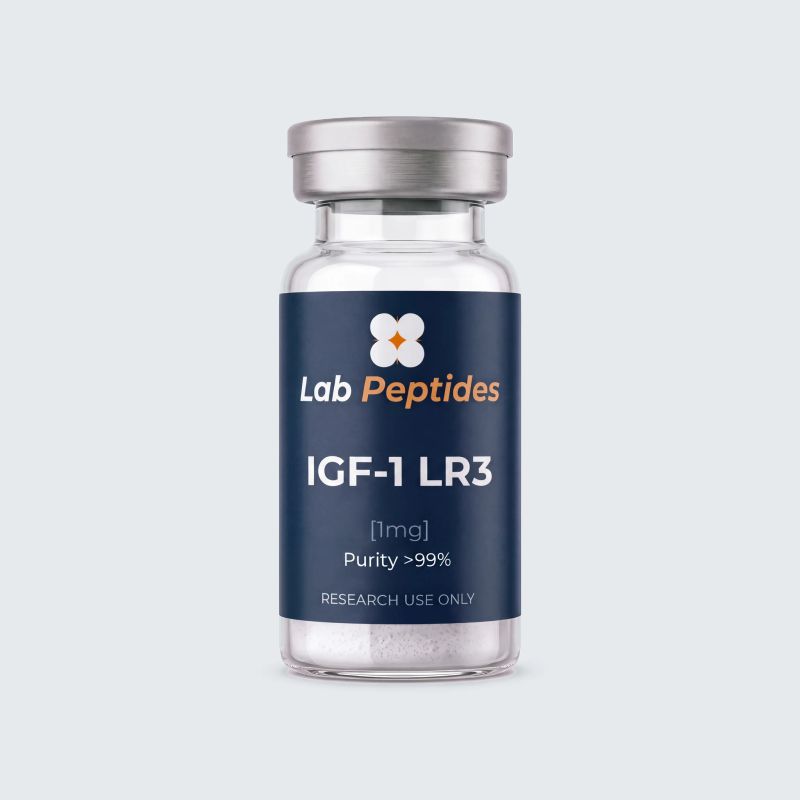
IGF-1 LR3 1mg GH / IGF-1 axis
83 amino acids, LR3 extension. Rare format.
The long-acting form of IGF-1. An 83-amino-acid analogue whose N-terminal extension and Arg3 substitution reduce its affinity for binding proteins: where native IGF-1 is neutralised within minutes, this one stays active for hours. HPLC purity ≥98%, 1 mg vial. For research use only.
- In stock in France
 Ordered with its water: shipped in a magnetic box
-10 % for life on each cyclePause, skip or cancel in 1 clickNo commitment, no hidden fees
No card: each delivery is paid in Bitcoin (extra -5%) or by bank transfer
Your complete kit
The vial alone cannot be used as is. Add what you need to prepare it:
Frequently bought together

Research Use Only (RUO) · Prohibited for human or veterinary use.
Key facts
IGF-1 LR3 (Long R3 Insulin-like Growth Factor 1) is a synthetic analogue of human IGF-1, with 83 amino acids against 70 for the native molecule. Two modifications set it apart: a 13-amino-acid N-terminal extension and the substitution of glutamic acid at position 3 with arginine (hence "R3").
Both changes target the same thingAffinity for the IGFBPs, the six binding proteins that sequester circulating IGF-1. Native IGF-1 is over 95% bound and its free plasma half-life is measured in minutes. The LR3 analogue binds them weakly and stays available far longer — that is the entire rationale for this research version.
In detail
This vial delivers 1 mg of IGF-1 LR3 at HPLC purity of at least 98%, lyophilised in type I borosilicate glass. For research use only.
Protocol and preparation
| Water added | Concentration | Reading marker |
|---|---|---|
| 1 ml | 1 mg/ml | 40 UI = 0,4 mg |
| 2 ml | 0,5 mg/ml | 40 UI = 0,2 mg |
The volume of water does not change the product, only its concentration. Add the water slowly along the vial wall, then swirl without shaking.
Asepsis
Disinfect surfaces and stoppers (70% alcohol).
Solvent
Draw the required volume of bacteriostatic water.
Introduction
Add gently against the vial wall (avoid a direct jet on the powder).
Solubilization
Roll the vial gently. Do not shake vigorously (degradation risk).
Solution storage Once reconstituted: 2-8°C (refrigerator).
Warning Theoretical tool for chemical handling. Does not constitute medical advice.
I open the dilution calculator- The amount of powder looks tiny. A lyophilisate takes up a few millimetres at the bottom of the vial, sometimes just a translucent film. The stated weight is there.
- The powder is compact, stuck to the wall or to the stopper. Transport moves the freeze-dried cake around. It changes nothing to reconstitution.
- The vial carries no individual label. That is our standard packaging, not a downgraded vial.
- After reconstitution, deposits or filaments appear. This is common, especially with small molecules. Let it settle and roll the vial between your palms, never shake it.
- The parcel is plain. Nothing on the outside indicates the contents or the brand name.
What is not normal: a cracked vial, an uncrimped cap or a stopper that moves, powder that has liquefied or changed colour. In those specific cases, write to us with a photo and we take the vial back.
Reconstitution. The 1 mg vial is reconstituted with 2 ml of bacteriostatic water, giving a 0.5 mg/ml solution, i.e. 500 mcg/ml. On a U-100 insulin syringe, 1 unit then equals 5 mcg, which makes small volumes readable without any calculation.
On acetic acid. Part of the laboratory literature reconstitutes IGF-1 LR3 in dilute acetic acid (0.6%) for extended storage stability. We do not sell that solvent, and bacteriostatic water is adequate for ordinary use periods; it is a protocol choice, to be documented by the researcher.
Reported orders of magnitude. Research literature typically mentions quantities of 20 to 50 mcg per administration, i.e. 4 to 10 units on a U-100 syringe at this concentration. A 1 mg vial therefore represents 20 to 50 administrations depending on the scheme used. These figures are reported, not recommended.
Technical data
- Reconstitution
- 2 ml d'eau → 0,5 mg/ml. 1 UI = 5 mcg ; 4 UI = 20 mcg.
- Physical form
- Poudre lyophilisée blanche
- Recommended solubility
- Eau bactériostatique, NaCl 0.9%, acide acétique 0.1%
- Storage conditions
- Au réfrigérateur (+2 à +8 °C), à l'abri de la lumière. En poudre, possible au congélateur pour une conservation longue. Une fois préparé : réfrigérateur, jamais au congélateur.
- Use
- Research reagent, in vitro only (RUO)
Storage & handling
Unreconstituted lyophilised vial: stable for several months between 2 and 8 °C, several years in a -20 °C freezer, protected from light. Ambient-temperature transport does not degrade it: the lyophilisate is designed to withstand far more than the duration of a shipment.
After reconstitution: refrigerated between 2 and 8 °C, protected from light. Bacteriostatic water, containing 0.9% benzyl alcohol, allows repeated draws over several weeks. Never freeze a reconstituted solution: a freeze-thaw cycle denatures the peptide even if the solution looks normal afterwards.
A light, uniform haze may appear after reconstitution; it is particles in suspension, a deposit that will not redissolve, or a yellow colour that justify discarding a vial.
Mechanism of action
IGF-1 acts on the IGF-1R receptor, a transmembrane tyrosine kinase of the insulin receptor family. Binding triggers receptor autophosphorylation and then two main cascades: the PI3K/Akt/mTOR pathway, associated in the literature with protein synthesis and cell survival, and the MAPK/ERK pathway, associated with proliferation.
What sets LR3 apart is not mechanistic but pharmacokinetic. The IGFBPs, particularly IGFBP-3, form a ternary complex with native IGF-1 that extends its circulating presence while making it unavailable. By reducing that binding, the LR3 analogue increases the free fraction — the amount of molecule actually able to reach the receptor.
Worth noting, as it is a common confusionReduced IGFBP affinity does not mean increased receptor affinity. LR3 binds IGF-1R with comparable, if slightly lower, affinity than native IGF-1.
Studies and references
The LR3 analogue, however, was developed and is still overwhelmingly used as a laboratory tool, notably in cell culture where it is widely employed as a medium supplement: its low IGFBP affinity is a direct advantage there, since the binding proteins present in serum would neutralise added native IGF-1.
Frequently asked questions
How much water to reconstitute the 1 mg vial?
Should I use acetic acid rather than bacteriostatic water?
What is the difference with classic IGF-1?
How many draws does a 1 mg vial represent?
Can it be combined with a secretagogue such as CJC-1295 or Ipamorelin?
Must the solution be perfectly clear?
 The complete guideIGF-1 LR3: complete guide to structure, mechanisms and uses in peptide researchLong R3 IGF-1: modified variant, reduced IGFBP affinity, extraordinary half-life. Scientific decoding of the most studied peptide in RUO anabolic research.Read the guide