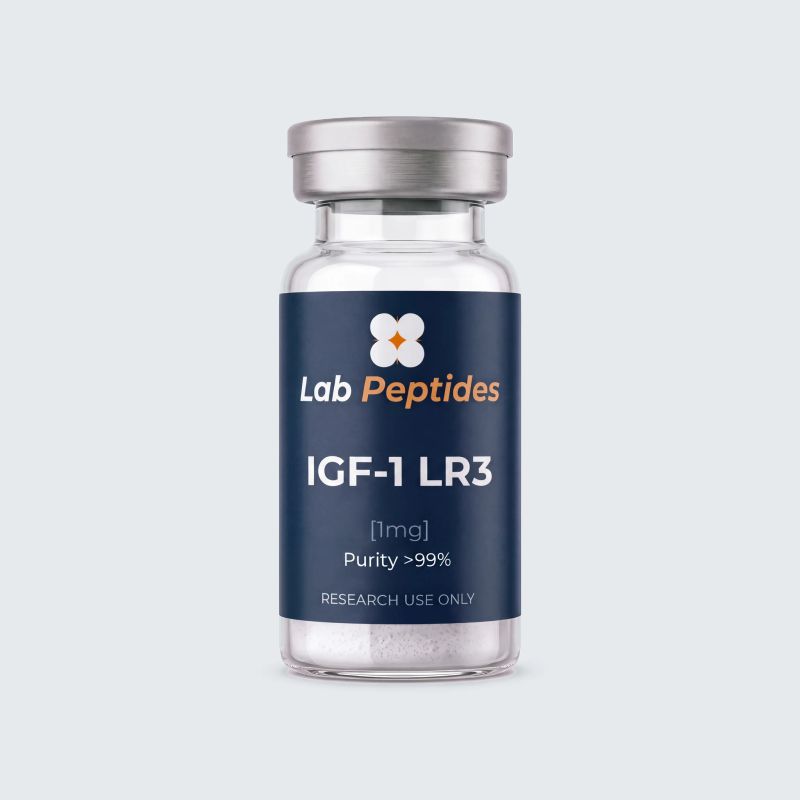
IGF-1 LR3 1mg Eje GH / IGF-1
83 aminoácidos, extensión LR3. Formato escaso.
La forma de larga duración del IGF-1. Análogo de 83 aminoácidos cuya extensión N-terminal y sustitución Arg3 reducen la afinidad por las proteínas de transporte: allí donde el IGF-1 nativo queda neutralizado en unos minutos, este sigue activo durante horas. Pureza HPLC ≥98 %, vial de 1 mg. Producto destinado a la investigación.
- Stock en Francia
 Pedido con su agua: enviado en estuche imantado
-10 % de por vida en cada cicloPause, salte o cancele en 1 clicSin compromiso, sin gastos ocultos
Sin tarjeta: cada envío se paga en Bitcoin (-5 % adicional) o por transferencia
Tu kit completo
El vial por sí solo no puede usarse tal cual. Añada lo necesario para prepararlo:
Se compran juntos a menudo

Uso exclusivo en investigación (RUO) · Prohibido para uso humano o veterinario.
Lo esencial
IGF-1 LR3 (Long R3 Insulin-like Growth Factor 1) is a synthetic analogue of human IGF-1, with 83 amino acids against 70 for the native molecule. Two modifications set it apart: a 13-amino-acid N-terminal extension and the substitution of glutamic acid at position 3 with arginine (hence "R3").
Both changes target the same thingAffinity for the IGFBPs, the six binding proteins that sequester circulating IGF-1. Native IGF-1 is over 95% bound and its free plasma half-life is measured in minutes. The LR3 analogue binds them weakly and stays available far longer — that is the entire rationale for this research version.
En detalle
This vial delivers 1 mg of IGF-1 LR3 at HPLC purity of at least 98%, lyophilised in type I borosilicate glass. For research use only.
Protocolo y preparación
| Agua añadida | Concentración | Marca de lectura |
|---|---|---|
| 1 ml | 1 mg/ml | 40 UI = 0,4 mg |
| 2 ml | 0,5 mg/ml | 40 UI = 0,2 mg |
El volumen de agua no cambia el producto, solo su concentración. Introduzca el agua despacio por la pared del vial y gírelo sin agitar.
Asepsia
Desinfecte las superficies y los tapones (alcohol al 70%).
Disolvente
Extraiga el volumen necesario de agua bacteriostática.
Introducción
Vierta suavemente contra la pared del vial (evite el chorro directo sobre el polvo).
Solubilización
Haga rodar el vial suavemente. No lo agite con fuerza (riesgo de degradación).
Conservación de la solución Una vez reconstituido: 2-8°C (nevera).
Advertencia Herramienta teórica para manipulación química. No constituye un consejo médico.
Abro la calculadora de dilución- La cantidad de polvo parece mínima. Un liofilizado ocupa unos pocos milímetros en el fondo del vial, a veces solo una película translúcida. El peso indicado está ahí.
- El polvo está compacto, pegado a la pared o al tapón. El transporte desplaza la torta liofilizada. No cambia nada en la reconstitución.
- El vial no lleva etiqueta individual. Es nuestro embalaje estándar, no un vial de menor calidad.
- Tras la reconstitución aparecen depósitos o filamentos. Es habitual, sobre todo con moléculas pequeñas. Deje que se asiente y haga rodar el vial entre las palmas, nunca lo agite.
- El paquete es neutro. Nada en el exterior indica el contenido ni el nombre de la marca.
Lo que no es normal: un vial agrietado, una cápsula sin engastar o un tapón que se mueve, polvo que se ha licuado o cambiado de color. En esos casos concretos, escríbanos con una foto y recuperamos el vial.
Reconstitution. The 1 mg vial is reconstituted with 2 ml of bacteriostatic water, giving a 0.5 mg/ml solution, i.e. 500 mcg/ml. On a U-100 insulin syringe, 1 unit then equals 5 mcg, which makes small volumes readable without any calculation.
On acetic acid. Part of the laboratory literature reconstitutes IGF-1 LR3 in dilute acetic acid (0.6%) for extended storage stability. We do not sell that solvent, and bacteriostatic water is adequate for ordinary use periods; it is a protocol choice, to be documented by the researcher.
Reported orders of magnitude. Research literature typically mentions quantities of 20 to 50 mcg per administration, i.e. 4 to 10 units on a U-100 syringe at this concentration. A 1 mg vial therefore represents 20 to 50 administrations depending on the scheme used. These figures are reported, not recommended.
Datos técnicos
- Reconstitución
- 2 ml d'eau → 0,5 mg/ml. 1 UI = 5 mcg ; 4 UI = 20 mcg.
- Forma física
- Poudre lyophilisée blanche
- Solubilidad recomendada
- Eau bactériostatique, NaCl 0.9%, acide acétique 0.1%
- Condiciones de conservación
- Au réfrigérateur (+2 à +8 °C), à l'abri de la lumière. En poudre, possible au congélateur pour une conservation longue. Une fois préparé : réfrigérateur, jamais au congélateur.
- Uso
- Reactivo de investigación, solo in vitro (RUO)
Conservación y manipulación
Unreconstituted lyophilised vial: stable for several months between 2 and 8 °C, several years in a -20 °C freezer, protected from light. Ambient-temperature transport does not degrade it: the lyophilisate is designed to withstand far more than the duration of a shipment.
After reconstitution: refrigerated between 2 and 8 °C, protected from light. Bacteriostatic water, containing 0.9% benzyl alcohol, allows repeated draws over several weeks. Never freeze a reconstituted solution: a freeze-thaw cycle denatures the peptide even if the solution looks normal afterwards.
A light, uniform haze may appear after reconstitution; it is particles in suspension, a deposit that will not redissolve, or a yellow colour that justify discarding a vial.
Mecanismo de acción
IGF-1 acts on the IGF-1R receptor, a transmembrane tyrosine kinase of the insulin receptor family. Binding triggers receptor autophosphorylation and then two main cascades: the PI3K/Akt/mTOR pathway, associated in the literature with protein synthesis and cell survival, and the MAPK/ERK pathway, associated with proliferation.
What sets LR3 apart is not mechanistic but pharmacokinetic. The IGFBPs, particularly IGFBP-3, form a ternary complex with native IGF-1 that extends its circulating presence while making it unavailable. By reducing that binding, the LR3 analogue increases the free fraction — the amount of molecule actually able to reach the receptor.
Worth noting, as it is a common confusionReduced IGFBP affinity does not mean increased receptor affinity. LR3 binds IGF-1R with comparable, if slightly lower, affinity than native IGF-1.
Estudios y referencias
The LR3 analogue, however, was developed and is still overwhelmingly used as a laboratory tool, notably in cell culture where it is widely employed as a medium supplement: its low IGFBP affinity is a direct advantage there, since the binding proteins present in serum would neutralise added native IGF-1.
Preguntas frecuentes
How much water to reconstitute the 1 mg vial?
Should I use acetic acid rather than bacteriostatic water?
What is the difference with classic IGF-1?
How many draws does a 1 mg vial represent?
Can it be combined with a secretagogue such as CJC-1295 or Ipamorelin?
Must the solution be perfectly clear?
 La guía completaIGF-1 LR3: guía completa de estructura, mecanismos y usos en la investigación con péptidosLong R3 IGF-1: variante modificada, afinidad reducida por las IGFBP, semivida extraordinaria. Análisis científico del péptido más estudiado en la investigación anabólica RUO.Leo la guía