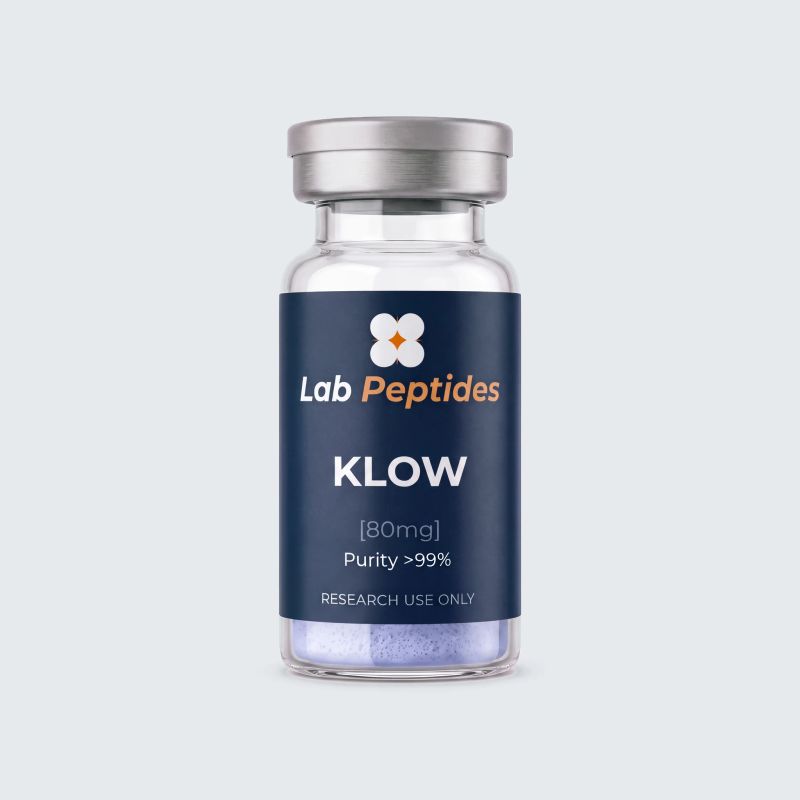
Klow 80mg Matriz extracelular
Cuatro péptidos, un vial. Pureza 99,8 %.
La belleza en concentración máxima. Blend 4 en 1: GHK-Cu + BPC-157 + TB-500 + KPV. Formulación de alta densidad para resultados acelerados — piel, cabello, regeneración tisular. Lo más alto de los blends de belleza.
- Certificado de análisis
- Stock en Francia
 Pedido con su agua: enviado en estuche imantado
-10 % de por vida en cada cicloPause, salte o cancele en 1 clicSin compromiso, sin gastos ocultos
Sin tarjeta: cada envío se paga en Bitcoin (-5 % adicional) o por transferencia
Este producto contiene BPC-157 et TB-500. Los trabajos publicados abordan la angiogénesis, la formación de nuevos vasos sanguíneos. Ningún ensayo clínico humano aleatorizado ha caracterizado las contraindicaciones.
Las alertas teóricas descritas en los trabajos preclínicos afectan a los antecedentes de cáncer, en particular tumores sólidos muy vascularizados, al embarazo y la lactancia, y a las retinopatías proliferativas.
Tu kit completo
El vial por sí solo no puede usarse tal cual. Añada lo necesario para prepararlo:
Se compran juntos a menudo


Uso exclusivo en investigación (RUO) · Prohibido para uso humano o veterinario.
Lo esencial
KLOW 80 mg is the advanced tetra-peptide formulation of our experimental cosmetic range: it fully reprises the synergistic logic of GLOW (GHK-Cu + BPC-157 + TB-500) while adding a fourth essential biological axis — modulation of chronic dermal inflammation — provided by the tripeptide KPV (Lys-Pro-Val). Cumulative concentration raised to 80 mg, including an increased GHK-Cu component to push matrix remodeling further, and the new KPV brick that covers a biological territory never addressed by classical regenerative peptides.
En detalle
Our 80 mg reference is co-lyophilized with a majorizing GHK-Cu concentration, BPC-157 and TB-500 in synergistic proportion, and KPV added according to a calibrated ratio to cover the inflammatory component without dominating the remodeling signal. The certificate of analysis is published on this page, viewable before you order. The format targets laboratories working on experimental models of inflammatory dermatoses (induced eczema, imiquimod psoriasis, acne cornea), hair research on inflammatory ground (alopecia areata, seborrheic dermatitis), and longitudinal cutaneous remodeling studies over 8-16 weeks requiring an increased work volume. Strictly Research Use Only (RUO) positioning.
Protocolo y preparación
| Agua añadida | Concentración | Marca de lectura |
|---|---|---|
| 2 ml | 40 mg/ml | 10 UI = 4 mg |
| 3 ml | 26,67 mg/ml | 10 UI = 2,67 mg |
El volumen de agua no cambia el producto, solo su concentración. Introduzca el agua despacio por la pared del vial y gírelo sin agitar.
Asepsia
Desinfecte las superficies y los tapones (alcohol al 70%).
Disolvente
Extraiga el volumen necesario de agua bacteriostática.
Introducción
Vierta suavemente contra la pared del vial (evite el chorro directo sobre el polvo).
Solubilización
Haga rodar el vial suavemente. No lo agite con fuerza (riesgo de degradación).
Conservación de la solución Una vez reconstituido: 2-8°C (nevera).
Advertencia Herramienta teórica para manipulación química. No constituye un consejo médico.
Abro la calculadora de dilución- La cantidad de polvo parece mínima. Un liofilizado ocupa unos pocos milímetros en el fondo del vial, a veces solo una película translúcida. El peso indicado está ahí.
- El polvo está compacto, pegado a la pared o al tapón. El transporte desplaza la torta liofilizada. No cambia nada en la reconstitución.
- El vial no lleva etiqueta individual. Es nuestro embalaje estándar, no un vial de menor calidad.
- Tras la reconstitución aparecen depósitos o filamentos. Es habitual, sobre todo con moléculas pequeñas. Deje que se asiente y haga rodar el vial entre las palmas, nunca lo agite.
- El paquete es neutro. Nada en el exterior indica el contenido ni el nombre de la marca.
Lo que no es normal: un vial agrietado, una cápsula sin engastar o un tapón que se mueve, polvo que se ha licuado o cambiado de color. En esos casos concretos, escríbanos con una foto y recuperamos el vial.
KLOW protocols take up the general logic of injectable cosmetic blends with adaptation for the increased concentration (80 mg vs 70 mg for GLOW) and integration of the KPV component. The formulation is designed to cover long exploratory cycles (8-16 weeks) or models requiring an increased work volume.
Reconstitution. Add 3 ml of 0.9% bacteriostatic water (benzyl alcohol preserved) to the 80 mg lyophilized vial, pouring slowly against the inner wall. Final concentration: approximately 26.7 mg/ml total (approximate distribution: 19 mg/ml GHK-Cu + 3.3 mg/ml BPC-157 + 3.3 mg/ml TB-500 + 1.1 mg/ml KPV). Gently swirl until complete dissolution (1-2 minutes). The solution must be clear and pale-blue to pale blue-green, identical to GLOW — coloration remains dominated by the GHK-Cu copper complex, KPV being chemically neutral in coloration. Note the reconstitution date on the vial.
Documented schedules.
Schedule B - Long remodeling protocol on inflammatory ground (inflammatory aged skin, chronic heliosis, post-acne): 0.1 ml SC daily for 8-12 weeks. Recommended cycle for longitudinal studies with weekly standardized photographic assessment. Consumption: 5.6-8.4 ml, requires 2-3 vials.
Schedule C - Hair protocol on inflammatory ground (experimental alopecia areata, seborrheic scalp dermatitis): 0.1-0.15 ml SC pericranial (mesotherapy technique), twice weekly, 12-16-week cycle. Consumption: 2.4-4.8 ml over 12-16 weeks, 1 to 2 vials.
Experimental topical route. As with GLOW, incorporation into a cream base (cold cream or serum) at 0.1-0.2% total peptide is conceivable for accessory cosmetic uses, but trans-epidermal bioavailability remains low (1-5%). For the KPV component specifically, oral literature (Dalmasso 2008) suggests better enzymatic stability than other components: liposomal topical formulations could theoretically increase penetration, but this exceeds the scope of our standard reference.
Cycles and pauses. 8-16-week cycles with 3-4-week pauses. Given the addition of KPV (anti-inflammatory), researchers working on chronic inflammatory models may document a post-cycle duration of remanence superior to that of pure GLOW, KPV seeming to durably normalize the dermal NF-κB axis.
Datos técnicos
- Reconstitución
- 3 ml d'eau → 26,7 mg/ml. 10 UI = 2,67 mg ; 15 UI = 4 mg.
- Secuencia peptídica
- Mélange : GHK-Cu (prézatide de cuivre) (50 mg) + BPC-157 (10 mg) + TB-500 (thymosine β4) (10 mg) + KPV (α-MSH 11-13) (10 mg)
- Forma física
- Poudre lyophilisée
- Solubilidad recomendada
- Eau bactériostatique, NaCl 0,9%
- Condiciones de conservación
- Au réfrigérateur (+2 à +8 °C), à l'abri de la lumière. En poudre, possible au congélateur pour une conservation longue. Une fois préparé : réfrigérateur, jamais au congélateur.
- Uso
- Reactivo de investigación, solo in vitro (RUO)
Conservación y manipulación
KLOW extends the GLOW blend with a fourth peptide (KPV) whose stability must be integrated into global conservation reasoning. The good news: KPV is the smallest and most stable of the four components.
Unopened lyophilized powder. Storage in the fridge (+2 to +8 °C), original packaging, protected from direct light: documented stability 12-18 months. Beyond 3 months of storage, a -20 °C freezer remains an option: 24 months documented. Controlled room temperature 15-25 degrees: 3-6 months maximum. As with GLOW, the lyophilized cake must present a slight bluish tint (due to GHK-Cu); a totally white or greenish-brownish cake would be abnormal.
- KPV: most stable in aqueous solution (short tripeptide, stabilizing central Pro bond, >21 days without documented degradation)
- GHK-Cu: stable thanks to the copper complex that rigidifies the structure (>14 days, moderate photosensitivity)
- TB-500: intermediate stability (10-14 days comfortably)
- BPC-157: most fragile (14-21 days, progressive degradation beyond)
The limiting component is therefore BPC-157, identical to GLOW. Practical stability of the reconstituted blend: 14-21 days refrigerated 2-8 degrees, protected from light, in the original vial.
Visual degradation signs. Fresh solution: very-pale-blue to pale blue-green tint. Warning signs identical to GLOW: shift to brown/dark-green (copper oxidation), particles/turbidity (contamination or precipitation), total loss of coloration (complex dissociation). In all these cases, discard the vial.
Freeze-thaw cycles. Lyophilized powder: tolerates several short out-and-back cold cycles. Reconstituted solution: NEVER freeze. Freezing degrades GHK-Cu (copper complex dissociation), BPC-157 (denaturation), TB-500 (aggregation). KPV alone would tolerate freezing, but the other components do not.
Light protection. Same rule as GLOW: keep the vial in its cardboard sleeve or an aluminum pouch in the refrigerator. UV = priority enemy of the GHK-Cu complex.
- Fully reconstitute the first vial (80 mg / 3 ml) and use over the first 14-21 days
- Keep the second lyophilized vial in the fridge
- Reconstitute the second vial at the start of week 3-4, just before exhaustion or expiration of the first
This strategy maintains optimal BPC-157 activity throughout the cycle, avoiding the "degradation plateau" of a single vial used over 5-6 weeks.
Transport and reception. Identical protocol to GLOW. Lyophilized powder travels 48-72h at ambient temperature without major impact. Upon receipt of a visually abnormal cake, photograph and contact the laboratory before reconstitution.
Expiration. Indicated on the vial label, typically 12-18 months from manufacturing date for refrigerated storage. For -20-degree storage, an additional 6-12-month margin is documented.
Mecanismo de acción
KLOW's mechanistic basis adds the three axes of GLOW (already widely documented in the GLOW product sheet) to a fourth dedicated axis — that of the KPV tripeptide, which deserves specific development.
KPV: chemical nature and alpha-MSH lineage. KPV is the tripeptide Lys-Pro-Val, i.e., the C-terminal fragment (positions 11-13) of alpha-melanocyte-stimulating hormone alpha-MSH, itself derived from the POMC precursor. The complete alpha-MSH sequence is Ac-Ser-Tyr-Ser-Met-Glu-His-Phe-Arg-Trp-Gly-Lys-Pro-Val-NH2 (13 amino acids). It is therefore a minimalist fragment of 3 amino acids, molecular mass 342.4 Da, remarkably small to be active. This structural compactness explains several key properties: efficient tissue penetration, superior enzymatic stability to long peptides, and documented oral activity (although less potent than via parenteral route).
KPV anti-inflammatory mechanism. The central documented mechanism is inhibition of nuclear translocation of NF-κB, master transcription factor of the inflammatory response. Thomas Luger's group in Münster showed from the 1990s onward that complete alpha-MSH and its fragments (including KPV) modulate the production of TNF-α, IL-6, and IL-1β in keratinocytes and Langerhans cells. Work by Mark Dalmasso and Didier Merlin at Emory University then documented in 2008 (Gastroenterology) the anti-inflammatory activity of KPV in murine ulcerative colitis models with remarkable oral efficacy. In dermato-research, Bassi 2016 and Taylor 2004 synthesized cutaneous data: reduction of inflammatory erythema, decrease of edema, restoration of the epidermal barrier in induced dermatitis models.
Direct antimicrobial activity. Beyond the anti-inflammatory action, KPV presents documented antimicrobial activity against Candida albicans, Staphylococcus aureus, and certain E. coli strains. This mechanism would involve disturbance of the microbial membrane and/or inhibition of fungal ergosterol synthesis. In the cutaneous research context, this dual activity (anti-inflammatory + antimicrobial) is particularly relevant for acne models (Cutibacterium acnes, S. aureus), seborrheic dermatitis (Malassezia), and colonized wounds.
Four-part synergy and feedback loops. KLOW's guiding principle is that chronic dermal inflammation compromises the efficacy of classical regenerative peptides: a tissue with sustained NF-κB activation secretes metalloproteinases (MMP-2, MMP-9) that actively degrade the new collagen deposited by fibroblasts stimulated by GHK-Cu. Suppression of this inflammatory noise via KPV therefore frees biological space for GHK-Cu, BPC-157, and TB-500 to express their full potential. We move from simple synergy (three additive axes) to second-order synergy (KPV potentiates the phenotypic expression of the other three by removing an underlying inflammatory brake).
Alpha-MSH-like positioning without pigmentary effect. Critical point: unlike Melanotan-2 which targets melanogenesis via MC1R, KPV (fragment 11-13 of alpha-MSH) does NOT have significant melanogenic activity. The critical motif for MC1R activation is concentrated in the central Phe-Arg-Trp segment (positions 7-9) of alpha-MSH, totally absent from KPV. KPV retains the anti-inflammatory and antimicrobial activity of alpha-MSH but loses its pigmentary activity. This is exactly what makes KPV interesting in inflammatory cutaneous research: immunomodulatory action without collateral pigmentary modification.
Estudios y referencias
The literature applicable to KLOW is structured in two blocks: the base already covered in the GLOW sheet (GHK-Cu, BPC-157, TB-500), which we do not fully reprise here, and the KPV-specific corpus that justifies the very existence of this extended reference.
KPV — origin and alpha-MSH lineage (1980-2010). The first work on short alpha-MSH fragments dates to the 1980s in the laboratories of Anna Catania in Milan and James Lipton in Chicago, following the demonstration that complete alpha-MSH was a powerful endogenous anti-inflammatory (Lipton 1997 Trends Neurosci). The natural question was: what is the smallest sequence that retains anti-inflammatory activity? The work of the 1990s progressively identified the C-terminal tripeptide KPV (positions 11-13) as the minimal functional core, with concomitant loss of melanogenic activity (which resides in the central Phe-Arg-Trp sequence, positions 7-9). Hiltz and Lipton 1990 (FASEB J) formalize this dissociation.
KPV in dermato-research (1998-2024). Luger et al. in Münster publish in 1998 (J Leukoc Biol) the first data on modulation of pro-inflammatory cytokines in human keratinocytes under KPV. Taylor 2004 (Ann N Y Acad Sci) synthesizes the state of research on alpha-MSH fragments in experimental dermatology: atopic dermatitis, allergic contact, and psoriasis-like murine models. Bassi 2016 (Peptides journal) reviews recent cutaneous data: reduction of erythema, edema, neutrophilic infiltrate in multiple models. The volume of KPV cutaneous literature remains modest compared to "major" cosmetic peptides, but is qualitatively solid and converges on a reproducible anti-inflammatory profile.
KPV in intestinal and IBD research (2008-2024). The major turn for KPV came from experimental gastroenterology. Dalmasso-Merlin 2008 (Gastroenterology 134:1) publish a pivotal work demonstrating oral anti-colitis activity of KPV in the murine DSS model, with spectacular reduction of macroscopic and histological severity. This publication opens a series of works on experimental IBD (inflammatory bowel disease): Kannengiesser 2008, Merlin 2014, Paiva 2018. KPV's oral activity (linked to its compactness and passage via intestinal PepT1 transporters) generated industrial interest for oral cosmetic "from within" formulations, widely publicized but whose clinical validation remains limited.
Antimicrobial KPV (2000-2024). Thomas Luger's group documented from 1999 (Cutler J Invest Dermatol) direct antimicrobial activity of KPV against Candida albicans and Staphylococcus aureus. Subsequent works (Wong 2003, Brzoska 2008) confirmed and broadened the antimicrobial spectrum. This activity is distinct from the anti-inflammatory effect and operates via direct membrane disruption. In cutaneous research practice, this dual activity is exploited in acne models (C. acnes) and seborrheic dermatitis (Malassezia).
Cosmetic multi-peptide blends with KPV. The specific GHK-Cu + BPC-157 + TB-500 + KPV combination has not been the subject of controlled publication to our knowledge. It is an empirical construction by regenerative medicine research laboratories, mechanistically rationalized but not RCT-validated. As with GLOW, this reality is honestly acknowledged: the biological rationale is strong, integrated data remain to be produced, and this is precisely what justifies availability of such a reference in exploratory research format.
Relation to Melanotan and differentiation precautions. It is important for a reader to clearly distinguish KPV from the family of melanogenic alpha-MSH analogs (Melanotan-1, Melanotan-2, afamelanotide). The latter are designed to maximize MC1R activation and therefore melanogenesis, which implies conservation and optimization of the central Phe-Arg-Trp segment. KPV, devoid of this segment, shares with Melanotan the alpha-MSH lineage but diverges radically in pharmacological profile: anti-inflammatory and antimicrobial, not melanogenic.
Preguntas frecuentes
When to choose KLOW over GLOW?
Is KPV a 'anti-inflammatory Melanotan'?
Can I switch from GLOW to KLOW during the protocol?
Is the solution color different between GLOW and KLOW?
Is there an interaction risk between KPV and the other peptides?
How long to observe an effect on experimental inflammatory dermatosis?
Can KLOW be used without a particular inflammatory component?