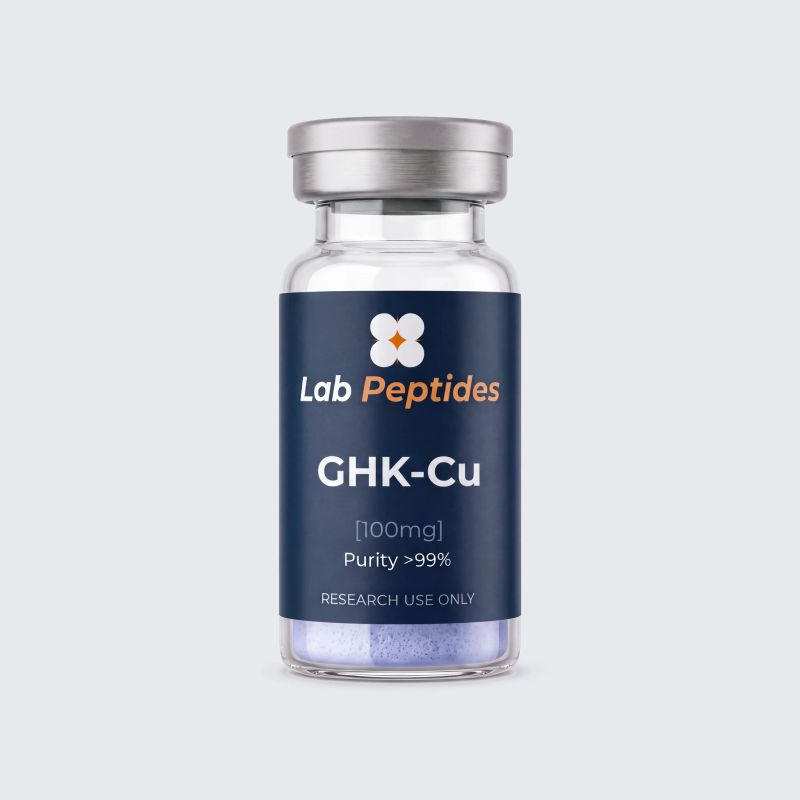
GHK-Cu 100mg Matriz extracelular
Tripéptido de cobre, 100 mg. Pureza 99,6 %.
El tripéptido de cobre antiedad por excelencia. GHK-Cu modula 4 000+ genes ligados al envejecimiento cutáneo — colágeno, elastina, regeneración. 50 años de investigación, más de 200 publicaciones. Piel visiblemente reafirmada. La ciencia tiene un nombre para la piel perfecta: GHK-Cu.
- Certificado de análisis
- Stock en Francia
 Pedido con su agua: enviado en estuche imantado
-10 % de por vida en cada cicloPause, salte o cancele en 1 clicSin compromiso, sin gastos ocultos
Sin tarjeta: cada envío se paga en Bitcoin (-5 % adicional) o por transferencia
Tu kit completo
El vial por sí solo no puede usarse tal cual. Añada lo necesario para prepararlo:
Se compran juntos a menudo


Uso exclusivo en investigación (RUO) · Prohibido para uso humano o veterinario.
Lo esencial
GHK-Cu (Glycyl-L-Histidyl-L-Lysine, Cu2+ copper complex) is a tripeptide of 340 Da free, 403 Da complexed with copper, discovered by Loren Pickart in 1973 at the University of San Francisco. It appears in human plasma at approximately 200 ng/ml in young subjects, with a drop of more than 60 % between ages 20 and 60, an observation that motivated forty years of research on its role in tissue repair, wound healing, hair growth and cutaneous longevity. Its short sequence Gly-His-Lys binds Cu2+ ions with exceptional affinity through the histidine imidazole ring and the terminal amine, forming the characteristic blue complex.
Protocolo y preparación
| Agua añadida | Concentración | Marca de lectura |
|---|---|---|
| 2 ml | 50 mg/ml | 10 UI = 5 mg |
| 3 ml | 33,33 mg/ml | 10 UI = 3,33 mg |
El volumen de agua no cambia el producto, solo su concentración. Introduzca el agua despacio por la pared del vial y gírelo sin agitar.
Asepsia
Desinfecte las superficies y los tapones (alcohol al 70%).
Disolvente
Extraiga el volumen necesario de agua bacteriostática.
Introducción
Vierta suavemente contra la pared del vial (evite el chorro directo sobre el polvo).
Solubilización
Haga rodar el vial suavemente. No lo agite con fuerza (riesgo de degradación).
Conservación de la solución Una vez reconstituido: 2-8°C (nevera).
Advertencia Herramienta teórica para manipulación química. No constituye un consejo médico.
Abro la calculadora de dilución- La cantidad de polvo parece mínima. Un liofilizado ocupa unos pocos milímetros en el fondo del vial, a veces solo una película translúcida. El peso indicado está ahí.
- El polvo está compacto, pegado a la pared o al tapón. El transporte desplaza la torta liofilizada. No cambia nada en la reconstitución.
- El vial no lleva etiqueta individual. Es nuestro embalaje estándar, no un vial de menor calidad.
- Tras la reconstitución aparecen depósitos o filamentos. Es habitual, sobre todo con moléculas pequeñas. Deje que se asiente y haga rodar el vial entre las palmas, nunca lo agite.
- El paquete es neutro. Nada en el exterior indica el contenido ni el nombre de la marca.
Lo que no es normal: un vial agrietado, una cápsula sin engastar o un tapón que se mueve, polvo que se ha licuado o cambiado de color. En esos casos concretos, escríbanos con una foto y recuperamos el vial.
- Topical minoxidil + topical GHK-Cu: effect addition on androgenetic alopecia (mechanisms are distinct: minoxidil acts on potassium channels, GHK-Cu on dermal papilla and collagen)
- Microneedling + GHK-Cu applied immediately: increased penetration, strengthened regenerative effect
- Fractional laser + GHK-Cu post-procedure: reduction of recovery times
This product is not intended for human use. The protocols described are examples drawn from scientific literature, provided strictly for informational purposes for research work on non-human models.
Datos técnicos
- Reconstitución
- 2 ml d'eau → 50 mg/ml. 2 UI = 1 mg ; 4 UI = 2 mg.
- Secuencia peptídica
- Gly-His-Lys · Cu²⁺
- Fórmula molecular
- C14H23CuN6O4
- Peso molecular
- 402.92 g/mol
- Número CAS
- 89030-95-5
- Forma física
- Poudre lyophilisée bleutée
- Solubilidad recomendada
- Eau bactériostatique, NaCl 0,9%
- Condiciones de conservación
- Au réfrigérateur (+2 à +8 °C), à l'abri de la lumière. En poudre, possible au congélateur pour une conservation longue. Une fois préparé : réfrigérateur, jamais au congélateur.
- Uso
- Reactivo de investigación, solo in vitro (RUO)
Conservación y manipulación
Sealed unreconstituted vialIn the fridge (+2 to +8 °C); for long-term storage (over 3 months), a -20 °C freezer is an option, stability 36 months (copper complex is particularly stable compared to free peptides thanks to chelation). At 2-8 C, stability 18 months. At room temperature (20-25 C), stability 2-3 months, significantly longer than most peptides.
- Loss of blue coloration: complex dissociation, free peptide or precipitated copper (non-toxic but loss of activity).
- Brown or green coloration: oxidation of copper to non-complexed Cu2+ or Cu3+ (toxic form).
- Greenish precipitate: reaction with residual phosphates or chlorides, lost chelation.
- Milky veil: peptide aggregation, hydrolytic degradation.
Recommended aliquotingFor extended use beyond 30 days, prepare 5-10 aliquots of 0.2 ml in 0.5 ml microtubes, frozen at -20 C. Thaw one aliquot as needed, store 7-10 days at 4 C after thawing.
Laboratory documentationReconstitution date, lot, storage conditions, aliquot usage must be systematically recorded in a laboratory logbook for experimental result traceability.
Mecanismo de acción
The mechanism of GHK-Cu articulates around three axesCopper chelation, extracellular matrix remodelling, and massive transcriptional modulation.
First axis, copper chelation and transport. Free Cu2+ is toxic (Fenton reactions, hydroxyl radicals), but the GHK-Cu complex is stable, diffusible and delivers copper in a targeted manner to copper-dependent metalloenzymes: lysyl oxidase (collagen/elastin crosslinking), Cu/Zn superoxide dismutase (SOD1, antioxidant defence), tyrosinase (controlled melanogenesis), dopamine-beta-hydroxylase. This controlled delivery explains why GHK-Cu restores copper-dependent enzymatic functions without metallic toxicity (Pickart & Margolina 2018 Int J Mol Sci).
Second axis, extracellular matrix and tissue regeneration. Maquart 1988 J Clin Invest showed that GHK-Cu at nanomolar concentration stimulates type I collagen synthesis by fibroblasts by 60-200 %, of glycosaminoglycans (hyaluronic acid, heparan sulphate) and proteoglycans. Simeon 2000 Life Sci simultaneously documented the stimulation of matrix repair and the suppression of degradation by MMP-2 and MMP-9 (matrix metalloproteases), a unique profile of constructive rather than destructive remodelling. Pollard 2005 J Biomed Mater Res confirmed the acceleration of cutaneous healing in injured animals and humans.
Fourth axis, stem cells and hair growth. Pyo 2007 Biofactors demonstrated that GHK-Cu activates the hair follicle by stimulating dermal papilla stem cells, increases follicle size, prolongs the anagen phase and inhibits early catagen follicle apoptosis. Daily topical applications at 0.05-0.1 % in liposomal vehicle have been validated in several controlled trichology dermatology studies.
PharmacokineticsThe complex is unstable in plasma (apparent half-life <30 min) but copper is rapidly taken up by target tissues where it is incorporated into copper-dependent enzymes. The biological effect thus persists well beyond plasma presence.
Estudios y referencias
The GHK-Cu literature exceeds 300 PubMed-indexed publications since 1973, including several systematic reviews and meta-analyses.
Initial discovery and characterisationPickart 1973 Nature described the effect of young plasma fractions on hepatic restoration, isolating the GHK tripeptide sequence. Pickart & Thaler 1973 Nature New Biology confirmed activity in a purified system. The following 10 years established the exceptional Cu2+ binding (Lau & Sarkar 1981 Biochem J) and tissue distribution.
Anti-inflammatory and immunomodulatory propertiesMcCormack 2001 Int J Biol Sci (TNF-alpha, IL-1, IL-6 suppression in LPS-stimulated cultures), Hong 2015 Front Pharmacol (neuroprotection preclinical Alzheimer and Parkinson models, cerebral antioxidant action). Cebrian 2005 J Biol Chem (fibrinogen reduction, anti-thrombotic effect).
Bone and tendon regenerationPollard 2005 J Biomed Mater Res (bone healing acceleration through incorporation in grafts), several studies on tendon matrices repaired with GHK-Cu incorporated.
- 1
- 2Remodelage tissulaireThe human tri-peptide GHK and tissue remodeling
- 3
Preguntas frecuentes
Why is the reconstituted solution blue?
What is the difference between free GHK and GHK-Cu?
How long to observe an effect on skin or hair?
Can GHK-Cu be combined with BPC-157 or TB-500?
 Lee antes de pedirPéptidos dermatológicos en investigación: GHK-Cu, Matrixyl, Argireline y la ciencia de los cosmecéuticosSíntesis científica sobre péptidos dermatológicos de investigación: GHK-Cu y complejos de cobre, Matrixyl y tripéptidos sintéticos, Argireline y acetilhexapéptidos, mecanismos del colágeno y estudios in vitro. Marco RUO estricto.Leo el artículo