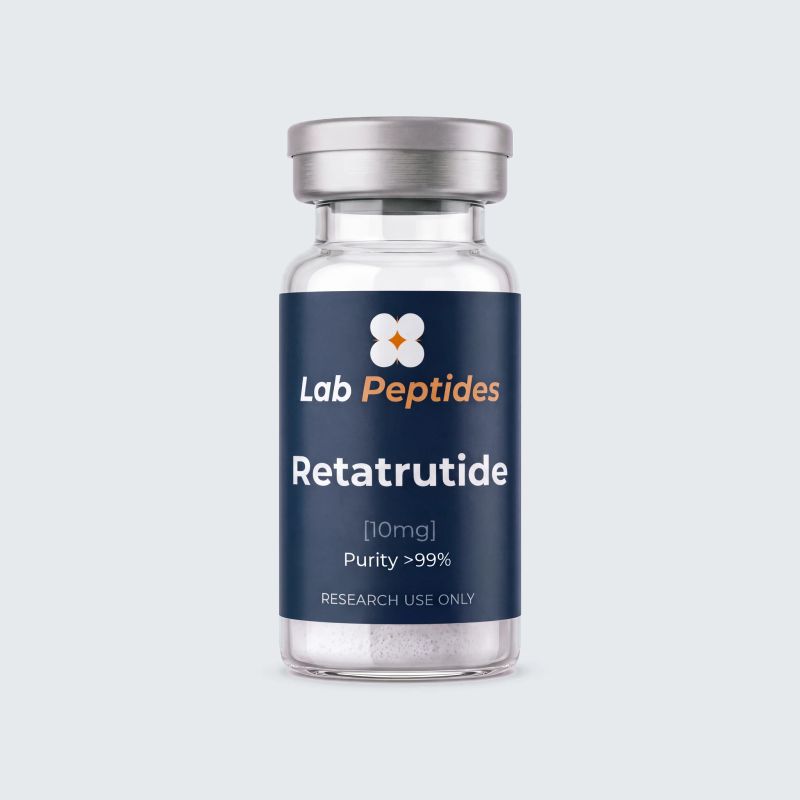
Retatrutide 10mg Metabolismo
Liofilizado · HPLC 99,7 % · COA en línea
- Certificado de análisis
- Stock en Francia
 Pedido con su agua: enviado en estuche imantado
-10 % de por vida en cada cicloPause, salte o cancele en 1 clicSin compromiso, sin gastos ocultos
Sin tarjeta: cada envío se paga en Bitcoin (-5 % adicional) o por transferencia
Tu kit completo
El vial por sí solo no puede usarse tal cual. Añada lo necesario para prepararlo:
Se compran juntos a menudo


Uso exclusivo en investigación (RUO) · Prohibido para uso humano o veterinario.
Lo esencial
Protocolo y preparación
| Agua añadida | Concentración | Marca de lectura |
|---|---|---|
| 1 ml | 10 mg/ml | 10 UI = 1 mg |
| 2 ml | 5 mg/ml | 40 UI = 2 mg |
El volumen de agua no cambia el producto, solo su concentración. Introduzca el agua despacio por la pared del vial y gírelo sin agitar.
Asepsia
Desinfecte las superficies y los tapones (alcohol al 70%).
Disolvente
Extraiga el volumen necesario de agua bacteriostática.
Introducción
Vierta suavemente contra la pared del vial (evite el chorro directo sobre el polvo).
Solubilización
Haga rodar el vial suavemente. No lo agite con fuerza (riesgo de degradación).
Conservación de la solución Una vez reconstituido: 2-8°C (nevera).
Advertencia Herramienta teórica para manipulación química. No constituye un consejo médico.
Abro la calculadora de dilución- La cantidad de polvo parece mínima. Un liofilizado ocupa unos pocos milímetros en el fondo del vial, a veces solo una película translúcida. El peso indicado está ahí.
- El polvo está compacto, pegado a la pared o al tapón. El transporte desplaza la torta liofilizada. No cambia nada en la reconstitución.
- El vial no lleva etiqueta individual. Es nuestro embalaje estándar, no un vial de menor calidad.
- Tras la reconstitución aparecen depósitos o filamentos. Es habitual, sobre todo con moléculas pequeñas. Deje que se asiente y haga rodar el vial entre las palmas, nunca lo agite.
- El paquete es neutro. Nada en el exterior indica el contenido ni el nombre de la marca.
Lo que no es normal: un vial agrietado, una cápsula sin engastar o un tapón que se mueve, polvo que se ha licuado o cambiado de color. En esos casos concretos, escríbanos con una foto y recuperamos el vial.
- 0.25 mg = 5 IU (weeks 1 to 4)
- 0.5 mg = 10 IU (weeks 5 to 8)
- 1 mg = 20 IU (weeks 9 to 12)
- 2 mg = 40 IU (weeks 13 to 16)
- 4 mg = 80 IU (from week 17, if 2 mg is well tolerated)
Starting on this vialPossible, same IU as the 5 mg vial, 0.25 mg = 5 IU. The 5 mg vial remains the format built for the first 8 to 10 weeks.
Step poorly toleratedDo not move up. Stay on the current step until it is well tolerated.
Datos técnicos
- Reconstitución
- 2 ml d'eau → 5 mg/ml. 5 UI = 0,25 mg ; 10 UI = 0,5 mg.
- Secuencia peptídica
- YXQGTFTSDYSILLDKKAQXAFIEYLLEGGPSSGAPPPS-NH2 (X = Aib ; lysine acylée)
- Fórmula molecular
- C221H342N46O68
- Peso molecular
- 4731.34 g/mol
- Número CAS
- 2381089-83-2
- Forma física
- Poudre lyophilisée
- Solubilidad recomendada
- Eau bactériostatique, NaCl 0,9%
- Condiciones de conservación
- Au réfrigérateur (+2 à +8 °C), à l'abri de la lumière. En poudre, possible au congélateur pour une conservation longue. Une fois préparé : réfrigérateur, jamais au congélateur.
- Uso
- Reactivo de investigación, solo in vitro (RUO)
Conservación y manipulación
Lyophilized retatrutide stores up to 24 months between 2 and 8 °C, protected from light, in its original borosilicate vial sealed under inert atmosphere. The peptide is stable in solid form; degradation pathways become operational only after solubilization. Extended stocks can tolerate -20 °C (deep freeze) without documented integrity loss, provided freeze-thaw cycles are avoided as they introduce mechanical stress on tertiary structure.
After reconstitution with bacteriostatic water (0.9% benzyl alcohol), the solution stores for 21-28 days at 2-8 °C, protected from light. The C20 diacid chain is more hydrophobic than semaglutide's (C18) and tirzepatide's, slightly slowing degradation but increasing oligomerization propensity if the solution undergoes agitation or shear. Dominant degradation pathways: methionine oxidation (specifically Met30), asparagine deamidation (Asn25, Asn35) pH-sensitive, aspartate isomerization, and oligomerization/fibrillation via the C20 lipid anchor. After 28 refrigerated days, typically expect 5-10% activity loss, acceptable for most research protocols.
Operational recommendations(1) handle the reconstituted vial with powder-free nitrile gloves to avoid surface contaminants that would catalyze degradation; (2) never vortex or shake, prefer gentle rotation with the vial tilted at 45 degrees until complete dissolution (typically 30-60 seconds); (3) if a precipitate persists after 5 minutes, warm gently to 25 °C (hand, never > 30 °C); (4) post-reconstitution storage must be a constant 2-8 °C, ideally low in the fridge (thermally most stable area), in a peptide-dedicated compartment (no contact with food or other volatile products).
Mecanismo de acción
Retatrutide is the first triple incretin-mimetic agonist to reach phase II/III clinical development. Its sequence combines three activities: GLP-1R, GIPR, and GCGR (glucagon receptor), a design that unites in a single molecule the three main metabolic levers of energy regulation. Coskun and Urva (2022, pharmacological description) describe the engineering: modified sequence derived from native GIP, Aib2 and Aib13 substitutions resisting DPP-4, and a C20 diacid fatty-acyl chain grafted to a lysine via a gamma-glutamate linker to extend half-life to approximately 6 days. The affinity profile is calibrated for triple balance: full agonist at GIPR, full agonist at GLP-1R, partial agonist at GCGR, preserving glycemia while exploiting glucagon thermogenic benefits.
Preguntas frecuentes
How long can reconstituted retatrutide be stored, and what signs indicate degradation?
Can retatrutide be combined with other research peptides (BPC-157, TB-500, CJC-1295, ipamorelin)?
 La guía completaRetatrutida (LY3437943): guía completa del triple agonistaLeo la guía
Lee también:Agua bacteriostática: guía completa para la reconstitución de péptidos de investigaciónTirzepatida: guía completa del co-agonista GLP-1R / GIPR en investigación preclínica