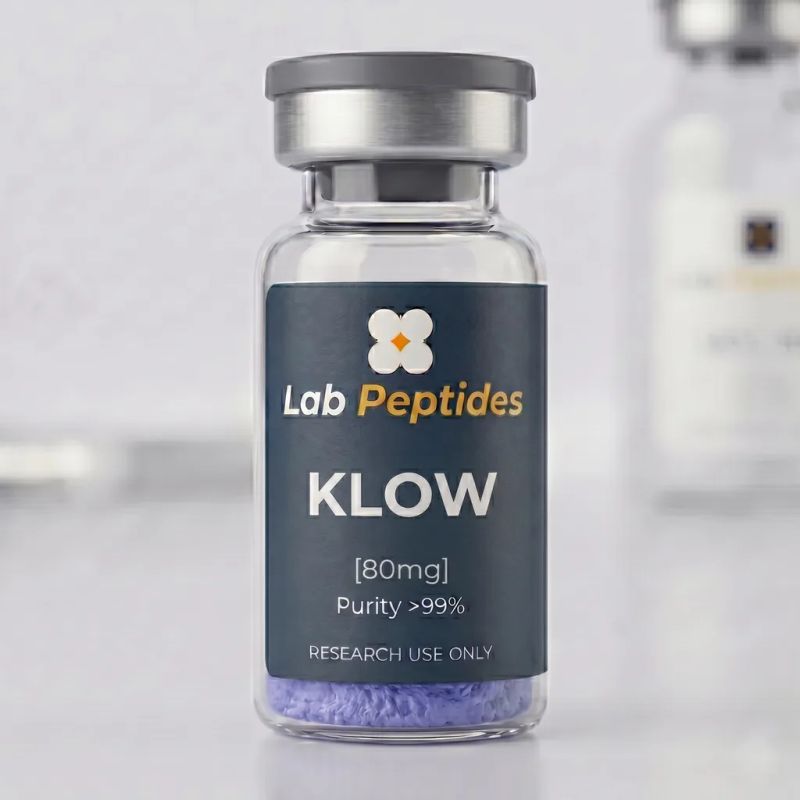
Klow 80mg Skin & Beauty
Enriched variation of the Glow combo. Extended formulation for cosmetic research protocols requiring higher concentrations.
Beauty at maximum concentration. 4-in-1 blend: GHK-Cu + BPC-157 + TB-500 + KPV. High-density formulation for accelerated results — skin, hair, tissue regeneration. The very best of beauty blends.

KLOW 80 mg is the advanced tetra-peptide formulation of our experimental cosmetic range: it fully reprises the synergistic logic of GLOW (GHK-Cu + BPC-157 + TB-500) while adding a fourth essential biological axis — modulation of chronic dermal inflammation — provided by the tripeptide KPV (Lys-Pro-Val). Cumulative concentration raised to 80 mg, including an increased GHK-Cu component to push matrix remodeling further, and the new KPV brick that covers a biological territory never addressed by classical regenerative peptides.
KLOW's rationale rests on a repeated field observation in dermato-experimental research: many relevant models are not simple "clean" wounds to heal, but tissues with an underlying chronic inflammatory component. Acne-prone skin, atopic eczema, psoriasis-like murine, contact dermatitis, inflammatory scalp, diabetic wounds with persistent leukocyte infiltrate — all these contexts share a common denominator that hampers classical remodeling: chronic NF-κB activation, sustained release of TNF-α, IL-6, IL-1β, and a tissue microarchitecture disturbed by immune infiltrate. GHK-Cu, BPC-157, and TB-500 work admirably on the repair cascade but do not actively suppress this inflammatory background noise. KPV, derived from the C-terminal of alpha-MSH, intervenes precisely on this register: blockade of NF-κB translocation, documented reduction of pro-inflammatory cytokines, direct antimicrobial activity against Candida and Staphylococcus aureus.
Our 80 mg reference is co-lyophilized with a majorizing GHK-Cu concentration, BPC-157 and TB-500 in synergistic proportion, and KPV added according to a calibrated ratio to cover the inflammatory component without dominating the remodeling signal. HPLC > 98% certificate of analysis on each component. The format targets laboratories working on experimental models of inflammatory dermatoses (induced eczema, imiquimod psoriasis, acne cornea), hair research on inflammatory ground (alopecia areata, seborrheic dermatitis), and longitudinal cutaneous remodeling studies over 8-16 weeks requiring an increased work volume. Strictly Research Use Only (RUO) positioning.
01Mechanism of action
KLOW's mechanistic basis adds the three axes of GLOW (already widely documented in the GLOW product sheet) to a fourth dedicated axis — that of the KPV tripeptide, which deserves specific development.
Reminder of GLOW's three axes (not redundant here). GHK-Cu (increased dose): transcriptomic modulation via more than 4,192 genes (Pickart-Margolina 2015), upregulation of collagen I/III, elastin, proteoglycans, copper-dependent SOD, downregulation of senescence and inflammation. BPC-157: structured angiogenesis via VEGF-R2 and eNOS (Chang 2011), functional tissue perfusion. TB-500: migration of keratinocytes and fibroblasts via reversible G-actin sequestration (Safer 1991), release of the pro-angiogenic tetrapeptide AcSDKP. In KLOW, the increased GHK-Cu proportion accentuates the transcriptomic axis, and the addition of KPV introduces the fourth dimension.
KPV: chemical nature and alpha-MSH lineage. KPV is the tripeptide Lys-Pro-Val, i.e., the C-terminal fragment (positions 11-13) of alpha-melanocyte-stimulating hormone alpha-MSH, itself derived from the POMC precursor. The complete alpha-MSH sequence is Ac-Ser-Tyr-Ser-Met-Glu-His-Phe-Arg-Trp-Gly-Lys-Pro-Val-NH2 (13 amino acids). It is therefore a minimalist fragment of 3 amino acids, molecular mass 342.4 Da, remarkably small to be active. This structural compactness explains several key properties: efficient tissue penetration, superior enzymatic stability to long peptides, and documented oral activity (although less potent than via parenteral route).
KPV anti-inflammatory mechanism. The central documented mechanism is inhibition of nuclear translocation of NF-κB, master transcription factor of the inflammatory response. Thomas Luger's group in Münster showed from the 1990s onward that complete alpha-MSH and its fragments (including KPV) modulate the production of TNF-α, IL-6, and IL-1β in keratinocytes and Langerhans cells. Work by Mark Dalmasso and Didier Merlin at Emory University then documented in 2008 (Gastroenterology) the anti-inflammatory activity of KPV in murine ulcerative colitis models with remarkable oral efficacy. In dermato-research, Bassi 2016 and Taylor 2004 synthesized cutaneous data: reduction of inflammatory erythema, decrease of edema, restoration of the epidermal barrier in induced dermatitis models.
Direct antimicrobial activity. Beyond the anti-inflammatory action, KPV presents documented antimicrobial activity against Candida albicans, Staphylococcus aureus, and certain E. coli strains. This mechanism would involve disturbance of the microbial membrane and/or inhibition of fungal ergosterol synthesis. In the cutaneous research context, this dual activity (anti-inflammatory + antimicrobial) is particularly relevant for acne models (Cutibacterium acnes, S. aureus), seborrheic dermatitis (Malassezia), and colonized wounds.
Four-part synergy and feedback loops. KLOW's guiding principle is that chronic dermal inflammation compromises the efficacy of classical regenerative peptides: a tissue with sustained NF-κB activation secretes metalloproteinases (MMP-2, MMP-9) that actively degrade the new collagen deposited by fibroblasts stimulated by GHK-Cu. Suppression of this inflammatory noise via KPV therefore frees biological space for GHK-Cu, BPC-157, and TB-500 to express their full potential. We move from simple synergy (three additive axes) to second-order synergy (KPV potentiates the phenotypic expression of the other three by removing an underlying inflammatory brake).
Alpha-MSH-like positioning without pigmentary effect. Critical point: unlike Melanotan-2 which targets melanogenesis via MC1R, KPV (fragment 11-13 of alpha-MSH) does NOT have significant melanogenic activity. The critical motif for MC1R activation is concentrated in the central Phe-Arg-Trp segment (positions 7-9) of alpha-MSH, totally absent from KPV. KPV retains the anti-inflammatory and antimicrobial activity of alpha-MSH but loses its pigmentary activity. This is exactly what makes KPV interesting in inflammatory cutaneous research: immunomodulatory action without collateral pigmentary modification.
Similar peptides
KLOW fits into a precise cosmetic peptide landscape. Positioning the blend against direct and indirect competitors clarifies real indications and limits.
KLOW vs GLOW. The most obvious comparison, and the most important to clarify. GLOW (70 mg, tri-peptide) covers the three axes of classical cutaneous remodeling: matrix, perfusion, migration. KLOW (80 mg, tetra-peptide) adds the fourth anti-inflammatory KPV brick. Choose GLOW for: healthy or moderately aged skin without marked inflammatory component, clean cicatrization protocols, basic cosmetic research. Choose KLOW for: acne-prone skin, atopic eczema, psoriasis-like, seborrheic dermatitis, inflammatory scalp, complicated wounds with leukocyte infiltrate, integrative experimental dermatitis models. For a researcher without certainty about the ground, KLOW is the prudent default choice, the KPV component having no documented unfavorable effect on non-inflammatory tissues.
KLOW vs KPV alone. Isolated KPV literature is primarily gastroenterological (experimental IBD) with a more limited cutaneous branch. For a study targeted on the pure anti-inflammatory axis (without remodeling component), isolated KPV is the rigorous reference. KLOW is relevant when the objective is to associate anti-inflammation with active remodeling, i.e., when the experimental model includes both inflammatory pathology and a need for tissue reconstruction — by far the most frequent situation in experimental dermatology.
KLOW vs topical corticosteroids (hydrocortisone, mometasone, clobetasol). Corticosteroids are the reference cutaneous anti-inflammatories in clinical dermatology. Their short-term efficacy is superior to that of KPV, but they present several limitations: cutaneous atrophy in prolonged use, rebound on discontinuation, inhibition of cicatrization (diametrically opposed to GHK-Cu/BPC/TB-500), systemic risks in absorbing zones. KLOW and corticosteroids are not direct competitors but different strategies: corticosteroids for rapid short-term relief, KLOW for integrative long-term remodeling on inflammatory ground.
KLOW vs topical JAK inhibitors (ruxolitinib, tofacitinib). Topical JAK inhibitors are the new anti-inflammatory generation in atopic dermatitis and alopecia areata. Completely different mechanism (direct pharmacological inhibition of JAK-STAT pathway vs MC receptor modulation by KPV). JAK inhibitors are powerful but specialized on the JAK-STAT axis, without regenerative component. KLOW is more versatile but less powerful on the JAK-STAT side alone if that is the main axis of the pathology studied.
KLOW vs anti-inflammatory cutaneous peptides (Thymulin, Thymosin Alpha-1). Thymulin and Thymosin Alpha-1 are peptides of thymic origin with immunomodulatory properties. Their profile is more systemic than local, and their mechanism more "global" (immune restoration) than "local" (dermal NF-κB blockade). They may complement KLOW in immunodeficiency models with cutaneous manifestation but do not substitute for KLOW for targeted experimental dermatology research.
KLOW vs melanotan-2 or afamelanotide. Possible confusion for a non-expert reader: all three derive distantly from alpha-MSH. KLOW contains KPV (C-terminal fragment 11-13) = anti-inflammatory and antimicrobial, NOT pigmentary. Melanotan-2 / afamelanotide are modified analogs of the central segment (Phe-Arg-Trp) = powerfully pigmentary. The two families have practically nothing in common in research practice, despite the distant filiation.
Realistic positioning. KLOW is a specialized tool for integrative experimental dermatology research, particularly suited to models where chronic inflammation coexists with a need for remodeling. It is not "better" than GLOW in absolute terms — it is better on a specific phenotype (inflammatory ground), and equivalent or slightly excessive on a non-inflammatory phenotype. The choice depends entirely on the target experimental model. When in doubt and for a laboratory wanting to cover broadly, KLOW is the default encompassing choice.