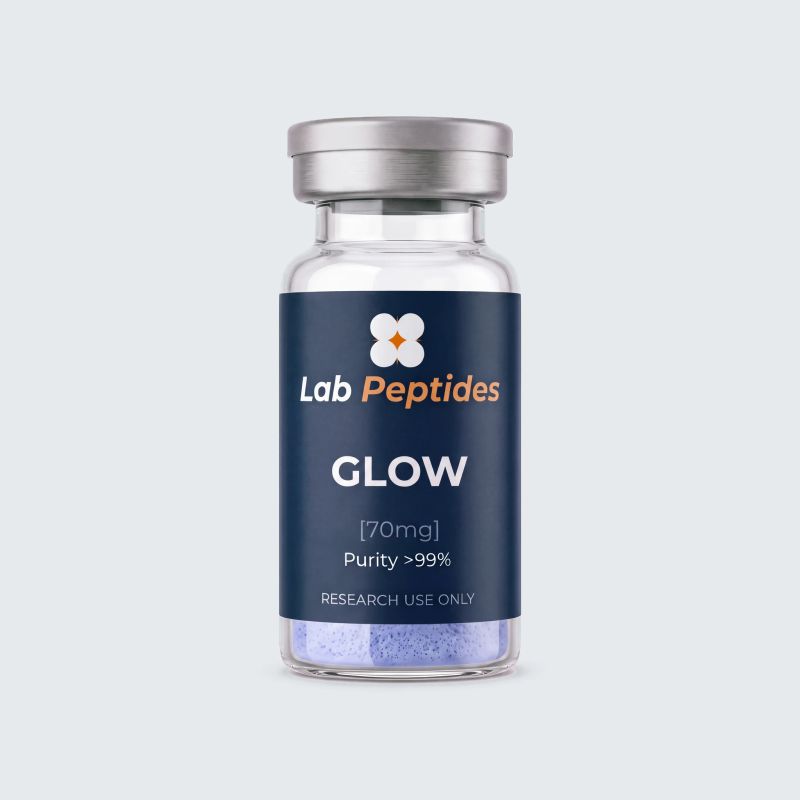
Glow 70mg Extracellular matrix
Three peptides, one vial. 99.4% purity.
- Certificate of analysis
- In stock in France
 Ordered with its water: shipped in a magnetic box
-10 % for life on each cyclePause, skip or cancel in 1 clickNo commitment, no hidden fees
No card: each delivery is paid in Bitcoin (extra -5%) or by bank transfer
Your complete kit
The vial alone cannot be used as is. Add what you need to prepare it:
Frequently bought together


Research Use Only (RUO) · Prohibited for human or veterinary use.
Key facts
GLOW 70 mg is a lyophilized combination formulation bringing together the three peptides most documented in cosmetic and regenerative research applied to skin and hair: GHK-Cu (50 mg), BPC-157 (10 mg), and TB-500 (10 mg). Each component targets a distinct biological lever of cutaneous tissue remodeling, and their combination covers the full cascade observed in preclinical dermal regeneration: extracellular matrix remodeling, local microvascular perfusion, and migration of resolving cell populations.
In detail
The logic behind this blend is not cosmetic marketingIt rests on an observation reproduced across more than forty years of peptide literature. Cutaneous renewal of injured, aged, or stressed tissue never mobilizes a single mechanism but an ordered sequence — controlled degradation of the old ECM, vascular recruitment to deliver nutrients and cells, repopulation by competent keratinocytes and fibroblasts, and synthesis of well-organized new collagen and elastin. No isolated peptide covers this complete sequence. GHK-Cu dominates matrix remodeling and transcriptomic modulation; BPC-157 specifically targets angiogenesis via the VEGF-R2/eNOS axis; TB-500 mobilizes migration of fibroblasts, keratinocytes, and endothelial cells toward remodeling zones. These three axes are additive, documented, and non-redundant.
Protocol and preparation
| Water added | Concentration | Reading marker |
|---|---|---|
| 2 ml | 35 mg/ml | 10 UI = 3,5 mg |
| 3 ml | 23,33 mg/ml | 10 UI = 2,33 mg |
The volume of water does not change the product, only its concentration. Add the water slowly along the vial wall, then swirl without shaking.
Asepsis
Disinfect surfaces and stoppers (70% alcohol).
Solvent
Draw the required volume of bacteriostatic water.
Introduction
Add gently against the vial wall (avoid a direct jet on the powder).
Solubilization
Roll the vial gently. Do not shake vigorously (degradation risk).
Solution storage Once reconstituted: 2-8°C (refrigerator).
Warning Theoretical tool for chemical handling. Does not constitute medical advice.
I open the dilution calculator- The amount of powder looks tiny. A lyophilisate takes up a few millimetres at the bottom of the vial, sometimes just a translucent film. The stated weight is there.
- The powder is compact, stuck to the wall or to the stopper. Transport moves the freeze-dried cake around. It changes nothing to reconstitution.
- The vial carries no individual label. That is our standard packaging, not a downgraded vial.
- After reconstitution, deposits or filaments appear. This is common, especially with small molecules. Let it settle and roll the vial between your palms, never shake it.
- The parcel is plain. Nothing on the outside indicates the contents or the brand name.
What is not normal: a cracked vial, an uncrimped cap or a stopper that moves, powder that has liquefied or changed colour. In those specific cases, write to us with a photo and we take the vial back.
The protocols documented for GHK-Cu + BPC-157 + TB-500 blends rest on a combination of peptide-by-peptide literature (well-established) and experimental practice in applied cosmetic research (case reports and industrial protocols). One 70 mg vial covers 20 to 30 days at 0.1-0.15 ml per day (2.33-3.5 mg).
Schedules documented in exploratory research.
Schedule A - Standard short protocol (cicatrization / pilot facial remodeling): 0.1-0.15 ml SC daily, abdominal or thigh location, 4-week cycle. Consumption: 0.1-0.15 ml per day, one 70 mg vial in 3 ml covers 20 to 30 days.
Schedule D - Loading-then-maintenance protocol0.2 ml SC daily for 14 days (loading phase), then 0.1 ml SC 3-4 times/week for 4-6 weeks (maintenance). Schedule inspired by BPC-157/TB-500 protocols in musculoskeletal research.
Cycles and pauses. The three peptides have no documented chronic toxicity, but peptide research tradition favors 4-8-week cycles with 2-4-week pauses between cycles. This pause allows evaluation of post-cessation duration of effect (remanence) and avoids hypothetical receptor desensitization phenomena.
Technical data
- Reconstitution
- 3 ml d'eau → 23,3 mg/ml. 10 UI = 2,33 mg ; 15 UI = 3,5 mg.
- Peptide sequence
- Mélange : GHK-Cu (prézatide de cuivre) (50 mg) + BPC-157 (10 mg) + TB-500 (thymosine β4) (10 mg)
- Physical form
- Poudre lyophilisée bleutée
- Recommended solubility
- Eau bactériostatique, NaCl 0,9%
- Storage conditions
- Au réfrigérateur (+2 à +8 °C), à l'abri de la lumière. En poudre, possible au congélateur pour une conservation longue. Une fois préparé : réfrigérateur, jamais au congélateur.
- Use
- Research reagent, in vitro only (RUO)
Storage & handling
GLOW is a tri-peptide blend combining a copper-peptide complex (GHK-Cu), a gastric pentadecapeptide (BPC-157), and a thymic fragment (TB-500). Each of these components has its own stability requirements, and the blend's behavior in solution reflects the most fragile compound.
Unopened lyophilized powder. Storage in the fridge (+2 to +8 °C) in the original packaging, protected from direct light: documented stability 12-18 months. For storage beyond 3 months, a -20 °C freezer remains an option, with documented stability of 24 months. At controlled room temperature (15-25 degrees), stability limited to 3-6 months, with progressive degradation observable via discoloration of the lyophilized cake (shift from normal bluish tint to a greenish-brown in case of copper complex loss).
Reconstituted vial. Refrigerated storage only 2-8 degrees, in its packaging or an opaque container. Practical stability 14-21 days, limited mainly by the BPC-157 component (less stable in solution than GHK-Cu, which benefits from stabilization by the copper complex). TB-500 is relatively stable in solution (10-14 days comfortably). The weak point of the blend in solution is therefore BPC-157: beyond 21 days, the relative proportion of peptides shifts (degraded BPC-157, still-active GHK-Cu and TB-500) and the blend loses its pharmacological balance.
Visual degradation signs. The freshly reconstituted solution presents a very-pale-blue to pale blue-green coloration, due to the GHK-Cu complex. This coloration is the main visual marker of integrity. Warning signs: color shifting to brown or dark greenish (copper oxidation or release of the cupric ion), appearance of particles or turbidity (peptide precipitation or contamination), total loss of coloration (copper release in free solution, denatured complex). In all these cases, discard the vial.
Light protection. The GHK-Cu complex is modestly photosensitive: keep the vial in its cardboard sleeve or an aluminum pouch. UV radiation can dissociate the copper complex. For long storage, aluminum packaging or a refrigerator with an opaque door is preferable.
Freeze-thaw cycles. The lyophilized powder tolerates several out-and-back cold cycles without significant degradation, provided each cycle remains short (less than 30 minutes at room temperature) and the powder does not take up moisture. The reconstituted solution must NEVER be frozen: freezing significantly degrades all three peptides and can dissociate the GHK-Cu copper complex.
Transport. Upon shipping, the vial typically travels at ambient temperature 48-72 hours, with no documented impact on lyophilized powder stability. If the parcel arrives with an abnormally colored cake (greenish, brown, or totally white without any bluish tint), photograph and contact the laboratory before reconstitution.
Practical "split vial" tip. For a researcher planning to use the blend over more than 3 weeks, it may be preferable to split reconstitution in two: reconstitute half the vial in 1.5 ml of bacteriostatic water, use over 2 weeks, then reconstitute the other half. This however requires an initial aliquoted cake, rarely provided by default. In practice, reconstitute entirely in 3 ml and strictly respect the 14-21 day window.
Mechanism of action
The mechanistic basis of GLOW rests on the convergence of three complementary modes of action, each rigorously documented in peptide and dermato-cosmetological literature.
GHK-Cu: cutaneous transcriptome and matrix remodeling (50 mg). The tripeptide Gly-His-Lys (GHK) was isolated in 1973 by Loren Pickart at the University of California San Francisco, initially identified as an albumin-fraction tissue regeneration factor in human plasma. The physiologically active form is the copper-peptide complex GHK-Cu (Gly-His-Lys-Cu2+), in which the cupric ion is chelated by the central histidine residue and the terminal amine/carboxyl functions. This copper coordination is indispensable: it enables selective copper transport to target cells (fibroblasts, keratinocytes) and activates copper-dependent transcriptional programs. The Pickart-Margolina 2015 publication (Biomed Res Int) documented via microarray analysis the modulation of more than 4,192 human genes under GHK-Cu exposure, including upregulation of collagen I and III, elastin, proteoglycans, copper-dependent SOD, and downregulation of senescent and inflammatory markers. This transcriptomic signature simultaneously covers matrix synthesis, antioxidant action, mitochondrial restoration, and immune modulation — making GHK-Cu probably the most versatile peptide in the cosmetic repertoire.
BPC-157: controlled angiogenesis and cytoprotection (10 mg). The pentadecapeptide BPC-157, derived from the human gastric protective protein, was characterized by Predrag Sikirić's team in Zagreb from the 1990s onward with more than 500 accumulated publications. In the cutaneous context, its dominant action is induction of localized angiogenesis via VEGF-R2 activation (Chang 2011, Journal of Applied Physiology) and the eNOS/endothelial NO synthase pathway. This targeted angiogenesis is qualitatively different from that induced by recombinant VEGF: more structured, less leaky, with formation of functional capillary networks rather than chaotic neo-vessels. In a cosmetic blend, BPC-157 ensures the perfusion necessary for nutrient, oxygen, and cell delivery to zones where GHK-Cu initiates matrix remodeling.
TB-500: cell migration and cytoskeletal polymerization (10 mg). TB-500 is the active fragment of thymosin beta-4 (Tβ4), a 44-amino-acid protein discovered by Allan Goldstein in 1981 (PNAS). The central mechanism rests on reversible sequestration of monomeric G-actin, thereby regulating dynamic polymerization of the cytoskeleton (Safer 1991, J Biol Chem). This regulation allows keratinocytes, fibroblasts, and endothelial cells to migrate efficiently toward remodeling zones. Works by Malinda (1999, J Invest Dermatol) and Philp (2003, Ann N Y Acad Sci) have specifically documented the pro-migratory activity of Tβ4 on human keratinocytes and its role in cutaneous reepithelialization. TB-500 also releases the tetrapeptide AcSDKP (acetyl-Ser-Asp-Lys-Pro), a proper angiogenic agent that potentiates the vascular action of BPC-157.
Quantifiable synergy. The combination of the three peptides is not simple additivity: it creates positive feedback loops. GHK-Cu increases GAG and collagen expression, BPC-157 ensures nutrient perfusion of these new matrix deposits, TB-500 brings producer cells to the sites.
Studies and references
The literature applicable to GLOW breaks down between the corpora proper to each peptide and emerging work on cosmetic multi-peptide blends. These three corpora are among the best documented in all modern peptide science.
GHK-Cu corpus (Pickart and school, 1973-2024). Pickart 1973 (Nature New Biol): original isolation of the tripeptide as a hepatotrophic factor from human plasma. Pickart 1980 (FASEB J): characterization of the copper complex and demonstration of lysyl oxidase activation (collagen-elastin cross-linking). Maquart 1993 (FEBS Letters): direct stimulation of glycosaminoglycan synthesis by human dermal fibroblasts. Maquart 1999 (J Investig Dermatol Symp Proc): porcine cutaneous wound model, significant cicatrization acceleration. Abdulghani 1998: clinical facial study (dermatoheliosis) N=71, improved dermal thickness and firmness. Leyden 2002: facial anti-wrinkle cream study, reduction of deep wrinkles. Pickart-Margolina 2012 (Int J Biol Sci) and 2015 (Biomed Res Int): integrated transcriptomic analyses, 4,192-gene signature, systematic review of validated cosmetic applications. Uno 1993: first work on follicular growth in macaques, foundation of subsequent hair developments.
Emerging literature on multi-peptide blends. The explicit GHK-Cu + BPC-157 + TB-500 combination has not yet been the subject of a published clinical trial in a rank-A journal, and this reality must be acknowledged. Unpublished industrial preclinical work probably exists, and regenerative medicine practitioners have documented topical and injectable protocols in case reports. Our scientific position is honest: the mechanistic rationale is solid (three axes individually documented and theoretically complementary), but controlled validation of the precise combination remains to be consolidated. This is exactly what makes this blend interesting for an exploratory research laboratory.
Hair literature (hair applications). Pickart-Margolina 2018 synthesizes hair data on GHK-Cu: stimulation of dermal papilla cells, increase of the anagen phase, indirect anti-DHT effect. Philp 2004 (FASEB J) documents the role of Tβ4 in the follicular growth phase. These axes open GLOW's use in hair research, beyond simple facial cutaneous remodeling.
Frequently asked questions
Why combine three peptides rather than use GHK-Cu alone?
Should the reconstituted solution be blue?
How long before observing a visible effect on the skin?
What's the main difference between GLOW and KLOW?
 Read before you orderDermatological peptides in research: GHK-Cu, Matrixyl, Argireline and the science of cosmeceuticalsScientific synthesis on research dermatological peptides: GHK-Cu and copper complexes, Matrixyl and synthetic tripeptides, Argireline and acetylhexapeptides, collagen mechanisms and in vitro studies. Strict RUO framework.Read the article