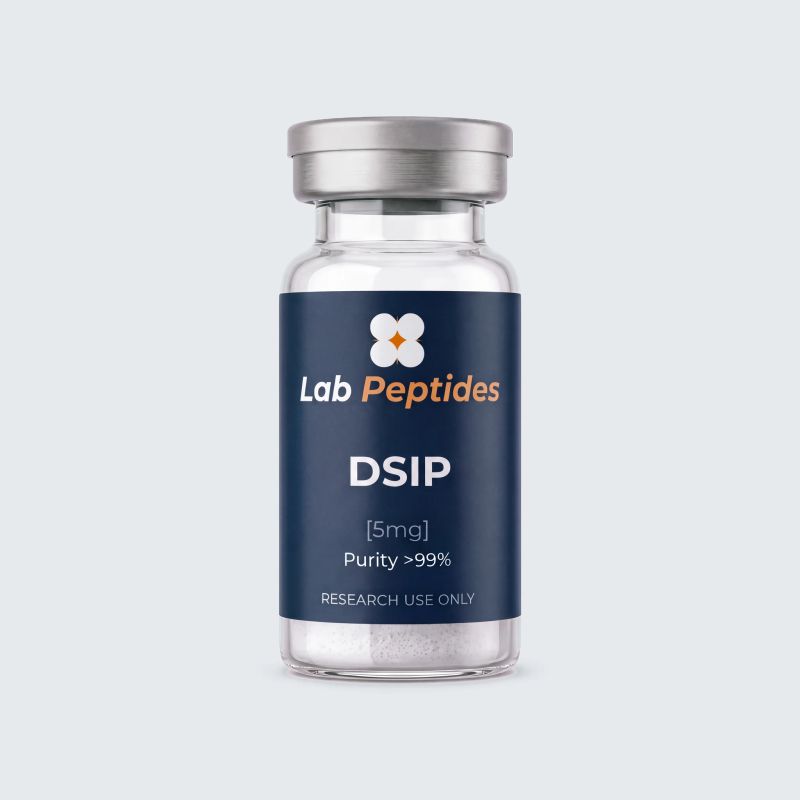
DSIP 5mg Senescencia celular
Nonapéptido escaso. Analizado al 99,2 %.
El péptido del sueño profundo. Delta Sleep-Inducing Peptide aumenta la duración de las fases lentas del sueño — las que de verdad reparan. Arquitectura del sueño restaurada, fatiga crónica eliminada. Descubierto en 1977 por la Universidad de Basilea, avalado por más de 40 años de investigación. Para quien ya no duerme.
- Certificado de análisis
- Stock en Francia
 Pedido con su agua: enviado en estuche imantado
-10 % de por vida en cada cicloPause, salte o cancele en 1 clicSin compromiso, sin gastos ocultos
Sin tarjeta: cada envío se paga en Bitcoin (-5 % adicional) o por transferencia
Tu kit completo
El vial por sí solo no puede usarse tal cual. Añada lo necesario para prepararlo:
Se compran juntos a menudo


Uso exclusivo en investigación (RUO) · Prohibido para uso humano o veterinario.
Lo esencial
DSIP (Delta Sleep-Inducing Peptide) is an endogenous nonapeptide with the sequence Trp-Ala-Gly-Gly-Asp-Ala-Ser-Gly-Glu, molecular mass 848.81 Da, first isolated in 1977 by Guido Schoenenberger and Marcel Monnier at the University of Bern from the cerebral venous blood of rabbits placed in a sleep state via low-frequency thalamic stimulation. This neuroactive peptide holds a singular place in peptide literature: heavily publicized in the 1980s-1990s as the "deep sleep molecule", it is today studied through a much broader lens encompassing neuroendocrine modulation, stress adaptation, thermoregulation, and neuroprotection under deprivation conditions.
En detalle
The 5 mg DSIP reference we offer targets laboratories and investigators working on short-chain neuromodulatory peptides, circadian dysregulation models, and exploratory protocols examining delta EEG activity (1-4 Hz). Unlike classical hypnotics (benzodiazepines, Z-drugs, GHB), DSIP acts neither through direct GABAergic facilitation nor through global sedation: animal data suggest a subtle "desynchronization/resynchronization" action on sleep-wake cycles, which differentiates it radically from anesthesia-adjacent hypnotics.
This document synthesizes what forty-seven years of scientific literature allow us today to assert, hypothesize, and question about DSIP: its Bernese historical origin, the never-fully-closed debate about its receptor, preclinical findings on delta sleep, pilot clinical data from the 1980s-1990s (including several Soviet and East-German trials), and the current research positioning of this peptide. Every statement is framed by the Research Use Only (RUO) regulatory framework governing our entire catalog.
Protocolo y preparación
| Agua añadida | Concentración | Marca de lectura |
|---|---|---|
| 1 ml | 5 mg/ml | 40 UI = 2 mg |
| 2 ml | 2,5 mg/ml | 40 UI = 1 mg |
El volumen de agua no cambia el producto, solo su concentración. Introduzca el agua despacio por la pared del vial y gírelo sin agitar.
Asepsia
Desinfecte las superficies y los tapones (alcohol al 70%).
Disolvente
Extraiga el volumen necesario de agua bacteriostática.
Introducción
Vierta suavemente contra la pared del vial (evite el chorro directo sobre el polvo).
Solubilización
Haga rodar el vial suavemente. No lo agite con fuerza (riesgo de degradación).
Conservación de la solución Una vez reconstituido: 2-8°C (nevera).
Advertencia Herramienta teórica para manipulación química. No constituye un consejo médico.
Abro la calculadora de dilución- La cantidad de polvo parece mínima. Un liofilizado ocupa unos pocos milímetros en el fondo del vial, a veces solo una película translúcida. El peso indicado está ahí.
- El polvo está compacto, pegado a la pared o al tapón. El transporte desplaza la torta liofilizada. No cambia nada en la reconstitución.
- El vial no lleva etiqueta individual. Es nuestro embalaje estándar, no un vial de menor calidad.
- Tras la reconstitución aparecen depósitos o filamentos. Es habitual, sobre todo con moléculas pequeñas. Deje que se asiente y haga rodar el vial entre las palmas, nunca lo agite.
- El paquete es neutro. Nada en el exterior indica el contenido ni el nombre de la marca.
Lo que no es normal: un vial agrietado, una cápsula sin engastar o un tapón que se mueve, polvo que se ha licuado o cambiado de color. En esos casos concretos, escríbanos con una foto y recuperamos el vial.
Reconstitution. Add 2 ml of 0.9% bacteriostatic water (benzyl alcohol preserved) to the lyophilized 5 mg vial, allowing the solution to flow slowly against the inner wall rather than directly onto the lyophilized cake. DSIP is less stable in solution than most short peptides: the N-terminal tryptophan motif is sensitive to photo-induced oxidation, and the central Gly-Gly bonds can undergo partial hydrolysis in prolonged aqueous medium. Do not shake vigorously (denaturation risk); gently swirl the vial until complete dissolution (30-60 seconds). Final concentration: 2.5 mg/ml, or 250 mcg per 0.1 ml on a U100 insulin syringe.
Post-reconstitution storage. Refrigerated 2-8 degrees, protected from light (wrap the vial in aluminum or keep in an opaque container). Documented stability 10-14 days maximum in solution, versus 18-24 months for lyophilized powder at -20 degrees. Never freeze/thaw the reconstituted solution (significant degradation after a single cycle).
Schedules documented in the preclinical and pilot clinical literature.
Schedule D - Russian "deltaran-like" protocol100-150 mcg SC morning AND evening for 14-21 days, targeting adaptogenic/anti-stress positioning rather than pure hypnotic.
Critical timing. Unlike melatonin (DLMO window 30-60 min before bedtime), DSIP appears better documented with a wider administration window (30 min to 2 hours before bedtime). Several Russian works even suggest late-afternoon administration with a delta-sleep peak delayed by several hours, more compatible with the kinetics of a peptide with a brief serum half-life but prolonged central effect.
Datos técnicos
- Reconstitución
- 2 ml d'eau → 2,5 mg/ml. 4 UI = 100 mcg ; 8 UI = 200 mcg.
- Secuencia peptídica
- Trp-Ala-Gly-Gly-Asp-Ala-Ser-Gly-Glu
- Fórmula molecular
- C35H48N10O15
- Peso molecular
- 848.8 g/mol
- Número CAS
- 62568-57-4
- Forma física
- Poudre lyophilisée
- Solubilidad recomendada
- Eau bactériostatique, NaCl 0,9%
- Condiciones de conservación
- Au réfrigérateur (+2 à +8 °C), à l'abri de la lumière. En poudre, possible au congélateur pour une conservation longue. Une fois préparé : réfrigérateur, jamais au congélateur.
- Uso
- Reactivo de investigación, solo in vitro (RUO)
Conservación y manipulación
DSIP belongs to the intermediate-stability peptide categoryMore fragile than cyclic cysteine-rich peptides (BPC-157, thymosins), more robust than peptides with highly reactive amide bonds. Three critical factors condition preservation of biological activity: oxidation of the N-terminal tryptophan, hydrolysis of the central Gly-Gly bonds, and global photo-induced degradation.
Unopened lyophilized powder. Storage in the fridge (+2 to +8 °C), in the original unopened packaging, protected from light: documented stability 12 months. For longer storage, a -20 °C freezer remains an option, with documented stability of 24 months. At controlled room temperature (15-25 degrees), stability drops to 3-6 months maximum, with progressive tryptophan-residue degradation observable by HPLC. It is crucial to remove the powder from cold and let it equilibrate 15-30 minutes before opening: any condensation on the powder significantly accelerates hydrolysis and can make the lyophilized cake visually cloudy or sticky.
Reconstituted vial. Refrigerated storage only 2-8 degrees, in an opaque container or wrapped in aluminum. Avoid the refrigerator door (thermal variations). Practical stability 10-14 days, with estimated activity loss of 15-25% at D14 according to accelerated-degradation studies. Beyond 14 days, discard the solution even if visually unchanged: tryptophan oxidation is progressive and invisible to the eye but impacts biological response.
Degradation signs to monitor. Normally clear and colorless solution after reconstitution. Appearance of a slight yellow tint: advanced oxidation, compromised activity. Presence of particles or turbidity: microbial contamination (benzyl alcohol protects but not indefinitely) or peptide precipitation, discard immediately. Abnormal odor: rare but reported in contamination cases, stop signal.
Transport and reception. A DSIP shipment remains viable even after 48-72 hours at room temperature provided the powder has remained dry and protected from direct light. Occasional cold-chain loss (a few hours) has limited impact on lyophilized powder (unlike complex disulfide peptides). Upon receipt of a visibly wet, melted, or decomposed cake, photograph and contact the laboratory before any reconstitution.
Good practice for sensitive short peptides. Prepare small volumes used quickly rather than reconstituting the entire large vial at once. For the 5 mg reference, the 2 ml bacteriostatic water schema is the right compromise between practicality and stability. Note the reconstitution date on the vial with indelible marker.
Mecanismo de acción
The mechanism of action of DSIP remains, to this day, one of the most intriguing in neuropeptidology. Unlike most modern peptides, no specific high-affinity receptor has been cloned and formally characterized for DSIP, despite four decades of investigation. This absence of a structurally isolated receptor long slowed DSIP's acceptance in the academic neuroscience canon, but has not prevented the reproduction of coherent biological phenotypes across dozens of preclinical models.
The Trp-Ala-Gly-Gly-Asp-Ala-Ser-Gly-Glu sequence is remarkably short and devoid of basic residues. This neutral-to-slightly-acidic chemistry confers high conformational flexibility and a documented ability to cross the blood-brain barrier despite its size, attributable to probable transit through circumventricular organs. The 848.81 Da mass, well above the theoretical passive-diffusion limit (400-500 Da), long puzzled neurophysiologists until radiolabeled-fragment studies confirmed cerebral passage (Banks-Kastin 1984).
Electrophysiologically, the seminal work of Monnier and Schoenenberger (1977, 1984) documented a significant increase in delta-band (1-4 Hz) spectral power on the cortical EEG of rabbits and rats, without a preceding phase of behavioral sedation. This delta increase distinguished DSIP from classical hypnotics: sleep architecture was reorganized rather than forcibly imposed, with preservation of REM cycles and absence of rebound insomnia upon withdrawal.
Modern mechanistic hypotheses favor multi-target indirect modulation rather than a single receptor. Three axes emerge from the post-2000 literature. First, modulation of the somatotropic axis: several works (Graf 1984, Iyer 1988) documented a transient elevation of nocturnal GH and an attenuation of the morning cortisol peak, suggesting upstream hypothalamic action. Second, interaction with the endogenous opioidergic system: DSIP modifies responsiveness to opioid agonists without being opioid itself, interpreted as allosteric or indirect action. Third, a documented antioxidant and neuroprotective effect in ischemia models, attributed to partial ROS scavenging by the N-terminal tryptophan motif.
Finally, recent Russian work (Kovalzon, Sudakov, Mikhaleva) has proposed that DSIP acts as an adaptogenic peptide in the strict sense: it normalizes dysregulated parameters (excess cortisol, delta deficit, sympathetic hyperactivity) without significantly modifying already-balanced parameters in healthy subjects. This "bidirectional" signature remains difficult to validate with modern methodology and must be considered a working hypothesis, not an established fact.
Estudios y referencias
The DSIP literature is uniqueIt combines an initial effervescent phase (1977-1995) with high-quality Western work, an under-exposed Russian discovery phase (1990-2010) with hard-to-access pilot clinical data, and a contemporary phase (post-2010) marked by renewed interest focused on neuroprotective applications.
European clinical studies 1982-1995. Scherschlicht et al. publish in Eur Neurol (1986) the first human data on chronic insomniacs under intravenous DSIP, with documented increase of delta power on polysomnography but mixed subjective results. Schneider-Helmert (Zurich 1985, 1988) conducts several series on opioid and alcohol withdrawal syndrome, documenting reduction of withdrawal dysphoria and insomnia. These works remain pilots (N<30 per study) and have never been the subject of modern double-blind RCTs against active placebo.
Russian and Soviet studies 1985-2010. This literature remains the least known in the West. Mikhaleva, Ivanov et al. at the Shemyakin Institute in Moscow conduct extensive work on DSIP analogs (notably deltaran, Russian formulation) for post-traumatic stress applications, chronic alcoholism, and extreme-condition adaptation (cosmonauts, deep-sea divers). Sudakov publishes in Bull Exp Biol Med (1995-2010) several series on DSIP and emotional stress. Kovalzon of the Russian Academy of Sciences synthesizes this literature in 2003 and 2015: DSIP is positioned there as an adaptogenic peptide more than a pure hypnotic.
Contemporary work 2010-2024. Post-2010 renewed interest has shifted toward three axes. First, neuroprotection under oxidative stress conditions: Mendzheritskii et al. (2014) document hippocampal protection against induced hypoxic crises in rats. Second, HPA axis modulation: Khvatova (2018, 2021) explores DSIP in circadian dysregulation models simulating jet lag. Third, thermoregulation: a few works evoke a role in pharmacological hibernation, which remains speculative.
- 1
- 2
Preguntas frecuentes
Is there a risk of dependence or tolerance?
Can DSIP be combined with other peptides or hormones?
Why so little modern data on DSIP?
 Lee antes de pedirPéptidos y sueño en investigación: DSIP, orexina y modulación del eje hipotalámicoDSIP, orexina, galanina, MCH: mapa de los péptidos neuromoduladores explorados en la investigación sobre los ciclos sueño-vigilia, la regulación circadiana y las arquitecturas NREM/REM.Leo el artículo