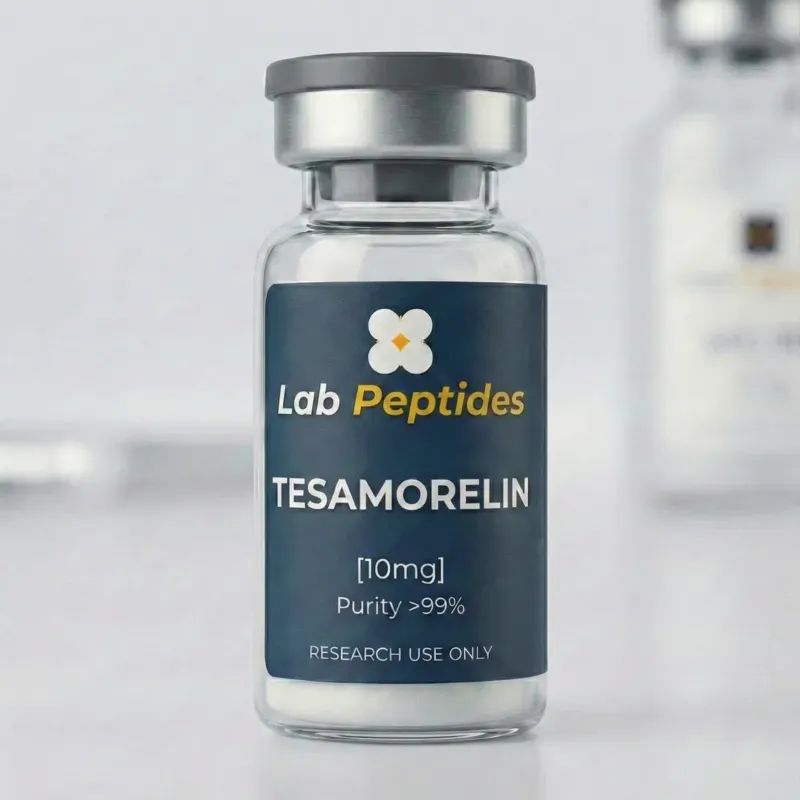
Tesamorelin 10mg Weight Loss
Stabilized analog of human GHRH. The reference secretagogue in literature on visceral adipose tissue mobilization.
The only FDA-approved GHRH peptide. Targets abdominal visceral fat exclusively — the kind no cardio touches. -18% visceral fat documented over 26 weeks. The world's #1 belly-fat burner, validated by science.
-10 % for life on each cyclePause, skip or cancel in 1 clickNo commitment, no hidden fees
One sealed vial of Tesamorelin 10mg, lyophilised, without individual labelling.
Bacteriostatic water for reconstitution and 1 ml precision syringes graduated in 100 units, sold separately. The vial alone cannot be used as is.
Don't forget the essentials

Our Tesamorelin 10 mg vial is the only currently FDA-approved GHRH analog (2010, commercial name Egrifta, HIV lipodystrophy indication), making it the best-documented peptide in the GHRH class in human clinical use. Developed by Theratechnologies (Montreal), Tesamorelin is a 44-amino-acid analog of native GHRH, stabilized by a trans-3-hexenoic group attached at the N-terminal position.
With 10 mg of lyophilized peptide per vial at HPLC purity >=99 percent, this format covers approximately 5 days of protocol at the pharmaceutical reference dose (2 mg/day, Falutz 2007/2010 pivotal dose on the original Egrifta formulation); the current Egrifta SV formulation (FDA 2019) reduces the daily dose to 1.4 mg/day SC. Each Atlas Lab vial ships with a complete Certificate of Analysis (COA): HPLC profile, mass spectrum, endotoxin tests, full batch traceability.
Tesamorelin stands out with a robust clinical corpus including pivotal phase 3 trials on over 800 patients (HIV lipodystrophy indication), with 52-week data documenting a significant reduction in visceral fat (visceral adipose tissue, VAT) and improved lipid parameters. It remains the absolute flagship of the GHRH class for laboratories prioritizing a peptide with tolerance and efficacy profile validated in regulatory human clinical studies.
01Mechanism of action
Tesamorelin is a complete synthetic analog of native human GHRH (44 amino acids), modified by adding a trans-3-hexenoic acid group at the N-terminal position. This chemical modification, developed by Theratechnologies, protects the peptide from degradation by dipeptidyl peptidase IV (DPP-IV), the main enzyme responsible for the short half-life of native GHRH. Total molecular weight ~5196 Da, chemical formula C221H366N72O67S.
At the molecular level, Tesamorelin activates the GHRH-R receptor expressed on the surface of somatotropic cells of the anterior pituitary, with affinity and efficacy comparable to native GHRH. Receptor binding triggers a Gs-cAMP-PKA signaling cascade leading to GH synthesis and pulsatile release. The primary mechanism is therefore identical to Sermorelin (GHRH 1-29) and CJC-1295 (tetra-substituted analog), but pharmacokinetics differ: approximately 8-minute plasma half-life for Tesamorelin via SC route (FDA Egrifta SV label) versus 10-15 min for Sermorelin and 6-8 days for CJC-1295 DAC.
The originality of Tesamorelin lies in its efficacy profile specifically documented on VISCERAL FAT REDUCTION (VAT). Pivotal phase 3 trials on HIV lipodystrophy showed an average 15-18 percent VAT reduction after 26 weeks, with effect maintenance at 52 weeks. This reduction is attributed to the lipolytic effect of amplified endogenous GH and its tissue-specific differential effect: visceral adipose tissue is more sensitive to GH-induced lipolysis than subcutaneous adipose tissue.
The pulsatile GH secretion induced by Tesamorelin remains physiological (preservation of endogenous pulses), distinguishing this approach from exogenous recombinant GH administration producing supra-physiological non-pulsatile levels. IGF-1 increases 80-100 percent from baseline after 26 weeks, a value comparable to CJC-1295 DAC trials but with daily rather than weekly kinetics.
Tesamorelin is FDA-approved (2010) and Health Canada-approved (2013) for the treatment of lipodystrophy in HIV patients under antiretroviral therapy. EMA refused authorization in 2014 for reasons of benefit-risk ratio deemed insufficient in the European population. Outside HIV indication, Tesamorelin remains strictly an exploratory research peptide.
Similar peptides
Tesamorelin occupies a unique position in the GHRH analog class: it is the only peptide in this family to have obtained maintained FDA approval (Egrifta, 2010, HIV lipodystrophy indication). Its validated clinical profile distinguishes it from all other molecules in the class.
Compared to CJC-1295 DAC (tetra-substituted GHRH analog with Drug Affinity Complex, 6-8 day half-life), Tesamorelin presents a short plasma half-life of approximately 8 minutes via SC route (FDA Egrifta SV label). Both peptides significantly increase IGF-1 (80-100 percent for Tesamorelin, similar for CJC-1295 DAC), but with radically different kinetics: daily injection for Tesamorelin vs weekly for CJC-1295 DAC. Tesamorelin benefits from regulatory human phase 3 clinical data, CJC-1295 DAC does not exceed phase 2.
Compared to Sermorelin (truncated native GHRH 1-29, 10-15 minute half-life), Tesamorelin offers significantly superior plasma stability thanks to its DPP-IV resistance. Sermorelin requires 1-2 daily injections, Tesamorelin one daily injection. Tesamorelin also surpasses Sermorelin in clinical corpus (approved phase 3 vs historical phase 2).
Compared to CJC-1295 without DAC (Mod GRF 1-29, tetra-substituted GHRH 1-29 analog without albumin, 30-minute half-life), Tesamorelin covers the complete 1-44 sequence of native GHRH with N-terminal protective group. GH stimulation profiles are comparable, but Tesamorelin benefits from superior regulatory human clinical data.
Compared to GHRPs (Ipamorelin, GHRP-6, Hexarelin), Tesamorelin acts on the GHRH-R pathway (GHRH receptor) while GHRPs activate the GHS-R1a pathway (ghrelin receptor). The two pathways are independent and synergistic — some exploratory protocols associate Tesamorelin + Ipamorelin to amplify GH effect.
Compared to exogenous recombinant GH (somatropin), Tesamorelin preserves the physiological pulsatility of endogenous secretion, maintaining better tissue response, avoiding GH-R desensitization, and presenting a more balanced metabolic profile (glycemic neutrality vs diabetogenic effect often documented with high-dose exogenous GH).
On the research peptide market, Tesamorelin is the GHRH class flagship thanks to its unique clinical corpus. Its commercialization for therapeutic use in France is however prohibited (2014 EMA refusal) — strict research use on European territory.