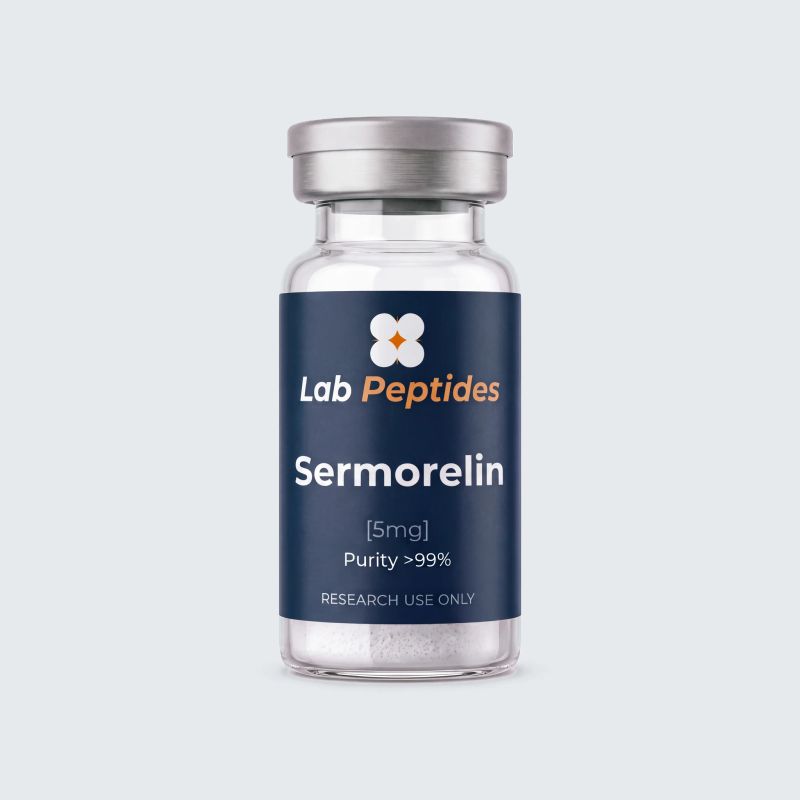
Sermorelin 5mg Cellular senescence
The original GHRH 1-29 fragment.
The reference GHRH analog. Sermorelin restarts your natural growth-hormone production — clean, physiological stimulation. Preserves feedback loops, no axis-inhibition risk. The premium pick for hormonal longevity.
- In stock in France
 Ordered with its water: shipped in a magnetic box
-10 % for life on each cyclePause, skip or cancel in 1 clickNo commitment, no hidden fees
No card: each delivery is paid in Bitcoin (extra -5%) or by bank transfer
Your complete kit
The vial alone cannot be used as is. Add what you need to prepare it:
Research Use Only (RUO) · Prohibited for human or veterinary use.
Key facts
Protocol and preparation
| Water added | Concentration | Reading marker |
|---|---|---|
| 1 ml | 5 mg/ml | 40 UI = 2 mg |
| 2 ml | 2,5 mg/ml | 40 UI = 1 mg |
The volume of water does not change the product, only its concentration. Add the water slowly along the vial wall, then swirl without shaking.
Asepsis
Disinfect surfaces and stoppers (70% alcohol).
Solvent
Draw the required volume of bacteriostatic water.
Introduction
Add gently against the vial wall (avoid a direct jet on the powder).
Solubilization
Roll the vial gently. Do not shake vigorously (degradation risk).
Solution storage Once reconstituted: 2-8°C (refrigerator).
Warning Theoretical tool for chemical handling. Does not constitute medical advice.
I open the dilution calculator- The amount of powder looks tiny. A lyophilisate takes up a few millimetres at the bottom of the vial, sometimes just a translucent film. The stated weight is there.
- The powder is compact, stuck to the wall or to the stopper. Transport moves the freeze-dried cake around. It changes nothing to reconstitution.
- The vial carries no individual label. That is our standard packaging, not a downgraded vial.
- After reconstitution, deposits or filaments appear. This is common, especially with small molecules. Let it settle and roll the vial between your palms, never shake it.
- The parcel is plain. Nothing on the outside indicates the contents or the brand name.
What is not normal: a cracked vial, an uncrimped cap or a stopper that moves, powder that has liquefied or changed colour. In those specific cases, write to us with a photo and we take the vial back.
Technical data
- Reconstitution
- 2 ml d'eau → 2,5 mg/ml. 8 UI = 200 mcg ; 12 UI = 300 mcg ; 20 UI = 500 mcg.
- Peptide sequence
- YADAIFTNSYRKVLGQLSARKLLQDIMSR-NH2
- Molecular formula
- C149H246N44O42S
- Molecular weight
- 3357.9 g/mol
- CAS number
- 86168-78-7
- Physical form
- Poudre lyophilisée
- Recommended solubility
- Eau bactériostatique, NaCl 0,9%
- Storage conditions
- Au réfrigérateur (+2 à +8 °C), à l'abri de la lumière. En poudre, possible au congélateur pour une conservation longue. Une fois préparé : réfrigérateur, jamais au congélateur.
- Use
- Research reagent, in vitro only (RUO)
Storage & handling
Lyophilized unreconstituted Sermorelin is stored in the fridge (+2 to +8 °C) in its original sealed packaging, protected from light and humidity; for long-term storage (over 3 months), a -20 °C freezer keeps it for up to 24 months. At refrigerated temperature (2-8 degrees Celsius), documented stability covers a minimum of 12 months. At room temperature (below 25 degrees Celsius), recommended duration for transport or temporary storage: 2 weeks maximum (Sermorelin is more sensitive than modern extended half-life peptides). Once reconstituted with bacteriostatic water, Sermorelin must be stored between 2 and 8 degrees Celsius. Documented post-reconstitution stability: 14-21 days with bacteriostatic (benzyl alcohol 0.9%), 5-7 days with preservative-free sterile water. This relatively short stability compared to modern peptides reflects the native (unmodified) nature of the 1-29 sequence. Specific sensitivities: Sermorelin is particularly sensitive to degradation by dipeptidyl peptidase IV (DPP-IV) in biological environment — hence its short 10-15 minute plasma half-life. In vitro, avoid repeated freeze-thaw cycles (limit to three), UV exposure, thermal shocks, and contact with non-inert metallic surfaces. Prefer aliquots for large-volume formats.
Mechanism of action
Sermorelin is a synthetic 29-amino-acid peptide corresponding to the first 29 N-terminal residues of native human GHRH (the complete molecule has 44 amino acids). Molecular weight 3358 Da. Truncation at position 29 fully preserves the active site necessary for GHRH-R receptor activation, while simplifying chemical synthesis and offering sufficient stability for clinical use.
At the molecular level, Sermorelin activates the GHRH-R receptor expressed on the surface of somatotropic cells of the anterior pituitary. Receptor binding triggers a Gs-cAMP-PKA signaling cascade leading to GH synthesis and its pulsatile release from storage granules. Sermorelin faithfully reproduces the action of endogenous native GHRH, preserving the physiological pulsatility of GH secretion — a critical element since pulses are essential to downstream tissue response (IGF-1, lipolysis, protein synthesis).
GHRH-R receptor activation by Sermorelin does NOT produce significant increases in prolactin, cortisol, or ACTH. It depends on physiological pulsatile stimulation rather than continuous exposure, thus avoiding receptor desensitization. Sermorelin thus retains its efficacy over extended protocols, unlike certain GHRH analogs with overly extended kinetics.
Studies and references
The scientific corpus on Sermorelin is one of the oldest and most documented in the GHRH analog class, with over three decades of publications covering pharmacokinetics, pharmacodynamics, pediatric and geriatric clinical trials.
Gelato et al. (JCEM 1983, 1984) had previously studied the pharmacology of native 1-44 GHRH in humans, providing the comparative framework that validated Sermorelin 1-29 as functional equivalent. The absence of clinically significant difference between the two forms justified the choice of the truncated fragment for commercial development (more economical to synthesize).
Vittone et al. (JCEM 1997; DOI 10.1210/jcem.82.12.4451) conducted a landmark study in healthy older subjects, documenting partial restoration of GH pulses and IGF-1 increase after daily Sermorelin for 16 weeks. This study inspired numerous research protocols on somatotropic aging.
Corpas et al. (JCEM 1993) studied the pituitary response to Sermorelin in normal older subjects, documenting a preserved but attenuated response compared to young subjects — suggesting a progressive decline in pituitary sensitivity with age.
Corpus limitationsDespite its age, Sermorelin has been supplanted in modern research by extended half-life GHRH analogs (CJC-1295 DAC, Tesamorelin). Long-term data (>2 years) are limited in adults. Sermorelin remains strictly a research peptide outside historical pediatric indications.
- 1
Frequently asked questions
Is your Sermorelin authentic?
What is the delivery lead time in Europe?
 Read before you orderGH secretagogues in research: CJC-1295, Ipamorelin, GHRP-2/6, hexarelin, MK-677 — mechanisms, synergies and preclinical protocolsComprehensive scientific overview of growth hormone secretagogues: GHRH analogues (sermorelin, CJC-1295, tesamorelin), peptide GHRPs (Ipamorelin, GHRP-2/6, hexarelin), non-peptide GHS-R1a agonist (MK-677). Pharmacology, GHRH+GHRP synergy, rodent models, analytical QC, RUO framework.Read the article
Also read:GHRH vs GHRP: the 2026 research peptide comparison for growth hormone secretagogues