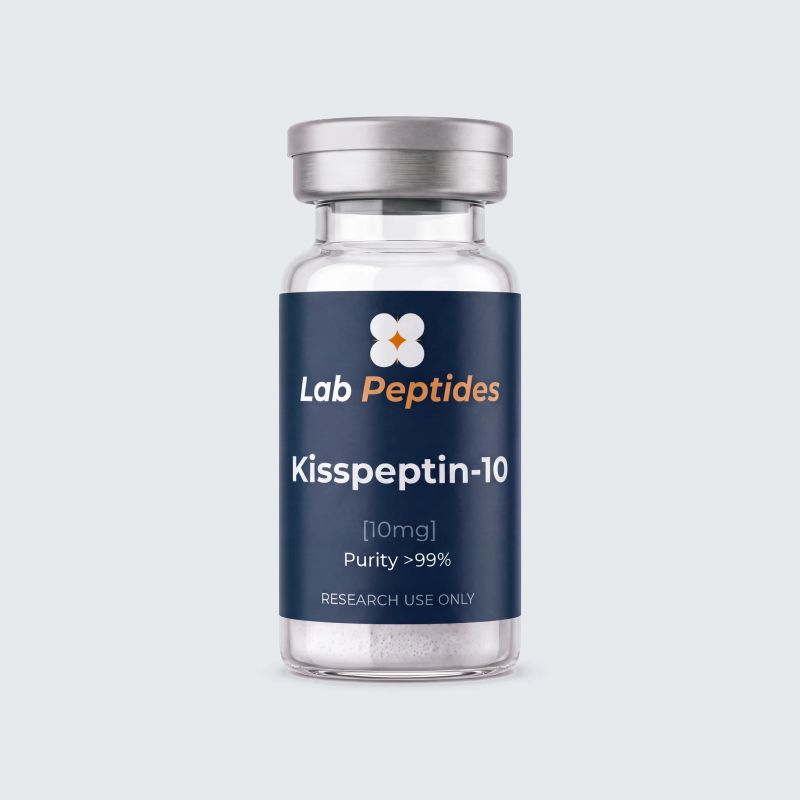
Kisspeptine-10 10mg Endocrinology
The KP-10 decapeptide. Stocked in France.
The master regulator of the hormonal axis. Kisspeptin fires the upstream hypothalamic LH/FSH cascade — the source of your testosterone and fertility. Regulation at the root, not a patch. The peptide rewriting the modern hormonal approach.
- In stock in France
 Ordered with its water: shipped in a magnetic box
-10 % for life on each cyclePause, skip or cancel in 1 clickNo commitment, no hidden fees
No card: each delivery is paid in Bitcoin (extra -5%) or by bank transfer
Your complete kit
The vial alone cannot be used as is. Add what you need to prepare it:
Research Use Only (RUO) · Prohibited for human or veterinary use.
Key facts
Kisspeptin-10 10mg (KP-10, Metastin 45-54) is a decapeptide with the sequence Tyr-Asn-Trp-Asn-Ser-Phe-Gly-Leu-Arg-Phe-NH2, corresponding to the bioactive C-terminal fragment of native kisspeptin-54 encoded by the human KISS1 gene on chromosome 1q32. With a molecular weight of approximately 1302 Da, this synthetic decapeptide binds to the G protein-coupled receptor GPR54 (renamed KISS1R) with nanomolar affinity and constitutes today one of the most precise pharmacological tools to study the human hypothalamic-pituitary-gonadal axis.
In detail
KP-10 occupies an absolutely central position in reproductive endocrinology. Kisspeptinergic neurons in the arcuate (ARC) and anteroventral periventricular (AVPV) hypothalamic nuclei control pulsatile release of gonadotropin-releasing hormone (GnRH), which itself commands pituitary LH and FSH secretion, and ultimately gonadal function. Seminal work by Seminara and colleagues (2003, New England Journal of Medicine) and de Roux and colleagues (2003, PNAS) demonstrated that inactivating GPR54 mutations cause congenital hypogonadotropic hypogonadism with absent puberty, while activating mutations cause central precocious puberty. These discoveries established kisspeptin as the molecular gatekeeper of puberty and reproductive function.
The name's history is singular. Kisspeptin was initially discovered in 1996 by Jung-Hoon Lee and colleagues (Journal of the National Cancer Institute) as a metastatic suppressor of cancer, in the city of Hershey, Pennsylvania, hence the nod to Hershey's Kisses chocolates and the name "kisspeptin". It was only in 2001-2003 that its endocrine and reproductive role was revealed through discovery of its endogenous receptor GPR54 and first human studies.
In exploratory research, KP-10 distinguishes itself by unique pharmacological specificity: it selectively activates GPR54 without cross activity on other peptide receptors, generating clean and reproducible stimulation of the GnRH-LH-FSH axis. Each Atlas Lab vial ships lyophilized, with an HPLC specification of at least 98% purity. The short plasma half-life (approximately 4 minutes for KP-10 versus 27 minutes for native KP-54) imposes an IV bolus or SC administration protocol with frequent rotations, typical of clinical endocrinology explorations.
Protocol and preparation
| Water added | Concentration | Reading marker |
|---|---|---|
| 1 ml | 10 mg/ml | 10 UI = 1 mg |
| 2 ml | 5 mg/ml | 40 UI = 2 mg |
The volume of water does not change the product, only its concentration. Add the water slowly along the vial wall, then swirl without shaking.
Asepsis
Disinfect surfaces and stoppers (70% alcohol).
Solvent
Draw the required volume of bacteriostatic water.
Introduction
Add gently against the vial wall (avoid a direct jet on the powder).
Solubilization
Roll the vial gently. Do not shake vigorously (degradation risk).
Solution storage Once reconstituted: 2-8°C (refrigerator).
Warning Theoretical tool for chemical handling. Does not constitute medical advice.
I open the dilution calculator- The amount of powder looks tiny. A lyophilisate takes up a few millimetres at the bottom of the vial, sometimes just a translucent film. The stated weight is there.
- The powder is compact, stuck to the wall or to the stopper. Transport moves the freeze-dried cake around. It changes nothing to reconstitution.
- The vial carries no individual label. That is our standard packaging, not a downgraded vial.
- After reconstitution, deposits or filaments appear. This is common, especially with small molecules. Let it settle and roll the vial between your palms, never shake it.
- The parcel is plain. Nothing on the outside indicates the contents or the brand name.
What is not normal: a cracked vial, an uncrimped cap or a stopper that moves, powder that has liquefied or changed colour. In those specific cases, write to us with a photo and we take the vial back.
The Atlas Lab Kisspeptin-10 10mg vial is reconstituted with 2 ml of bacteriostatic water to reach a final concentration of 5 mg/ml, or 5,000 mcg/ml. KP-10's very short plasma half-life (approximately 4 minutes) imposes specific administration protocols suited to endocrine explorations via bolus or continuous infusion, distinct from long-acting peptides.
Continuous infusion protocolPhase II-III clinical studies (Jayasena 2014, Abbara 2015) use continuous SC or IV infusions of KP-54 or KP-10 over several hours or weeks. These protocols require dedicated infusion equipment and exit typical exploratory use. Short-half-life KP-10 requires higher flow rates than KP-54 to maintain stable plasma concentrations.
Administration frequencyKP-10 short half-life suggests daily or twice-daily administration in exploratory SC protocols. However, overly frequent administrations may induce GPR54 desensitization through receptor internalization, a phenomenon paradoxically responsible for using super-agonist GnRH analogs in oncology for chemical castration. Favor 5-to-10-day consecutive cycles followed by 5-to-10-day pauses to avoid this phenomenon and preserve receptor sensitivity.
Absolute contraindicationsPregnancy (robust gonadal axis activation), breastfeeding (insufficient data on milk passage), active or recently remitted hormone-dependent cancers (breast, prostate, endometrial, ovarian) due to testosteronic or estrogenic stimulation, severe hepatic or renal insufficiency. Caution in adolescents and pre-adolescents: KP-10 may trigger precocious puberty in subjects in pubertal maturation and should not be used outside strictly supervised medical protocols. Recommended biological monitoring: LH, FSH, total and bioavailable testosterone (men), estradiol, progesterone (women), baseline blood count and liver panel.
Technical data
- Reconstitution
- 2 ml d'eau → 5 mg/ml. 4 UI = 200 mcg.
- Peptide sequence
- Tyr-Asn-Trp-Asn-Ser-Phe-Gly-Leu-Arg-Phe-NH2
- Molecular formula
- C63H83N17O14
- Molecular weight
- 1302.4 g/mol
- CAS number
- 374675-21-5
- Physical form
- Poudre lyophilisée
- Recommended solubility
- Eau bactériostatique, NaCl 0,9%
- Storage conditions
- Au réfrigérateur (+2 à +8 °C), à l'abri de la lumière. En poudre, possible au congélateur pour une conservation longue. Une fois préparé : réfrigérateur, jamais au congélateur.
- Use
- Research reagent, in vitro only (RUO)
Storage & handling
Le flacon lyophilisé de Kisspeptine-10 10mg se conserve entre 2 et 8 degrés Celsius dans son emballage d'origine, à l'abri de la lumière directe et de toute source d'humidité. Sous ces conditions optimales, un lyophilisat reste en général stable jusqu'à 24 mois. La forme lyophilisée est particulièrement sensible à l'humidité atmosphérique: refermer systématiquement le flacon après manipulation et manipuler à atmosphère contrôlée. Après reconstitution avec 2 ml d'eau bactériostatique (alcool benzylique 0,9 pour cent), la solution obtenue à 5 mg/ml présente une stabilité modérée de 14 à 21 jours entre 2 et 8 degrés Celsius, sensiblement plus courte que pour les peptides cycliques comme le Melanotan-2 ou les heptapeptides PGP-stabilisés comme Semax ou Selank. Cette durée plus courte reflète la sensibilité intrinsèque du décapeptide linéaire aux protéases résiduelles et aux réactions d'oxydation sur les résidus tyrosine, tryptophane et sérine. Planifier l'utilisation du flacon en conséquence: idéalement, consommer la solution reconstituée en 2 à 3 semaines maximum. Stabilité conservée par congélation: contrairement à la majorité des peptides, le KP-10 reconstitué peut être aliquoté en fractions de 0,5 à 1 ml et conservé à -20 degrés Celsius pour une durée étendue jusqu'à 6 mois avec stabilité supérieure à 90 pour cent mesurée par HPLC. Cette option est utile pour les utilisateurs souhaitant rationner le flacon sur plusieurs cycles d'exploration espacés. Décongeler chaque aliquote à température réfrigérée et consommer en une à deux administrations pour éviter tout cycle gel-dégel répété. À réception, contrôler l'intégrité du pack froid et placer immédiatement le flacon au réfrigérateur. Une exposition brève à température ambiante lors du transport n'altère pas significativement la bioactivité du produit lyophilisé, mais prolonger cette exposition au-delà de 96 heures consécutives est déconseillé. Contrôle visuel avant usage: la solution reconstituée doit rester parfaitement limpide, incolore et dépourvue de particules visibles. Toute apparition de turbidité, précipité ou coloration jaune intense indique une dégradation et proscrit l'utilisation du flacon. Les décapeptides linéaires comme le KP-10 peuvent développer des agrégats fibrillaires visibles en cas de conservation prolongée en solution, rendant la solution trouble: dans ce cas, éliminer le flacon. Ne jamais diluer le KP-10 avec de l'eau non stérile, des solutions contenant des ions métalliques divalents en forte concentration, ou des solutions tamponnées à pH fortement alcalin (au-dessus de 9) ou fortement acide (en dessous de 3). Les dilutions dans NaCl 0,9 pour cent, eau pour préparation injectable et eau bactériostatique sont compatibles et recommandées.
Mechanism of action
Kisspeptin-10 mechanism of action articulates a hierarchical neuroendocrine cascade of rare elegance, where activation of a single hypothalamic GPR54 receptor triggers the entire human reproductive axis within minutes.
First stage, GPR54 activation on GnRH neurons. GPR54 (KISS1R) is a Class A G protein-coupled receptor, predominantly expressed on GnRH neurons of the preoptic hypothalamus. KP-10 binding activates the Gq/11 -> phospholipase C beta -> IP3 production -> calcium release from reticular stores pathway. This intraneuronal calcium elevation triggers synaptic vesicle fusion containing GnRH and pulsatile release of the neuropeptide into the hypothalamic-pituitary portal system. The effect is rapid: GnRH release is detectable within 5 minutes after KP-10 IV administration, with peak at 15-30 minutes.
Third stage, gonadal action. LH elevation stimulates testicular Leydig cells producing testosterone and activates ovarian thecal cells involved in steroidogenesis. FSH elevation supports spermatogenesis in men and follicular maturation in women. The testosterone effect in men is measurable 4 to 6 hours after single administration, with 20-to-50-percent increase in serum testosterone in healthy subjects.
Fourth axis, duality of kisspeptinergic neuronal populations. Kisspeptin neurons of the arcuate nucleus (ARC) co-express neurokinin B and dynorphin (KNDy population) and are responsible for baseline GnRH pulsatility in both sexes. AVPV neurons predominate in females and mediate the preovulatory LH surge in response to estrogen positive feedback. This duality explains why KP-10 can be used both to study baseline GnRH pulsatility and to trigger ovulation (Abbara 2015 JCEM).
Fifth dimension, extra-hypothalamic action. KP-10 also exerts documented extra-gonadal axis effects. At the limbic brain level, Comninos and colleagues (2017, Journal of Clinical Investigation) showed by fMRI that KP-10 activates regions responsible for sexual emotional processing (insula, anterior cingulate gyrus, amygdala, hippocampus) in healthy men, with correlated improvement of sexual motivation parameters. Thurston and colleagues (2022, JAMA Network Open) extended these observations to men with HSDD. KP-10 also activates kisspeptin receptors expressed in placenta, trophoblastic vessels, and several cancers, but these actions fall outside the direct reproductive framework.
Studies and references
Scientific literature on Kisspeptin is particularly rich and of high academic level, with over 3,000 peer-reviewed publications since 2003 and human clinical trials published in top-tier journals (NEJM, JCI, JCEM, Nature, Cell). This scientific density distinguishes KP-10 from most exploratory research peptides and makes it one of the best characterized tools in modern reproductive endocrinology.
Founding discoveriesLee and colleagues (1996, Journal of the National Cancer Institute, 88:23) identified the KISS1 gene as a metastatic suppressor, first on melanomas. Ohtaki and colleagues (2001, Nature, 411) characterized metastin/KP-54 as the endogenous GPR54 ligand. Then simultaneous publications by Seminara and colleagues (2003, NEJM, 349:17) and de Roux and colleagues (2003, PNAS, 100:19) demonstrated in human genetics that inactivating GPR54 mutations cause idiopathic hypogonadotropic hypogonadism, revolutionizing understanding of puberty and fertility.
Dhillo and colleagues (2007, JCEM, 92:10 pages 3958-3966) extended observations to healthy female volunteers in follicular, luteal, and preovulatory phases, confirming KP-10 effect dependence on menstrual cycle with maximal response in preovulatory phase. These results established KP-10 as a precise endocrine phenotyping tool.
Abbara and colleagues (2015, JCEM, 100:9 pages 3322-3331; and 2017 Human Reproduction) published pivotal studies demonstrating that KP-54 can trigger ovulation in IVF (in vitro fertilization) with efficacy equivalent to classical hCG but without risk of ovarian hyperstimulation syndrome (OHSS), the main dangerous complication of ovarian stimulation. This application could transform assisted reproductive safety if confirmed in phase III.
Integrative reviewsKirby and colleagues (2010, J Neuroendocrinol), Skorupskaite and colleagues (2014, Hum Reprod Update), and Dhillo (2024, Nat Rev Endocrinol) published reference syntheses on the field, positioning kisspeptin as one of the major endocrinology discoveries of the 21st century and identifying application perspectives in infertility, hypogonadism, pubertal induction, sexual disorders, and functional endocrine diagnosis.
- 1
- 2
Frequently asked questions
Why is Kisspeptin named this way?
Does KP-10 create tolerance or tachyphylaxis phenomenon?