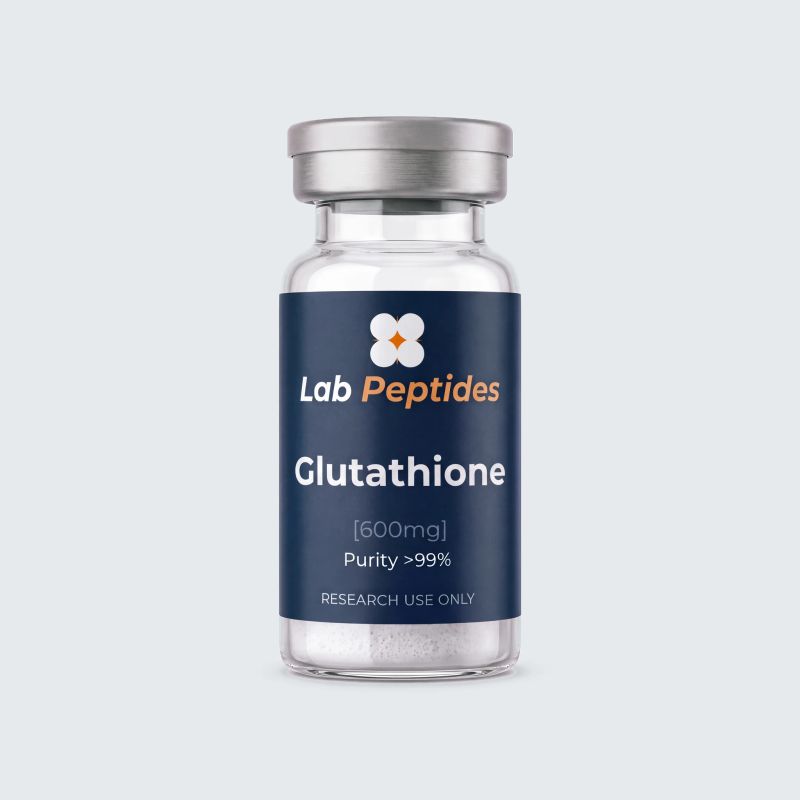
Glutathione 600mg Matriz extracelular
El tripéptido tiol de referencia. 600 mg.
- Stock en Francia
 Pedido con su agua: enviado en estuche imantado
-10 % de por vida en cada cicloPause, salte o cancele en 1 clicSin compromiso, sin gastos ocultos
Sin tarjeta: cada envío se paga en Bitcoin (-5 % adicional) o por transferencia
Tu kit completo
El vial por sí solo no puede usarse tal cual. Añada lo necesario para prepararlo:
Se compran juntos a menudo


Uso exclusivo en investigación (RUO) · Prohibido para uso humano o veterinario.
Lo esencial
Glutathione 600mg (GSH, reduced L-glutathione) is the master antioxidant tripeptide of the living cell, with the sequence gamma-Glu-Cys-Gly. Its structural feature is unique among peptides: the gamma bond, formed via the glutamate side chain, makes it resistant to classical peptidases and explains its biological stability. With a molecular weight of 307 Da and the formula C10H17N3O6S, glutathione is present in every cell at millimolar concentrations, where it forms the first line of defense against oxidative stress.
En detalle
At the heart of longevity and skin beauty research, glutathione concentrates three roles: free radical neutralization, cellular detoxification and skin radiance through melanogenesis modulation. It is the reference molecule for studying redox balance and the oxidative protection of tissues.
Protocolo y preparación
| Agua añadida | Concentración | Marca de lectura |
|---|---|---|
| 2 ml | 300 mg/ml | 10 UI = 30 mg |
| 3 ml | 200 mg/ml | 10 UI = 20 mg |
El volumen de agua no cambia el producto, solo su concentración. Introduzca el agua despacio por la pared del vial y gírelo sin agitar.
Asepsia
Desinfecte las superficies y los tapones (alcohol al 70%).
Disolvente
Extraiga el volumen necesario de agua bacteriostática.
Introducción
Vierta suavemente contra la pared del vial (evite el chorro directo sobre el polvo).
Solubilización
Haga rodar el vial suavemente. No lo agite con fuerza (riesgo de degradación).
Conservación de la solución Una vez reconstituido: 2-8°C (nevera).
Advertencia Herramienta teórica para manipulación química. No constituye un consejo médico.
Abro la calculadora de dilución- La cantidad de polvo parece mínima. Un liofilizado ocupa unos pocos milímetros en el fondo del vial, a veces solo una película translúcida. El peso indicado está ahí.
- El polvo está compacto, pegado a la pared o al tapón. El transporte desplaza la torta liofilizada. No cambia nada en la reconstitución.
- El vial no lleva etiqueta individual. Es nuestro embalaje estándar, no un vial de menor calidad.
- Tras la reconstitución aparecen depósitos o filamentos. Es habitual, sobre todo con moléculas pequeñas. Deje que se asiente y haga rodar el vial entre las palmas, nunca lo agite.
- El paquete es neutro. Nada en el exterior indica el contenido ni el nombre de la marca.
Lo que no es normal: un vial agrietado, una cápsula sin engastar o un tapón que se mueve, polvo que se ha licuado o cambiado de color. En esos casos concretos, escríbanos con una foto y recuperamos el vial.
Handling and oxidation. Critical point: glutathione's thiol group oxidizes in air. Reconstitute just before use, limit exposure to air and light, do not vortex, draw under aseptic conditions. A solution that yellows or clouds signals advanced oxidation (conversion to GSSG) and must be discarded.
Datos técnicos
- Reconstitución
- 3 ml d'eau → 200 mg/ml. 25 UI = 50 mg ; 50 UI = 100 mg.
- Secuencia peptídica
- γ-Glu-Cys-Gly
- Fórmula molecular
- C10H17N3O6S
- Peso molecular
- 307.33 g/mol
- Número CAS
- 70-18-8
- Forma física
- Poudre lyophilisée
- Solubilidad recomendada
- Eau bactériostatique, NaCl 0,9%
- Condiciones de conservación
- Au réfrigérateur (+2 à +8 °C), à l'abri de la lumière. En poudre, possible au congélateur pour une conservation longue. Une fois préparé : réfrigérateur, jamais au congélateur.
- Uso
- Reactivo de investigación, solo in vitro (RUO)
Conservación y manipulación
In lyophilized form, Glutathione 600mg is stable when stored in the fridge (+2 to +8 °C), away from light and air; a -20 °C freezer is an option for long-term storage (over 3 months). The dry powder withstands room-temperature transport over a few days, but since glutathione is oxidation-sensitive, cold storage on receipt is recommended to preserve the maximum reduced form (GSH).
After reconstitution, glutathione is markedly more fragile than most peptides: the solution must be kept at +2/+8°C, away from light, and used quickly (ideally within a few days). Prolonged contact with atmospheric oxygen progressively converts GSH into inactive GSSG. Reseal tightly, minimize the dead air volume in the vial, and avoid any freeze/thaw cycle.
Our peptides are HPLC-tested to over 98% purity and vacuum lyophilized.
Mecanismo de acción
Glutathione's mechanism of action relies on the sulfur chemistry of its central cysteine, whose thiol group (-SH) is the true active site.
Direct neutralization of reactive species. The cysteine thiol donates an electron to neutralize free radicals (ROS, reactive oxygen species). Two molecules of reduced glutathione (GSH) then oxidize into glutathione disulfide (GSSG). The GSH/GSSG ratio is the reference indicator of cellular redox state in research, subsequently restored by glutathione reductase using NADPH.
Cofactor of glutathione peroxidases. GSH fuels the glutathione peroxidase enzymes that destroy hydrogen peroxide and lipid peroxides, protecting membranes from peroxidation. It is a pillar of enzymatic antioxidant defense.
Phase II detoxification. Via glutathione-S-transferases, GSH conjugates with xenobiotics, heavy metals and electrophilic metabolites, making them water-soluble and eliminable (mercapturic acid pathway). This is the central mechanism of cellular detoxification studied in hepatic models.
Skin radiance and melanogenesis. Glutathione inhibits tyrosinase and shifts melanin synthesis toward light pheomelanin rather than dark eumelanin. This mechanism founds research on skin depigmentation and radiance, the field where glutathione is the most studied candidate.
Estudios y referencias
Glutathione is one of the most studied antioxidants in biology, with a corpus spanning several decades.
Redox balance and oxidative stress. The GSH/GSSG ratio is a validated oxidative-stress marker in countless cellular and animal models. Glutathione depletion sensitizes cells to oxidative apoptosis, a repeated demonstration of its fundamental protective role.
Hepatic detoxification. The liver is the organ richest in glutathione. Toxicity models (notably acetaminophen overdose, where N-acetylcysteine restores glutathione) established GSH's central role in neutralizing reactive metabolites.
Skin depigmentation. Several clinical trials, especially in Asian dermatology, evaluated glutathione (oral, topical and intravenous) on skin radiance and lightness, with positive results but methodological heterogeneity and an ongoing debate on the optimal administration route and effect duration.
Bioavailability and forms. The literature widely documents the poor oral bioavailability of native glutathione (digestive degradation), which steered research toward injectable, liposomal forms and precursors such as NAC. This delivery question remains an active research axis.
Preguntas frecuentes
Is glutathione a peptide?
Why does glutathione oxidize so fast once reconstituted?
What is the difference between glutathione and NAC?