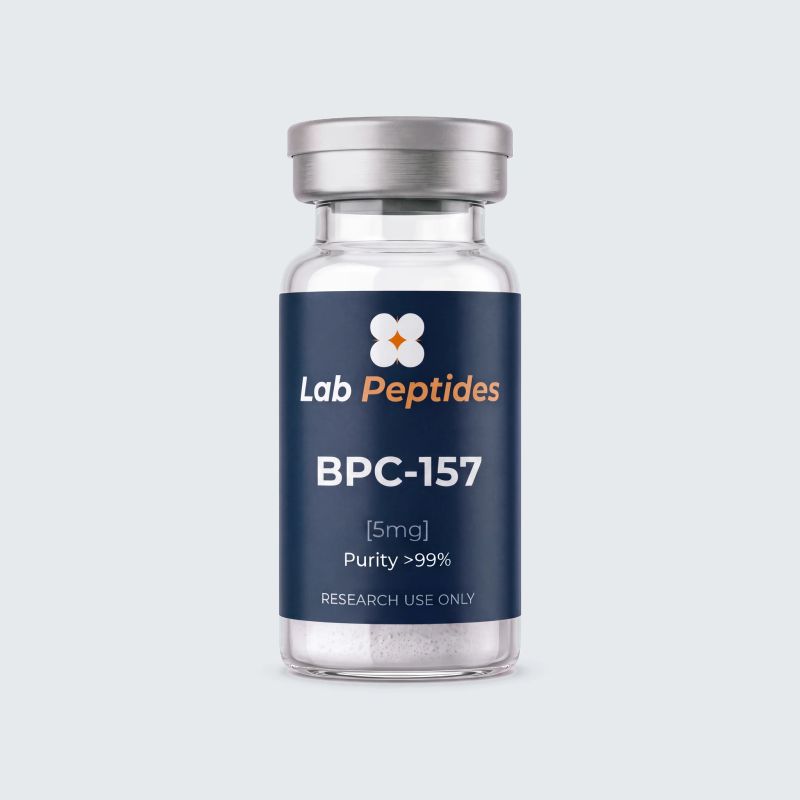
BPC-157 5mg Regeneración tisular
30 años de publicaciones. Pureza 99,4 %.
- Certificado de análisis
- Stock en Francia
 Pedido con su agua: enviado en estuche imantado
-10 % de por vida en cada cicloPause, salte o cancele en 1 clicSin compromiso, sin gastos ocultos
Sin tarjeta: cada envío se paga en Bitcoin (-5 % adicional) o por transferencia
Este producto contiene BPC-157. Los trabajos publicados abordan la angiogénesis, la formación de nuevos vasos sanguíneos. Ningún ensayo clínico humano aleatorizado ha caracterizado las contraindicaciones.
Las alertas teóricas descritas en los trabajos preclínicos afectan a los antecedentes de cáncer, en particular tumores sólidos muy vascularizados, al embarazo y la lactancia, y a las retinopatías proliferativas.
Tu kit completo
El vial por sí solo no puede usarse tal cual. Añada lo necesario para prepararlo:
Se compran juntos a menudo


Uso exclusivo en investigación (RUO) · Prohibido para uso humano o veterinario.
Lo esencial
Protocolo y preparación
| Agua añadida | Concentración | Marca de lectura |
|---|---|---|
| 1 ml | 5 mg/ml | 40 UI = 2 mg |
| 2 ml | 2,5 mg/ml | 40 UI = 1 mg |
El volumen de agua no cambia el producto, solo su concentración. Introduzca el agua despacio por la pared del vial y gírelo sin agitar.
Asepsia
Desinfecte las superficies y los tapones (alcohol al 70%).
Disolvente
Extraiga el volumen necesario de agua bacteriostática.
Introducción
Vierta suavemente contra la pared del vial (evite el chorro directo sobre el polvo).
Solubilización
Haga rodar el vial suavemente. No lo agite con fuerza (riesgo de degradación).
Conservación de la solución Una vez reconstituido: 2-8°C (nevera).
Advertencia Herramienta teórica para manipulación química. No constituye un consejo médico.
Abro la calculadora de dilución- La cantidad de polvo parece mínima. Un liofilizado ocupa unos pocos milímetros en el fondo del vial, a veces solo una película translúcida. El peso indicado está ahí.
- El polvo está compacto, pegado a la pared o al tapón. El transporte desplaza la torta liofilizada. No cambia nada en la reconstitución.
- El vial no lleva etiqueta individual. Es nuestro embalaje estándar, no un vial de menor calidad.
- Tras la reconstitución aparecen depósitos o filamentos. Es habitual, sobre todo con moléculas pequeñas. Deje que se asiente y haga rodar el vial entre las palmas, nunca lo agite.
- El paquete es neutro. Nada en el exterior indica el contenido ni el nombre de la marca.
Lo que no es normal: un vial agrietado, una cápsula sin engastar o un tapón que se mueve, polvo que se ha licuado o cambiado de color. En esos casos concretos, escríbanos con una foto y recuperamos el vial.
Datos técnicos
- Reconstitución
- 1 ml d'eau → 5 mg/ml. 5 UI = 250 mcg ; 10 UI = 500 mcg.
- Secuencia peptídica
- Gly-Glu-Pro-Pro-Pro-Gly-Lys-Pro-Ala-Asp-Asp-Ala-Gly-Leu-Val
- Fórmula molecular
- C62H98N16O22
- Peso molecular
- 1419.5 g/mol
- Número CAS
- 137525-51-0
- Forma física
- Poudre lyophilisée
- Solubilidad recomendada
- Eau bactériostatique, NaCl 0,9%
- Condiciones de conservación
- Au réfrigérateur (+2 à +8 °C), à l'abri de la lumière. En poudre, possible au congélateur pour une conservation longue. Une fois préparé : réfrigérateur, jamais au congélateur.
- Uso
- Reactivo de investigación, solo in vitro (RUO)
Conservación y manipulación
Le BPC-157 lyophilisé non reconstitué se conserve au réfrigérateur (+2 à +8 °C), dans son emballage d'origine scellé, à l'abri de la lumière et de l'humidité ; pour un stockage long (plus de 3 mois), le congélateur (-20 °C) le garde jusqu'à 24 mois. A température refrigeree (2-8 degres Celsius), la stabilité documentee couvre au moins 12 mois. A température ambiante (en dessous de 25 degres Celsius), la durée recommandee pour un transport ou un stockage temporaire ne depasse pas 4 semaines. Une fois reconstitué avec de l'eau bacteriostatique pour preparation injectable, le BPC-157 doit imperativement être conserve entre 2 et 8 degres Celsius. Sa stabilité post-reconstitution est documentee dans la litterature pour 28 jours maximum lorsque l'eau bacteriostatique (contenant 0,9 pourcent d'alcool benzylique) est utilisee. Avec de l'eau sterile sans conservateur, la fenetre d'utilisation se reduit a 5-7 jours. Le peptide est particulierement sensible a plusieurs facteurs deleteres: la congelation-decongelation repetee (preferer des aliquots si volume important), l'exposition directe a la lumiere UV, les variations thermiques brutales, et le contact avec des surfaces metalliques non inertes. Les cycles de gel-degel doivent être limites a trois maximum. Le certificat d'analyse est publié sur cette fiche, consultable avant de commander. Le pH optimal se situe entre 5.5 et 7.0: éviter toute reconstitution en solution acide (pH < 4) ou basique (pH > 9) qui favoriserait la dégradation hydrolytique des liaisons proline-proline. Ne jamais recongeler une solution déjà reconstituée: les cycles gel/dégel génèrent des agrégats détectables par SEC-HPLC et diminuent l'activité biologique en modèles rongeurs. Le conditionnement en flacon verre borosilicaté type I avec bouchon butyl siliconé limite les interactions peptide/contenant et garantit l'intégrité du lot pour la durée d'étude planifiée.
Mecanismo de acción
BPC-157 (Body Protection Compound-157) is a synthetic 15-amino-acid pentadecapeptide (Gly-Glu-Pro-Pro-Pro-Gly-Lys-Pro-Ala-Asp-Asp-Ala-Gly-Leu-Val), derived from a body-protection sequence originally identified in human gastric juice. Its unusual stability in acidic environments sets it apart from conventional peptides: the literature has reported a meaningful half-life at pH 2 and resistance to digestive proteases, making it a unique subject of study within the regenerative research peptide class.
At the molecular level, preclinical models have suggested a multimodal mechanism. BPC-157 modulates the nitric oxide (NO) system via an eNOS / neuronal NOS axis, which according to published observations influences local vasodilation and tissue perfusion. Complementary work has documented activation of the VEGFR2 (Vascular Endothelial Growth Factor Receptor 2) pathway, involved in angiogenesis, along with upregulation of early growth response genes (Egr-1) and the FAK-paxillin transcription factor in studied endothelial cells.
The peptide has also been reported to interact with central dopaminergic and serotonergic axes: rodent behavioral studies describe effects on neuroplasticity, GABAergic tone, and stress response. On the gastrointestinal front, literature has described mucosal barrier protection via modulation of endogenous prostaglandin (PGE2) and heat shock proteins (HSP70/90). These converging mechanisms position BPC-157 as a research peptide of particular interest in tissue-repair models (tendons, ligaments, skeletal muscle), traumatic brain injury (TBI) models, and experimental gastropathy.
Structurally, BPC-157 (Body Protection Compound 157) is a synthetic 15-amino-acid pentadecapeptide (sequence Gly-Glu-Pro-Pro-Pro-Gly-Lys-Pro-Ala-Asp-Asp-Ala-Gly-Leu-Val, mass 1419.6 Da) derived from a protective sequence identified by Sikiric and colleagues (University of Zagreb) from a stable fragment of human gastric juice, pepsin-resistant (Sikirić et al., Eur J Pharmacol 1991, J Physiol Paris 1997). Its stability in gastric acid radically distinguishes BPC-157 from most naturally occurring proteolysis-sensitive peptides. Molecular pathways documented in preclinical research include: (1) activation of nitric oxide (NO) synthesis via L-arginine/eNOS pathway, (2) transcriptional upregulation of VEGF-A and FGF-2 favouring angiogenesis, (3) modulation of the Egr-1 early transcription factor involved in fibroblast proliferation, (4) interaction with 5-HT2A and dopaminergic receptors in some behavioural models, (5) stabilisation of endothelial function via eNOS modulation and reduction of oxidative stress (8-OH-dG, MDA).
Estudios y referencias
The BPC-157 preclinical corpus is dense and spans over two decades, driven primarily by the Sikiric group (Zagreb University School of Medicine). The main publications cover several converging experimental models.
Sikiric et al. (Journal of Physiology — Paris, 2001; DOI 10.1016/S0928-4257(01)00003-5) laid the initial mechanistic foundation, documenting gastric cytoprotection and mucosal barrier restoration in rats subjected to various chemical stressors (ethanol, NSAIDs, caustic agents). This foundational work was extended in Current Pharmaceutical Design (Sikiric et al. 2011; DOI 10.2174/138161211795589837), which synthesizes over 50 distinct animal models and positions BPC-157 as a "stable gastric pentadecapeptide" candidate.
On tendon repair, Staresinic et al. (Journal of Orthopaedic Research 2003; DOI 10.1016/S0736-0266(03)00016-X) reported in rats an acceleration of Achilles tendon healing after transection, with improved histological and biomechanical parameters versus control. Chang et al. (Journal of Applied Physiology 2011; DOI 10.1152/japplphysiol.00110.2011) extended these observations to the ischemia-reperfusion-injured quadriceps tendon.
In the cerebral field, Klicek et al. (Journal of Physiology and Pharmacology 2013) documented attenuation of post-traumatic lesions in a murine TBI model, with preservation of motor parameters assessed via neurological scale. Complementary work on MPTP neurotoxicity suggested a protective action on the nigrostriatal dopaminergic system.
On the cardiovascular side, Sikiric et al. (European Journal of Pharmacology 2016) reported effects on experimentally induced pulmonary hypertension and on ventricular arrhythmia in rats. Finally, colitis models (DSS-induced ulcerative colitis in mice) have documented restoration of intestinal mucosal integrity.
Critical limitations of the corpusThe vast majority of data comes from a limited number of laboratories, independent reproducibility studies are rare, and no large-scale randomized controlled phase 3 human clinical trial has been published or registered. BPC-157 remains in a regulatory gray zone and is strictly a preclinical research tool.
- 1
- 2
- 3
- 4
Preguntas frecuentes
Why is BPC-157 considered stable in acidic environments?
Can BPC-157 be combined with TB-500 in research?
Is your BPC-157 authentic and research-grade?
What is the delivery lead time in Europe?
Is BPC-157 stable at room temperature?
What HPLC purity is expected for a research-grade BPC-157 batch?
 La guía completaSíntesis de péptidos en fase sólida (SPPS): guía completa de Merrifield, Fmoc, Boc, resinas, reactivos de acoplamiento y control de calidadPrincipio de Merrifield, estrategias Fmoc y Boc, resinas (Wang, Rink amide, 2-clorotritilo), reactivos de acoplamiento (HBTU, HATU, DIC/HOBt), ciclo de síntesis, escisión con TFA, purificación por RP-HPLC, control de calidad por LC-MS y test de Kaiser. La referencia científica sobre la fabricación de péptidos sintéticos.Leo la guía
Lee también:Analítica peptídica: LC-MS de alta resolución, RMN, HPLC y Edman - Guía completa de investigaciónEstabilidad peptídica: degradación, liofilización y almacenamiento - Guía de referencia para investigación