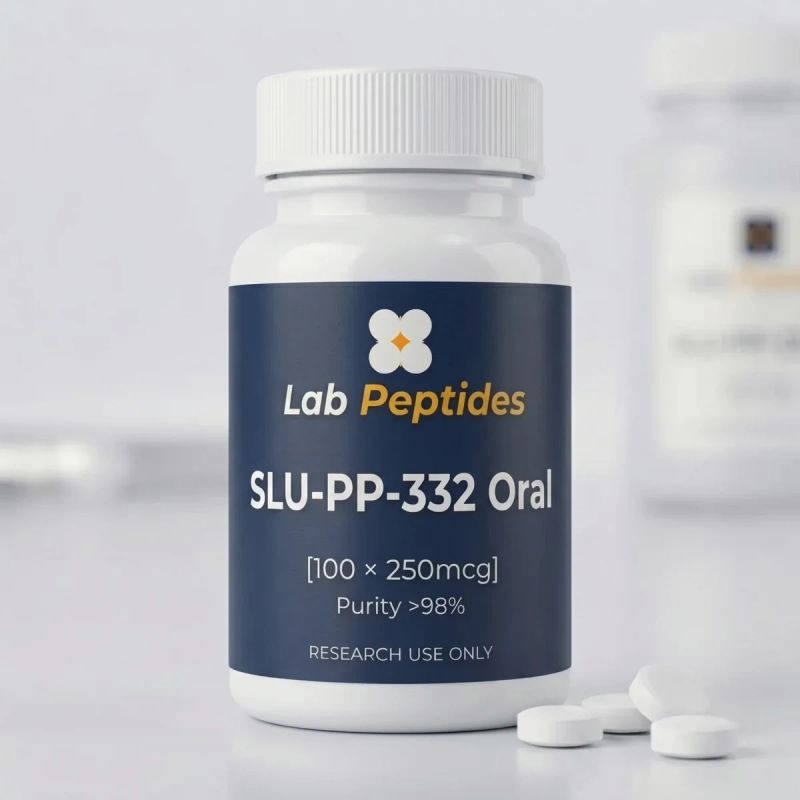
SLU-PP-332 Oral 100 × 250mcg Performance
Tablet format · needle-freeSLU-PP-332 oral tablets. 100 × 250mcg. Pan-ERR agonist exercise mimetic in pre-dosed format. No DMSO prep needed. RUO.
Endurance in a pill. The Billon 2023 pan-ERR agonist in pre-dosed oral format — optimized bioavailability, zero injection. Every training adaptation without the time cost. The future of oral performance. 100 × 250mcg.
-10 % for life on each cyclePause, skip or cancel in 1 clickNo commitment, no hidden fees

SLU-PP-332 Oral 250mcg is the pre-dosed tablet formulation of the pan-ERR agonist small organic molecule that made scientific headlines in 2023 with its publication in Nature Metabolism (Billon et al.) under the mediatized "exercise in a pill" label. Each bottle contains 100 tablets of 250mcg, i.e. 25mg of active SLU-PP-332 per bottle, packaged for RUO preclinical protocols on animal models and cell culture.
SLU-PP-332's pharmacological positioning is that of a synthetic agonist of all three paralogs ERRalpha, beta, gamma (Estrogen-Related Receptors), orphan nuclear receptors discovered by Vincent Giguere in 1988. ERRs orchestrate the oxidative transcriptional program of skeletal muscle, brown adipose tissue and liver: mitochondrial biogenesis, oxidative phosphorylation, fatty acid beta-oxidation, type I muscle fiber specification. Pan-ERR activation by SLU-PP-332 bypasses the need to stimulate PGC-1alpha via physical exercise, making it the first credible "exercise mimetic" class candidate with complete pharmacokinetic profile.
This low dose (250mcg / tablet) is optimal for titration and exploratory dose-response protocols: mapping the ERR activation curve at low exposure, long chronic protocols (> 12 weeks) where logistical stock buildup becomes critical, and pharmacokinetic experiments (AUC, Cmax, half-life) on rodent models where fine dose-response resolution is required.
Lot certified by HPLC certificate of analysis exceeding 98%, mass spectrometry confirming theoretical chemical structure (pyrrole carboxamide, approximately 395 Da molecular weight). Tablet format formulated with inert pharmaceutical excipients compatible with oral rodent administration. Room temperature storage, > 24 months stability in sealed bottle.
Use strictly reserved for RUO preclinical research (rodents, cell culture). SLU-PP-332 has not been approved by any health authority (FDA, EMA, ANSM) for human use. The "exercise in a pill" media coverage in mainstream press does not reflect the current state of scientific knowledge: no human clinical trial has been conducted, human pharmacokinetics remain entirely uncharacterized.
01Mechanism of action
ERR receptors — Orphan nuclear receptor family
Estrogen-Related Receptors (ERRalpha, beta, gamma) were isolated in 1988 by Vincent Giguere (Nature 331:91) based on strong sequence homology with the estrogen receptor alpha (ESR1) in their DNA-binding (DBD, 68% identity) and ligand-binding (LBD, 36% identity) domains. This structural proximity stops there: ERRs do not bind 17beta-estradiol or any other endogenous estrogen, their ligand pocket is too narrow. They have long been considered strict orphans — no endogenous physiological ligand has been formally identified to date.
The three paralogs show preferential tissue expression:
- ERRalpha (ESRRA): ubiquitous expression with enrichment in high-energy-demand tissues — skeletal muscle (type I oxidative fibers), myocardium, brown adipose tissue (BAT), renal cortex, liver.
- ERRbeta (ESRRB): embryonic stem cells, inner ear, placenta.
- ERRgamma (ESRRG): skeletal muscle, myocardium, brain, adult liver.
Transcriptional mode of action is constitutive: ERRs occupy their DNA response elements (ERRE, 5'-TNAAGGTCA-3') and recruit transcriptional machinery even in the absence of ligand. The intensity of their activity depends on interaction with co-activators, foremost PGC-1alpha (and secondarily PGC-1beta). PGC-1alpha is an inducible transcriptional co-activator whose muscle expression is massively increased by endurance exercise, cold exposure (in BAT), and prolonged fasting (in liver) — three physiological contexts characterized by increased oxidative energy demand.
Exercise - PGC-1alpha - ERR - mitochondria axis
The molecular architecture of the endurance exercise response, elucidated by Bruce Spiegelman (Puigserver 1998 Cell, Lin 2002 Nature, Wu 1999 Cell) and consolidated by a subsequent corpus, breaks down as follows:
1. Exercise signal — Prolonged muscle contraction -> cytosolic Ca2+ rise, AMP/ATP rise -> CaMK + AMPK + p38 MAPK activation -> transcription factor phosphorylation (MEF2, CREB).
2. PGC-1alpha induction — Activated factors increase PPARGC1A (PGC-1alpha) gene transcription in myocyte nuclei.
3. ERR co-activation — PGC-1alpha binds ERRs (primarily ERRalpha in muscle), dramatically amplifying their transcriptional activity on genomic ERREs.
4. Oxidative gene reprogramming — ERRs activate hundreds of target genes: mitochondrial biogenesis (NRF1, TFAM), oxidative phosphorylation (complex I, II, III, IV, V subunits), fatty acid beta-oxidation (CPT1B, MCAD, LCAD), Krebs cycle (IDH3, SDHA), type I fiber specification (myoglobin, Myh7, slow troponins), angiogenesis (VEGF-A).
5. Adaptive phenotype — After several weeks: increased mitochondrial number and density per fiber, shift from type IIa/IIx toward type I oxidative fibers, increased muscle capillarization, improved maximum aerobic capacity (VO2max), increased endurance.
Pharmacological mode of action of SLU-PP-332
SLU-PP-332 is a pan-ERR synthetic agonist that activates all three ERRalpha, beta, gamma paralogs with sub-micromolar potency. It binds into the ERR ligand pocket and stabilizes the receptor's active conformation, increasing its affinity for co-activators (PGC-1alpha and alternative co-activators) even in the absence of exercise-induced PGC-1alpha induction. The molecular result is direct pharmacological activation of the oxidative transcriptional program, bypassing the physical activity prerequisite.
In mice treated for 4 weeks with SLU-PP-332 (Billon 2023, 10-30 mg/kg orally or IP):
- Skeletal muscle: increased mitochondrial content (mitochondrial/nuclear DNA +30-50%), slow-oxidative fiber shift, increased beta-oxidation enzymatic capacity, treadmill endurance increase +45 to +70%.
- Brown adipose tissue (BAT): increased UCP1 expression, increased basal thermogenesis, increased energy expenditure.
- Liver: steatosis reduction in MAFLD (high-fat diet) models, improved glucose tolerance.
- Total fat mass: significant reduction in induced obesity models, without concomitant food intake reduction (the effect is truly energetic uncoupling via expenditure, not caloric restriction).
The preclinical side effect profile is favorable over 4 weeks: no pathological cardiac hypertrophy (some ERRalpha myocardial effects are physiological, dose is calibrated to remain in the adaptive range), no hepatic toxicity, no mitogenic signal at tested doses. Long-term tolerance (>12 weeks) and in humans remains uncharacterized.
Similar peptides
SLU-PP-332 versus other exercise mimetics
The "exercise mimetics" field — molecules pharmacologically reproducing some effects of physical exercise — comprises several distinct mechanistic classes:
- AICAR (5-aminoimidazole-4-carboxamide ribonucleoside) — AMPK activator, pivotal Narkar 2008 Cell publication. Historically the "first exercise mimetic" to receive media attention. Activates AMPK but with a much broader target spectrum, modest endurance effect (+20-40% in mice).
- GW501516 (cardarine) — Selective PPARdelta agonist. Induces muscle beta-oxidation, robustly increases endurance in rodents. Clinically abandoned due to a rat carcinogenic signal (long-term hepatocarcinomas).
- SR9009 (stenabolic) — REV-ERB agonist. Multiple metabolic effects (circadian clock, mitochondria, hepatic lipogenesis). Controversial oral bioavailability, no human data.
- MOTS-c — Mitochondrial peptide (16 aa), Lee 2015 Cell Metab publication. AMPK activation, effect on insulin sensitivity and exercise.
- SLU-PP-332 — Pan-ERR agonist. Most downstream mechanism (directly on nuclear master receptors of oxidative expression), most robust published endurance effect (+70%), most recent and best-controlled Billon 2023 data.
Relative positioning: SLU-PP-332 is the most mechanistically promising molecule in 2024-2025 (directly targets ERRs, masters of the oxidative program, without the limitations of alternative targets like AMPK which also activates undesirable catabolic pathways). The limitation remains the total absence of human data.
SLU-PP-332 versus GLP-1 agonists (semaglutide, tirzepatide)
GLP-1 analogues are the dominant pharmacological class in obesity in 2024-2025 with clinically documented weight reductions of 15 to 25%. GLP-1 mechanism: central action (satiety) + gastric emptying delay + insulin effect. SLU-PP-332 mechanism: peripheral action (muscle, BAT, liver) on oxidative energy expenditure. The two approaches are mechanistically orthogonal: GLP-1 acts on caloric input (reduction), SLU-PP-332 acts on energy output (increase). In theory a combination could be complementary, but no study has explored this avenue.
Clinically, GLP-1 largely outperforms SLU-PP-332 in documented effect magnitude in humans (phase III data vs total absence of human data for SLU-PP-332). SLU-PP-332 remains a research molecule.
SLU-PP-332 versus Tesamorelin + Ipamorelin (GH axis)
Tesamorelin + Ipamorelin stimulates the endogenous GH axis, inducing clinically documented visceral lipolysis and indirect muscle anabolism via IGF-1. SLU-PP-332 acts directly on target tissue (muscle, BAT) via ERRs, without going through the hypothalamic-pituitary axis. Theoretical complementarity: GH stimulates lipolysis and anabolism, ERR stimulates oxidation and mitochondrial biogenesis. No combined study.
SLU-PP-332 versus actual endurance training
Real physical endurance exercise generates a multi-system beneficial pleiotropy that SLU-PP-332 only partially reproduces:
- Muscle oxidative effects: well reproduced by SLU-PP-332 (80% of the transcriptional signature per Billon 2023).
- Cardiovascular effects (blood pressure reduction, endothelial function improvement): partially reproduced, limited data.
- Cognitive effects (BDNF, hippocampal neurogenesis): not documented with SLU-PP-332.
- Bone effects (density, osteoblast force): not documented.
- All-cause mortality benefits: obviously not extrapolable.
SLU-PP-332 is not a substitute for physical exercise, even in mice: it is a potential pharmacological complement for populations unable to engage in physical activity (advanced age, disability, limiting pathology). In this perspective, its potential clinical development would target sarcopenia, cachexia, inflammatory myopathy, or severe deconditioning.