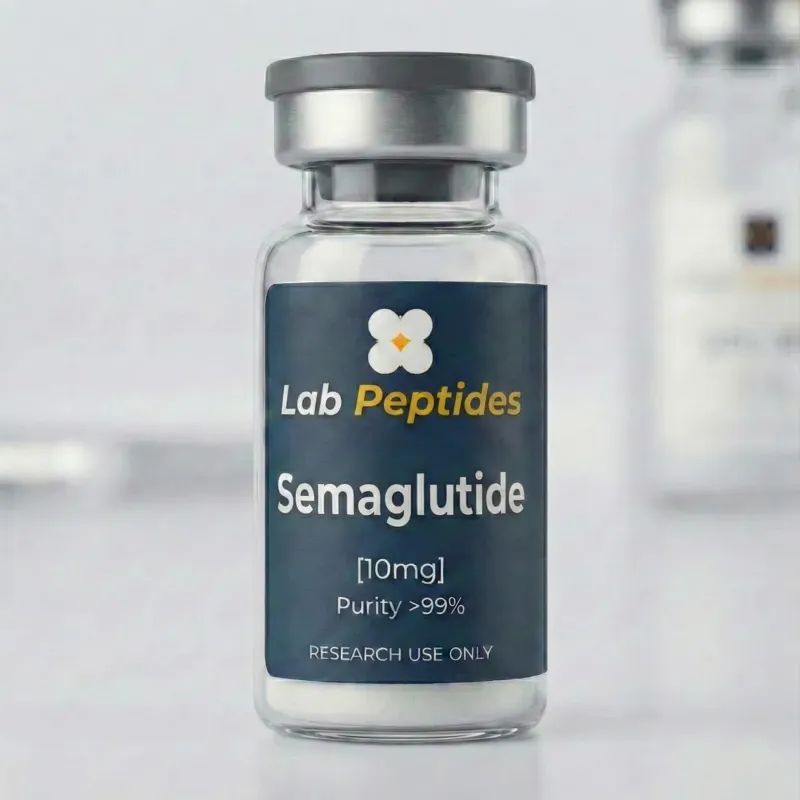
Semaglutide 10mg Weight Loss
Long-half-life GLP-1 mono-agonist. The molecule that established the modern GLP-1 analog class and remains a benchmark in metabolic research.
The GLP-1 that sparked the global revolution. -15 to -20% body weight documented. 30+ million users worldwide. Triple action: satiety, slowed gastric emptying, stable blood sugar. The absolute reference in modern weight loss.
One sealed vial of Semaglutide 10mg, lyophilised, without individual labelling.
Bacteriostatic water for reconstitution and 1 ml precision syringes graduated in 100 units, sold separately. The vial alone cannot be used as is.
Don't forget the essentials

Semaglutide 10mg is the standard cycle format for GLP-1 peptide research. This intermediate dosage positions the vial at the core of complete cycles covering progressive titration + stable therapeutic phase, typically 12 to 20 weeks with well-calibrated reconstitution. It's the sweet spot between dosimetric granularity (concentrated enough for STEP high doses, dilute enough for titration micro-doses) and usage economy (better mg/euro ratio than 5mg, more practical than 20mg for short cycles).
Semaglutide occupies a unique historical and scientific position in the peptide landscape. Selective GLP-1R agonist developed by Novo Nordisk (Ozempic 2017 diabetes, Wegovy 2021 obesity), it established modern standards of pharmacological intervention on the incretin axis. SUSTAIN (type 2 diabetes), STEP (non-diabetic obesity) and SELECT (cardiovascular) trials constitute the most voluminous corpus of the entire GLP-1 class, with over 30 phase III studies and 2 million cumulative patient-years of pharmacovigilance. No other research peptide benefits from such a level of characterisation.
The 10mg format specifically addresses the researcher who has already validated individual tolerance (via prior test cycle) and wishes to conduct a representative complete cycle with progressive titration 0.25mg -> 2.4mg/week, covering reference clinical protocols. Reconstituted with 2ml bacteriostatic water, it gives 5 mg/ml - a concentration readable on U100 syringe for the entire therapeutic range (1-100 units = 50 mcg to 5 mg per injection). The 10mg vial approximately covers a complete high-dose STEP cycle (17 weeks at final 2.4 mg/week after 4-step titration), or two SUSTAIN cycles at 1 mg/week.
Positioning vs other dosages: 5mg suits initiation and testing, 10mg covers standard cycles, 20mg optimises long cycles at high doses. For first research use with unknown tolerance, start with 5mg. For regular use after validation, 10mg is the optimal quality-price-flexibility format.
01Mechanism of action
Semaglutide is a complete and selective GLP-1 receptor agonist (Glucagon-Like Peptide-1 Receptor, GLP-1R), resulting from sophisticated molecular engineering carried out by Novo Nordisk on the native scaffold of endogenous human GLP-1. The base peptide is modified at three critical positions to simultaneously resolve the two major limitations of native GLP-1: plasma half-life of 1-2 minutes (rapid degradation by dipeptidyl peptidase-4, DPP-4) and weak albumin affinity compromising duration of action.
Semaglutide structural modifications (described by Lau et al 2015, J Med Chem):
1. Ala8 to Aib (alpha-aminoisobutyrate) substitution: totally blocks DPP-4 cleavage at the N-terminal site, primary cause of native GLP-1 inactivation.
2. Lys34 to Arg34 substitution: removes a potential glycation site and stabilises conformation.
3. Lys26 acylation with C18 diacid fatty chain (octadecanedioic acid) via glutamic linker: creates a highly lipophilic covalent anchor that reversibly binds to serum albumin.
This C18 diacid acylation is the heart of semaglutide's pharmacological innovation. Once subcutaneously injected and diffused into the vascular compartment, semaglutide binds mainly to serum albumin (> 99%) through hydrophobic interaction between the C18 chain and the albumin lipid pocket. This reversible binding serves as a plasma reservoir progressively releasing free peptide for action on GLP-1R. Result: plasma half-life of 155-180 hours (about one week), a 10,000-fold increase vs native GLP-1.
Cellular-level mechanism: once bound to GLP-1R (G-protein coupled receptor class B), semaglutide triggers a pleiotropic signalling cascade:
- Adenylate cyclase activation via Gs protein -> intracellular cAMP increase.
- PKA and EPAC2 activation -> potentiation of glucose-dependent insulin secretion by pancreatic beta cells (explaining the absence of iatrogenic hypoglycaemia except under concomitant insulin).
- Glucagon secretion inhibition by pancreatic alpha cells under hyperglycaemia (preserved in hypoglycaemia, counter-regulatory mechanism intact).
- Gastric emptying slowing via vagus nerve (central effect on dorsal vagal complex), prolonging satiety and flattening post-prandial glycaemic peaks.
- Central POMC neuron activation in hypothalamus (arcuate nucleus) and AgRP/NPY neuron inhibition -> drastic food intake and appetite reduction.
- Recently identified extra-metabolic effects: inflammatory modulation (CRP, TNF-alpha reduction), direct cardioprotective effects (experimental studies on cardiomyocytes), neuroprotective effects (studies on Alzheimer's and Parkinson's mouse models).
Semaglutide's GLP-1R selectivity distinguishes it from dual agonists (Tirzepatide GLP-1/GIP) or triple agonists (Retatrutide GLP-1/GIP/GCGR). This monospecificity offers a more predictable and better-characterised pharmacological profile (extensive clinical corpus SUSTAIN + STEP + SELECT), but limits metabolic amplitude vs more recent multi-receptor agonists. Semaglutide nevertheless remains the historical reference of the class and the best-documented GLP-1 molecule to date.
Similar peptides
Semaglutide vs native human GLP-1: native GLP-1 has a half-life of 1-2 minutes, unusable in therapeutic practice. Semaglutide, through its three structural modifications, reaches a half-life of 155-180 hours, a 10,000-fold increase. First synthetic GLP-1s (exenatide 2005, liraglutide 2010) progressed along this gradient without ever approaching semaglutide which remains the current mono-agonist class plateau.
Semaglutide vs Liraglutide (Victoza, Saxenda): liraglutide has a 13-hour half-life requiring daily injection, vs semaglutide once weekly. Comparable weight loss SUSTAIN/STEP (semaglutide -15% vs liraglutide -8% at obesity dose). Liraglutide retains niche utility (sensitive digestive profile patients tolerating lower peaks better). Semaglutide dominates on nearly all clinical criteria: efficacy, convenience (weekly), cardiovascular data, long-term cumulative tolerance.
Semaglutide vs Dulaglutide (Trulicity): direct SUSTAIN-7 comparison (Pratley 2018 Lancet Diabetes Endocrinol) on 1201 patients: semaglutide 1mg superior to dulaglutide 1.5mg on HbA1c (-1.8% vs -1.4%) and weight loss (-6.5kg vs -3.0kg). Same injection frequency (weekly). Dulaglutide retains marginal digestive tolerance advantage. Semaglutide = first choice if main objective is weight + glycaemia.
Semaglutide vs Tirzepatide (Mounjaro, Zepbound): tirzepatide is a GLP-1/GIP dual agonist from the next generation (approved 2022). SURMOUNT-1 trial (Jastreboff 2022 NEJM): mean weight loss at 72 weeks -20.9% at 15mg (vs -14.9% semaglutide STEP-1 at 2.4mg). Direct comparison SURPASS-2 (Frias 2021 NEJM, diabetics) shows tirzepatide 15mg superior to semaglutide 1mg on HbA1c and weight. Tirzepatide is mechanically more powerful thanks to GIP co-activation adding a thermogenic arm. Semaglutide retains the advantage of massive clinical corpus (> 10x longer) and specific SELECT cardiovascular data.
Semaglutide vs Retatrutide: retatrutide is an even more recent GLP-1/GIP/GCGR triple agonist (phase III ongoing late 2024-2025). Published phase II data (Jastreboff 2023 NEJM) suggest -24.2% weight loss at 48 weeks at 12mg - the highest ever observed in a peptide trial. The additional glucagon arm activates thermogenesis and lipid beta-oxidation. Semaglutide will remain relevant for its known profile and lower cost but will probably be surpassed in amplitude by retatrutide.
Semaglutide vs bupropion/naltrexone, orlistat, phentermine: older obesity pharmacological treatments typically reach -3 to -8% weight loss, largely inferior to semaglutide's -15%. Less favourable tolerance profiles (psychiatric bupropion/naltrexone effects, orlistat steatorrhoea, phentermine dependence). GLP-1s have redefined the obesity therapeutic standard starting with STEP-1.
Semaglutide oral (Rybelsus) vs Semaglutide SC (Ozempic, Wegovy): oral version (Rybelsus, approved 2019) available in 3, 7, 14 mg daily with absorption assisted by salcaprozate (SNAC). Oral bioavailability 1%, efficacy inferior to SC (-3 to -5 kg vs -15 kg). Practical interest (needle phobia) but unfavourable cost-efficacy ratio. Weekly SC form remains gold standard for peptide research and real practice.