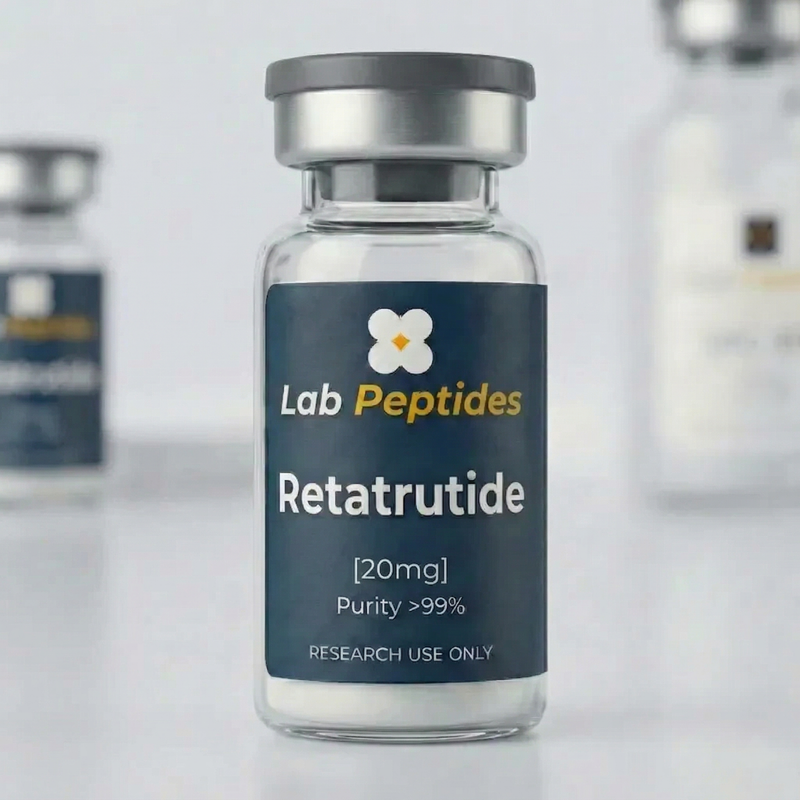
Retatrutide 20mg Weight Loss
Triple GIP / GLP-1 / glucagon agonist. The next-generation incretin under study in metabolic research, backed by the most striking preclinical data of the decade.
The absolute heavyweight of weight loss. Triple GLP-1 / GIP / glucagon agonist — the triple hormonal synergy built to shatter records. -24% body weight documented over 24 weeks in Phase 2 trials. Nothing on the market comes close. The future has arrived.
-10 % for life on each cyclePause, skip or cancel in 1 clickNo commitment, no hidden fees
One sealed vial of Retatrutide 20mg, lyophilised, without individual labelling.
Bacteriostatic water for reconstitution and 1 ml precision syringes graduated in 100 units, sold separately. The vial alone cannot be used as is.
Don't forget the essentials

Retatrutide 20mg is the mid-volume format optimized for 6-10 week cycles at 12mg target dose. One vial covers 1.67 weeks at 12mg, 2 weeks at 10mg, 2.5 weeks at 8mg, or 5 weeks at 4mg. This density is the ideal compromise between stability-window control (28 days post-reconstitution) and reduced reconstitutions vs 10mg or 15mg formats.
Positioning: for a researcher committed to a full Jastreboff-like cycle (12-week titration + 12-week target plateau = 24 weeks), 20mg is a good format for the last titration weeks (W9-12 at 8mg) and the start of the target plateau (W13-16 at 12mg). For a shorter 8-week 12mg plateau cycle, count 5 vials of 20mg (1 dose 12mg per vial + 8mg residual reusable, i.e., 4 full doses + 4 reconstructible partial doses).
Reconstituted at 2 mL (10 mg/mL), it delivers 12mg in 1.2 mL and 10mg in 1 mL. Reconstituted at 4 mL (5 mg/mL), it delivers 2/4/5/8/10/12mg in 0.4/0.8/1/1.6/2/2.4 mL. The 10 mg/mL concentration is preferable to minimize injection volume (1.2 mL vs 2.4 mL), improving comfort and reducing site-dependent lipohypertrophy risk. 5 mg/mL suits protocols with multiple intermediate doses and better syringe-error tolerance. At 10 mg/mL with 12mg/week, one vial covers exactly 1 week + 40% residual dose (8mg = 0.67 dose), reusable the next week with a 2nd vial.
01Mechanism of action
Retatrutide is the first triple incretin-mimetic agonist to reach phase II/III clinical development. Its sequence combines three activities: GLP-1R, GIPR, and GCGR (glucagon receptor), a design that unites in a single molecule the three main metabolic levers of energy regulation. Coskun and Urva (2022, pharmacological description) describe the engineering: modified sequence derived from native GIP, Aib2 and Aib13 substitutions resisting DPP-4, and a C20 diacid fatty-acyl chain grafted to a lysine via a gamma-glutamate linker to extend half-life to approximately 6 days. The affinity profile is calibrated for triple balance: full agonist at GIPR, full agonist at GLP-1R, partial agonist at GCGR, preserving glycemia while exploiting glucagon thermogenic benefits.
The GCGR arm is retatrutide's signature. Hepatic glucagon increases gluconeogenesis and lipolysis via PKA/CREB activation, stimulates brown adipose tissue thermogenesis, and reduces hepatic triglyceride accumulation. This activity partly antagonizes the GIP lipogenic effect and translates clinically into weight loss exceeding tirzepatide's. Tuning the GCGR / GLP-1 + GIP affinity ratio is critical: too much GCGR would trigger hyperglycemia; too little would cancel the thermogenic benefit. Retatrutide was optimized to maximize brown adipose activity without net glycemic disturbance, thanks to the combined glucose-normalizing effect of the GLP-1/GIP incretins.
Additive mechanisms: central activation of GLP-1R / GIPR hypothalamic satiety circuits, slowed gastric emptying, amplified glucose-dependent insulin secretion, direct adipocyte lipolysis via GCGR, brown thermogenesis via UCP1, and increased hepatic lipid oxidation. Obese mouse models (Coskun 2022) show basal energy expenditure +8-12% vs vehicle, a major contributor to the magnitude of weight loss observed in phase II clinical trials.
Pharmacokinetics: approximate terminal half-life 6 days, Cmax at 40-48 hours post-injection, steady-state in 4-5 weeks. Proteolytic clearance (no CYP450), no major pharmacokinetic interactions expected. Subcutaneous bioavailability is nearly complete thanks to albumin binding conferred by the C20 chain. Weekly administration standardizes pharmacokinetics, simplifies protocols, and smooths plasma concentrations — conditions favorable for reproducible cohort studies.
In exploratory research, retatrutide represents the most ambitious incretin agent currently available. Its signaling complexity (triple agonism) imposes heightened methodological vigilance: systematic glycemic monitoring to detect any paradoxical hyperglycemia linked to the glucagon arm, regular hepatic panel given the lipolytic effect, and lean mass tracking to quantify the share of weight loss linked to muscle depletion under severe caloric restriction.
Similar peptides
Versus tirzepatide (GLP-1/GIP dual agonist): retatrutide surpasses tirzepatide in documented weight efficacy. Phase II Jastreboff 2023 NEJM: -24.2% at 12mg/48w for retatrutide vs SURMOUNT-1 Jastreboff 2022: -20.9% at 15mg/72w for tirzepatide. The absolute 3.3-point weight gap over a shorter window (48 vs 72 weeks) suggests retatrutide reaches maximum plateau faster and further. The GCGR arm adds hepatic thermogenesis and lipolysis that tirzepatide does not generate. Limit: retatrutide is newer, with fewer long-term data (phase III ongoing, not yet published), and the glucagon arm imposes stricter ALT/AST follow-up.
Versus semaglutide (GLP-1 mono-agonist): considerable gap. STEP-1 Wilding 2021 NEJM: -14.9% at 2.4mg/68w for semaglutide vs -24.2% at 12mg/48w for retatrutide. For a researcher seeking maximal metabolic performance, retatrutide is superior by >9 weight points over a shorter window. Semaglutide remains the option when gastrointestinal tolerance is problematic (milder profile) or on tight budget (older molecule, available in more economical formats).
Versus liraglutide 3mg (Saxenda): massive gap (-8% over 56 weeks Pi-Sunyer 2015 NEJM SCALE vs -24.2% over 48 weeks for retatrutide). Liraglutide is outpaced by all modern incretin agents and holds residual interest only for its long-term data (> 5 years) which retatrutide still lacks.
Versus bariatric surgery (sleeve, Roux-en-Y bypass): the most strategically interesting comparison. Sleeve typically produces -25% at 1 year, bypass -30-35%. Retatrutide 12mg produced -24.2% at 48 weeks (phase II) and could reach -28-30% at 72 weeks by extrapolation (TRIUMPH phase III results pending). For the first time, a non-invasive pharmacological agent approaches or exceeds the least aggressive bariatric surgery. Limit: weight regain is faster upon drug discontinuation than after surgery, and cumulative chronic treatment cost may equal or exceed surgery at 5-7 years.
Versus other triple/multi-agonists in development: survodutide (GLP-1/GCGR Boehringer Ingelheim), mazdutide (GLP-1/GCGR Eli Lilly), orforglipron (oral non-peptide GLP-1 Eli Lilly), HRS9531 (GLP-1/GIP Hengrui): each represents a distinct signaling architecture. Retatrutide remains the most advanced triple agonist in phase III and holds the highest published weight efficacy to date.
Versus bupropion-naltrexone, orlistat, phentermine-topiramate: the gap is such that these agents no longer compete. They remain relevant as inexpensive oral alternatives for patients refusing injection or with incretin contraindications.
Research positioning: retatrutide is the most powerful tool currently available to study multi-receptor metabolic regulation. Its triple agonism allows simultaneous study of combined GLP-1 + GIP + glucagon effects, experimental dissections impossible with mono-agonists or dual agonists. Exploratory protocols thus gain unique signaling benefit at the cost of more demanding monitoring complexity.