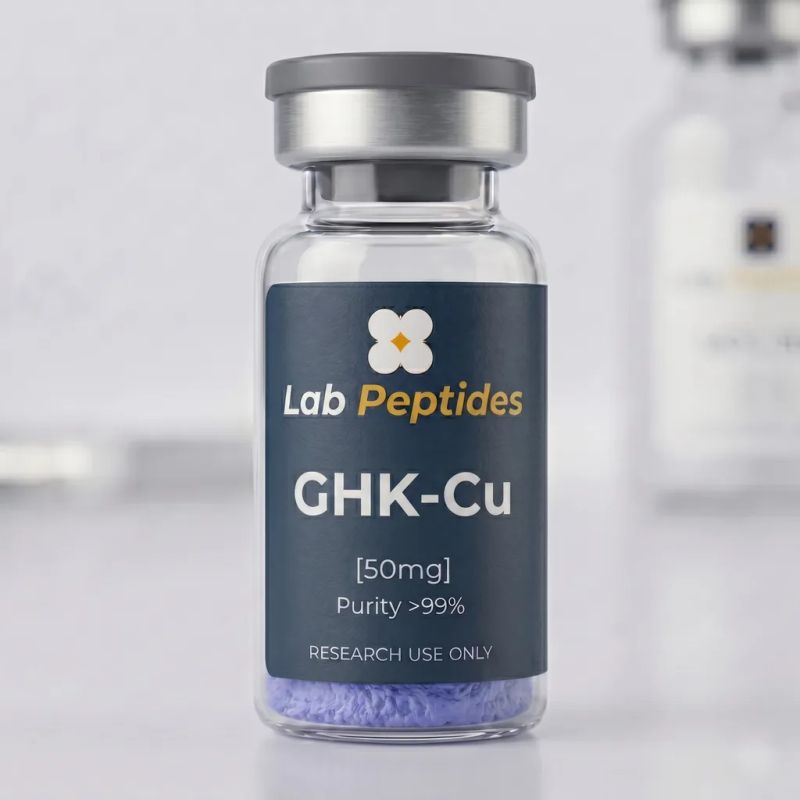
GHK-Cu 50mg Skin & Beauty
50mg compact format of the anti-aging copper tripeptide. 4,000+ modulated genes. 4-week starter cure.
Compact format to discover the reference anti-aging copper tripeptide. GHK-Cu modulates 4,000+ genes tied to skin aging — collagen, elastin, regeneration. 50 years of research, 200+ papers. 4-week cure, visibly firmer skin. The ideal format to test without committing.
-10 % for life on each cyclePause, skip or cancel in 1 clickNo commitment, no hidden fees
One sealed vial of GHK-Cu 50mg, lyophilised, without individual labelling.
Bacteriostatic water for reconstitution and 1 ml precision syringes graduated in 100 units, sold separately. The vial alone cannot be used as is.
Don't forget the essentials
GHK-Cu (Glycyl-L-Histidyl-L-Lysine, Cu2+ copper complex) is a tripeptide of 340 Da free, 403 Da complexed with copper, discovered by Loren Pickart in 1973 at the University of San Francisco. It appears in human plasma at approximately 200 ng/ml in young subjects, with a drop of more than 60 % between ages 20 and 60, an observation that motivated forty years of research on its role in tissue repair, wound healing, hair growth and cutaneous longevity. Its short sequence Gly-His-Lys binds Cu2+ ions with exceptional affinity through the histidine imidazole ring and the terminal amine, forming the characteristic blue complex.
GHK-Cu is one of the few peptides to benefit from a rigorous scientific corpus simultaneously covering molecular biology (activation of more than 4000 genes in cutaneous fibroblasts, Pickart 2015 BioMed Research International), clinical dermato-regeneration (healing, anti-ageing, damaged skin) and hair aesthetics (documented trichological protocols). Unlike most peptides sold in research networks, GHK-Cu has been integrated for 40 years in premium cosmeceutical formulations (Procyte Corporation, NeoCutis, Estee Lauder Advanced Night Repair) after showing reproducible structural effects on human skin.
This vial delivers 50 mg of high-purity GHK-Cu (>98 %, HPLC) in lyophilised form, type I borosilicate glass, fluorinated butyl stopper. The dose is deliberately high compared to classical peptides (5-10 mg for GLP-1 analogues, 2-5 mg for short regeneratives) because documented GHK-Cu protocols use larger quantities in trichological and cutaneous research (1-3 mg per injection, concentrated topical applications). Destined exclusively for in vitro research and preclinical studies on non-human models.
01Mechanism of action
The mechanism of GHK-Cu articulates around three axes: copper chelation, extracellular matrix remodelling, and massive transcriptional modulation.
First axis, copper chelation and transport. Free Cu2+ is toxic (Fenton reactions, hydroxyl radicals), but the GHK-Cu complex is stable, diffusible and delivers copper in a targeted manner to copper-dependent metalloenzymes: lysyl oxidase (collagen/elastin crosslinking), Cu/Zn superoxide dismutase (SOD1, antioxidant defence), tyrosinase (controlled melanogenesis), dopamine-beta-hydroxylase. This controlled delivery explains why GHK-Cu restores copper-dependent enzymatic functions without metallic toxicity (Pickart & Margolina 2018 Int J Mol Sci).
Second axis, extracellular matrix and tissue regeneration. Maquart 1988 J Clin Invest showed that GHK-Cu at nanomolar concentration stimulates type I collagen synthesis by fibroblasts by 60-200 %, of glycosaminoglycans (hyaluronic acid, heparan sulphate) and proteoglycans. Simeon 2000 Life Sci simultaneously documented the stimulation of matrix repair and the suppression of degradation by MMP-2 and MMP-9 (matrix metalloproteases), a unique profile of constructive rather than destructive remodelling. Pollard 2005 J Biomed Mater Res confirmed the acceleration of cutaneous healing in injured animals and humans.
Third axis, genome-wide transcriptional modulation. Pickart 2015 BioMed Res Int sequenced by Affymetrix chip the effects of 10 nM GHK-Cu on human fibroblasts after 24h: 4192 significantly modulated genes, including activation of DNA repair programmes (NBN, BRCA1), regeneration (collagens, elastin, integrins), antioxidant defence (glutathione peroxidase, SOD, peroxiredoxins) and anti-inflammatory modulation (reduction of TNF-alpha, IL-6, IL-8). It is the peptide with the widest documented genomic modulation spectrum, which explains the apparent diversity of its effects (skin, hair, healing, anti-ageing).
Fourth axis, stem cells and hair growth. Pyo 2007 Biofactors demonstrated that GHK-Cu activates the hair follicle by stimulating dermal papilla stem cells, increases follicle size, prolongs the anagen phase and inhibits early catagen follicle apoptosis. Daily topical applications at 0.05-0.1 % in liposomal vehicle have been validated in several controlled trichology dermatology studies.
Pharmacokinetics: the complex is unstable in plasma (apparent half-life <30 min) but copper is rapidly taken up by target tissues where it is incorporated into copper-dependent enzymes. The biological effect thus persists well beyond plasma presence.
Similar peptides
GHK-Cu occupies a singular position among regenerative peptides through its copper chelation mechanism, ancient scientific corpus and documented cosmetic use. Versus other regeneratives:
Versus BPC-157 (15 AA, dose 500 mcg-1 mg): BPC-157 is mostly oriented towards gastro-protection, tendon and vascular regeneration (angiogenesis via VEGF, nitric oxide pathway). GHK-Cu is oriented towards structural cutaneous regeneration (collagen, elastin) and trichology. Both are complementary in multi-tissue protocols, with non-redundant mechanisms.
Versus TB-500 / Thymosin beta-4 (43 AA, dose 2-10 mg): TB-500 acts mainly on the cytoskeleton (G-actin sequestration), cell migration and angiogenesis. GHK-Cu acts on extracellular matrix and broad genomic transcription. TB-500 is more oriented towards internal repair (cardiac, tendon), GHK-Cu more oriented towards surface (skin, hair).
Versus retinol and retinoic acid (cosmetic anti-ageing reference): retinol acts via RAR/RXR receptors and transcriptional modulation but with irritating effects (desquamation, solar sensitivity). GHK-Cu acts via copper chelation and massive genomic modulation without irritation: it is the morning (GHK-Cu) + evening (retinol) combination often adopted in premium cosmeceutics.
Versus vitamin C (ascorbic acid) topical: vitamin C is cofactor of prolyl/lysyl hydroxylase (collagen synthesis) and antioxidant. It is unstable, photo-sensitive and irritating at high concentrations. GHK-Cu is stable, non-irritating and acts on a broader genomic spectrum. Frequent combination in cosmeceutical serums: additive effects.
Versus Minoxidil topical (trichology): Minoxidil acts via vasodilation (potassium channels) and anagen prolongation. GHK-Cu acts via dermal papilla stem cells and matrix. Both are complementary: empirical studies document superior hair density with combination than with each alone.
Versus exosomes (cutting-edge cell derivatives in dermato-regeneration): exosomes deliver a complete cocktail of microRNAs, proteins, growth factors. GHK-Cu is a simple, well-characterised, reproducible molecule. Exosomes are more potent but less standardised; GHK-Cu is easier to handle and dose.
Versus biomimetic cosmetic peptides (matrixyl, argireline, acetyl hexapeptide): these peptides are protein fragments with targeted activity (calcium neurotransmission modulation for argireline, matrix stimulation for matrixyl). GHK-Cu is more polyvalent (healing + matrix + genome + hair) and more ancient in the literature.
Unique positioning: short tripeptide, exceptional copper stability, 50-year corpus, commercial cosmetic use integrated since the 1990s, broadest documented genomic modulation for a peptide. GHK-Cu is one of the rare peptides to combine the triple advantage fundamental research / commercial cosmeceutical application / accessible cost.