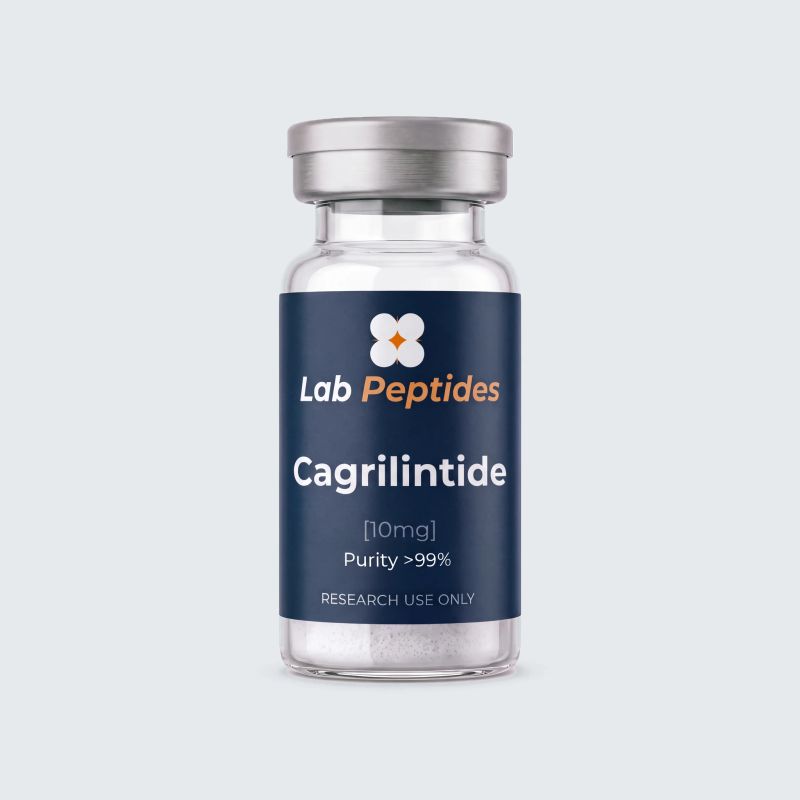
Cagrilintide 10mg Metabolism
Lyophilised · HPLC 99.6% · COA online
Research Use Only (RUO) · Prohibited for human or veterinary use.
Key facts
Protocol and preparation
| Water added | Concentration | Reading marker |
|---|---|---|
| 1 ml | 10 mg/ml | 10 UI = 1 mg |
| 2 ml | 5 mg/ml | 40 UI = 2 mg |
The volume of water does not change the product, only its concentration. Add the water slowly along the vial wall, then swirl without shaking.
Asepsis
Disinfect surfaces and stoppers (70% alcohol).
Solvent
Draw the required volume of bacteriostatic water.
Introduction
Add gently against the vial wall (avoid a direct jet on the powder).
Solubilization
Roll the vial gently. Do not shake vigorously (degradation risk).
Solution storage Once reconstituted: 2-8°C (refrigerator).
Warning Theoretical tool for chemical handling. Does not constitute medical advice.
I open the dilution calculator- The amount of powder looks tiny. A lyophilisate takes up a few millimetres at the bottom of the vial, sometimes just a translucent film. The stated weight is there.
- The powder is compact, stuck to the wall or to the stopper. Transport moves the freeze-dried cake around. It changes nothing to reconstitution.
- The vial carries no individual label. That is our standard packaging, not a downgraded vial.
- After reconstitution, deposits or filaments appear. This is common, especially with small molecules. Let it settle and roll the vial between your palms, never shake it.
- The parcel is plain. Nothing on the outside indicates the contents or the brand name.
What is not normal: a cracked vial, an uncrimped cap or a stopper that moves, powder that has liquefied or changed colour. In those specific cases, write to us with a photo and we take the vial back.
Stability window after reconstitutionUp to 28 days at 2-8 °C if the vial is reconstituted under sterile conditions and the bacteriostatic water contains a preservative (benzyl alcohol 0.9%). Never freeze after reconstitution at the risk of partial denaturation of the peptide backbone.
Technical data
- Reconstitution
- 2 ml d'eau → 5 mg/ml. 6 UI = 0,3 mg ; 12 UI = 0,6 mg.
- Peptide sequence
- C20-diacide-γGlu-KCNTATCATQRLAEFLRHSSNNFGPILPPTNVGSNTP-NH2 (pont disulfure Cys2-Cys7)
- Molecular formula
- C194H312N54O59S2
- Molecular weight
- 4409 g/mol
- CAS number
- 1415456-99-3
- Physical form
- Poudre lyophilisée blanche
- Recommended solubility
- Eau bactériostatique, NaCl 0.9%, acide acétique 0.1%
- Storage conditions
- Au réfrigérateur (+2 à +8 °C), à l'abri de la lumière. En poudre, possible au congélateur pour une conservation longue. Une fois préparé : réfrigérateur, jamais au congélateur.
- Use
- Research reagent, in vitro only (RUO)
Storage & handling
À la réception, le vial de Cagrilintide lyophilisé se conserve au réfrigérateur (+2 à +8 °C), hermétiquement clos, à l'abri de toute exposition lumineuse directe ; pour un stockage long (plus de 3 mois), le congélateur (-20 °C) le garde jusqu'à 24 mois. Un stockage temporaire a 2-8 °C pendant 30 jours maximum est tolere sans perte documentee de pureté HPLC. Eviter les cycles de congelation/decongelation repetes: chaque cycle degrade marginalement la structure tertiaire et peut reduire l'activité biologique mesurable. Pour la reconstitution, utiliser exclusivement de l'eau bacteriostatique steril filtree 0.22 µm (alcool benzylique 0.9% comme conservateur). Deposer lentement le solvant contre la paroi interieure du vial pour eviter la formation de mousse qui endommagerait la chaine peptidique. Faire tourner doucement le vial — ne jamais vortexer ni agiter brutalement. Après reconstitution, conserver au refrigerateur (2-8 °C) protege de la lumiere, et utiliser idealement dans les 28 jours. Si un protocole exige une conservation prolongee (rare), aliquoter en fractions a usage unique et congeler a -80 °C: cette pratique preserve mieux l'intégrité qu'un stockage etendu a 4 °C. La stabilité du cagrilintide lyophilisé est bonne à -20°C sous dessiccation: > 24 mois sans perte de pureté RP-HPLC mesurable. Le point critique de stabilité du cagrilintide réside dans sa propension résiduelle à la fibrillisation (héritée de l'amyline native, atténuée mais non supprimée totalement par les substitutions Pro): en solution aqueuse, à pH neutre, à température ambiante, des oligomères β-sheet peuvent se former sur 72h+, détectables par fluorescence ThT (thioflavine T) et par SEC-HPLC. Recommandations opérationnelles: reconstitution juste avant usage ou conservation < 14 jours à 2-8°C, éviter l'agitation mécanique (vortex prolongé), utiliser des flacons à faible surface de verre / volume (limite la nucléation interfaciale), pH optimal 6.0-7.0. La lumière UV et les températures > 25°C accélèrent significativement la fibrillisation. Le dosage LC-MS avec détection SEC-HPLC est recommandé avant toute étude pharmacologique critique pour quantifier la fraction monomère active.
Mechanism of action
Cagrilintide is a long-acting synthetic analog of human amylin, designed by Novo Nordisk to overcome the pharmacokinetic limitations of pramlintide (short half-life, multi-daily administration). The molecule is modified by acylation with a C18 fatty acid chain on the Lys22 residue, which maximizes serum albumin binding and extends plasma half-life to approximately 7 days in humans, compatible with weekly administration.
Cagrilintide also modulates bone markers and calcium metabolism via the calcitonin pathway, which is the subject of parallel studies on bone mineral density and post-menopausal fractures. These avenues remain exploratory but broaden the research scope beyond pure energy metabolism.
Studies and references
The scientific database on Cagrilintide rapidly took shape between 2020 and 2024 around four reference trials published or presented at major congresses (ADA, EASD, ObesityWeek).
Frequently asked questions
Is your Cagrilintide authentic and research-grade?
How long does shipping take?
How to avoid cagrilintide fibrillisation in solution?
 The complete guideCagrilintide (AM-833): complete guide to the long-acting amylin analog in metabolic researchStructure, amylin mechanism, CTR + RAMP1/2/3 receptor, pharmacokinetics, REDEFINE program (CagriSema), comparison versus pramlintide Symlin, GLP-1 synergy, research-only reconstitution protocols, stability and outlook. The scientific reference on cagrilintide.Read the guide