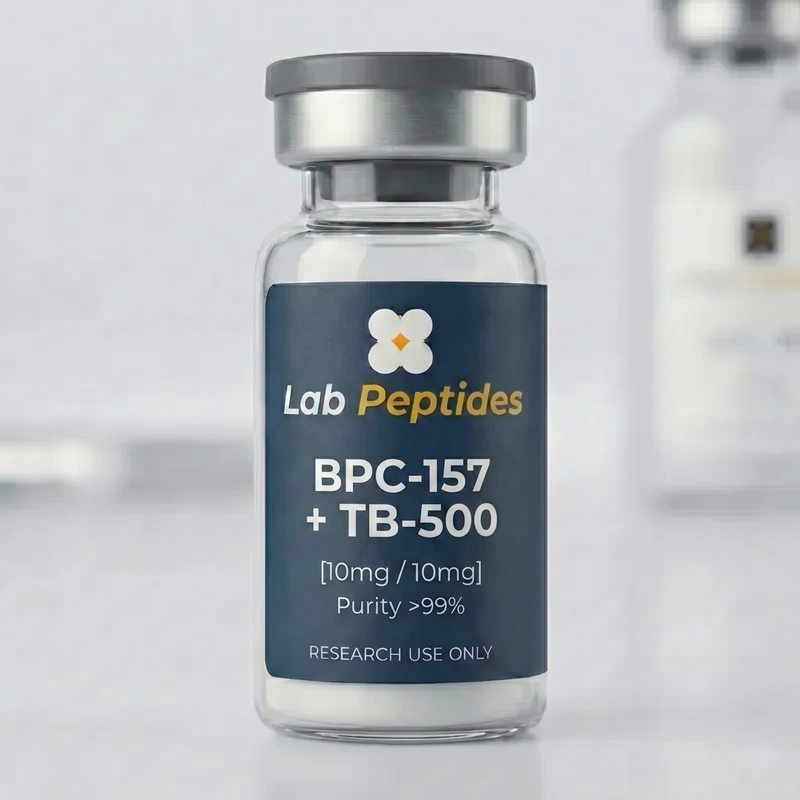
BPC-157 + TB-500 10mg Recovery
The reference regeneration combo. Two peptides with complementary mechanisms in a single formulation.
The recovery combo every pro runs. BPC-157 (local healing) plus TB-500 (systemic cell migration) in full synergy. Two complementary mechanisms in one formulation. Documented 2x faster recovery. The gold standard of advanced recovery.
-10 % for life on each cyclePause, skip or cancel in 1 clickNo commitment, no hidden fees
One sealed vial of BPC-157 + TB-500 10mg, lyophilised, without individual labelling.
Bacteriostatic water for reconstitution and 1 ml precision syringes graduated in 100 units, sold separately. The vial alone cannot be used as is.
Don't forget the essentials

The BPC-157 + TB-500 10mg combo delivers in a single vial the two most extensively studied tissue regeneration peptides in musculoskeletal research: 5 mg of BPC-157 (Body Protection Compound-157, a 15-amino-acid pentadecapeptide derived from human gastric juice, isolated by Predrag Sikiric's team at Zagreb from the 1990s) paired with 5 mg of TB-500 (active fragment of thymosin beta-4 described by Allan Goldstein in 1981, 44-residue ubiquitous regeneration peptide). Together these molecules constitute the reference pairing in tendon, ligament, muscle and vascular repair research: two complementary mechanisms of action, one shared angiogenic vector, and dramatically expanded tissue coverage.
BPC-157 operates locally as an ultra-stable cytoprotectant: it survives gastric milieu, reactivates the VEGF-receptor-2 pathway at the lesion site, modulates the nitric oxide system (NO / eNOS), upregulates growth hormone receptors on tendon fibroblasts (Chang et al. 2011), and orchestrates the FAK-paxillin signaling cascade governing cell migration within tendon tissue. TB-500 operates systemically as a cytoskeleton remodeler: its primary function is G-actin monomer sequestration (active N-terminal Ac-Ser-Asp-Lys-Pro), its cleaved AcSDKP sequence is an autonomous angiogenic factor, it upregulates laminin-5 and matrix metalloproteinases (MMPs), and mobilizes mesenchymal progenitor cells.
The value of the combo lies in mechanistic divergence coupled with vascular convergence: BPC-157 covers local cytoprotection and the gut-tendon axis, TB-500 covers systemic cell migration and stem-cell mobilization, and both converge on the neoangiogenesis required for deep tissue regeneration. This combo is intended exclusively for RUO preclinical research and documented equine veterinary protocols (notably digital flexor tendon regeneration, well characterized in equine sports medicine).
Lot certified by HPLC certificate of analysis exceeding 99%, mass spectrometry confirming theoretical molecular weight (BPC-157: 1419.53 Da / TB-500 fragment: supplier-dependent, full thymosin beta-4: 4963 Da), cold chain maintained from synthesis to delivery. Unique dual-lyophilized vial, two-minute reconstitution, aliquoting supported to extend functional shelf life.
01Mechanism of action
BPC-157 — Cytoprotective pentadecapeptide (Gly-Glu-Pro-Pro-Pro-Gly-Lys-Pro-Ala-Asp-Asp-Ala-Gly-Leu-Val)
BPC-157 is a 15-amino-acid fragment of a larger 40 kDa protein isolated from human gastric juice. Its exceptional stability (acid-pH resistance, enzymatic resistance outperforming most bioactive peptides) enables partial oral bioavailability and a systemic half-life compatible with once-daily administration. Four mechanisms are established by over 500 peer-reviewed publications from the Zagreb school (Sikiric, Seiwerth, Staresinic, Krivic) and independent laboratories:
1. VEGF-R2 axis / local angiogenesis — BPC-157 upregulates VEGF-R2 (KDR) receptor expression on vascular endothelium at the lesion site, triggering early neoangiogenesis required for tendon and ligament repair (Sikiric 2018, successive reviews).
2. FAK-paxillin signaling in tendon fibroblasts — Chang et al. (J Appl Physiol 2011) showed BPC-157 accelerates tendon fibroblast migration in vitro via FAK and paxillin phosphorylation, a critical pathway in focal adhesion remodeling.
3. NO / eNOS axis modulation — BPC-157 normalizes nitric oxide production, a vascular and mucosal protective effect demonstrated in ischemia-reperfusion and gastroduodenal injury models.
4. Growth hormone receptor upregulation — GH-R expression on tendon fibroblasts is increased, potentiating the local anabolic response to circulating IGF-1.
TB-500 — Thymosin beta-4 fragment (44 aa, Ac-SDKPDMAEIEKFDKSKLKKTETQEKNPLPSKETIEQEKQAGES)
Thymosin beta-4 is the most abundant member of the beta-thymosin family in mammalian cell cytoplasm. Its primary function is G-actin sequestration — TB4 binds monomeric actin with nanomolar affinity, regulates the polymerizable actin pool, and indirectly governs cytoskeletal dynamics during cell migration, wound healing and inflammatory response. Five mechanistic axes are documented:
1. G-actin sequestration — Primary function, essential for motility of fibroblasts, keratinocytes, endothelial cells and cardiomyocytes.
2. Angiogenic AcSDKP generation — Prolyl oligopeptidase cleaves TB4 and releases the tetrapeptide Ac-Ser-Asp-Lys-Pro, an autonomous angiogenic factor layered on top of TB4's direct effect on endothelial migration.
3. Laminin-5 and MMP upregulation — TB4 induces expression of matrix metalloproteinases (MMP-2, MMP-9) that remodel extracellular matrix during healing (Malinda 1999 J Invest Dermatol).
4. Mesenchymal progenitor cell mobilization — TB4 activates cardiac epicardial progenitors (Smart 2011 Nature) and mobilizes hair follicle cutaneous stem cells.
5. Anti-inflammation — NF-kB pathway inhibition and reduced pro-inflammatory mediator production in keratitis and colitis models.
Combo synergy — Vascular convergence, tissue divergence
Complementarity hinges on a single principle: BPC-157 initiates local repair, TB-500 amplifies systemic regeneration. On angiogenesis, both peptides converge (VEGF-R2 for BPC-157, AcSDKP for TB-500) and potentiate each other — the shared denominator. On matrix remodeling they diverge: BPC-157 acts specifically on tendon fibroblast signaling, TB-500 acts transversally across all repairing tissues via actin dynamics. On the hormonal axis, BPC-157 potentiates local IGF-1 while TB-500 mobilizes stem cells — two orthogonal anabolic levers.
Similar peptides
Combo versus BPC-157 alone
BPC-157 alone remains the reference cytoprotective peptide for gastroduodenal protocols, ischemia-reperfusion models and local tendon repair. The combo adds the systemic dimension of thymosin beta-4: progenitor cell mobilization, generalized actin remodeling, AcSDKP angiogenic activity. For deep, multi-tissue tendon or ligament injuries, the combo covers a broader tissue spectrum than BPC-157 in isolation.
Combo versus TB-500 alone
TB-500 alone excels on cutaneous wounds, corneal regeneration and cardiac protection models. The combo adds gastrointestinal cytoprotection, fibroblast-specific FAK-paxillin signaling in tendons, and local IGF-1 / GH-R axis potentiation. On pure tendinopathies, the combo outperforms TB-500 alone in the majority of documented equine veterinary protocols.
Combo versus GHK-Cu
GHK-Cu (copper tripeptide) is oriented toward cutaneous wound healing and cosmetics, with a strong axis on dermal collagen synthesis and anti-glycation. The BPC-157+TB-500 combo is oriented toward deep tendon, ligament and visceral regeneration. The two are complementary and non-redundant: GHK-Cu for dermis and adnexae, BPC-157+TB-500 for deep structures (tendons, ligaments, muscles, gut).
Combo versus hyaluronic acid or PRP injections
Intra-articular hyaluronic acid injections deliver passive lubrication with no structural regenerative effect. PRP (platelet-rich plasma) provides a heterogeneous cocktail of autologous growth factors (PDGF, TGF-beta, IGF-1), but its composition varies from one draw to another. The BPC-157+TB-500 combo offers a defined, dosable, lot-to-lot reproducible peptide composition via HPLC CoA, with characterized mechanisms of action. By contrast, PRP and HA benefit from randomized human clinical data (knee osteoarthritis, tendinopathies) that the combo lacks.
Combo versus conventional pharmacology
NSAIDs (ibuprofen, diclofenac) reduce acute pain and inflammation but delay tissue repair by blocking the constructive inflammatory phase. Infiltrated corticosteroids relieve pain but accelerate long-term tendon degeneration. The BPC-157+TB-500 combo positions itself as a pro-regenerative strategy orthogonal to symptomatic anti-inflammatories, with an opposite mechanistic logic.